How to Extract Ice on the Moon

May 18, 2020
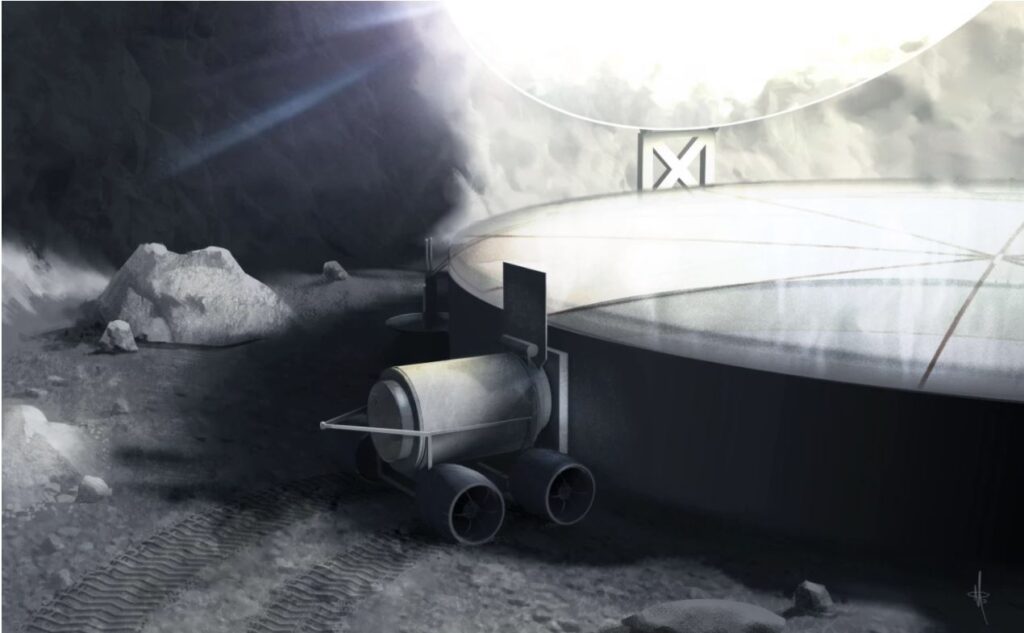
Lunar ice water extractor. Concept art credit: George Sowers and MIT Technology Review

Water is essential to space exploration and colonization. Now that it has been demonstrated that billions of gallons of ice and molecular water are found on the Moon, the challenge is to figure out how to extract it.

In MIT Technology Review, space reporter Neel V. Patel lists the obstacles. Super-cold temperatures and radiation could endanger humans and degrade equipment. Lunar dust sticks to everything, wrecking machinery and posing safety issues to workers in spacesuits. And, of course, astronaut miners would have to be housed and supported on the Moon.

Lunar water comes in the form of tiny icy grained mixed with the soil, mostly in permanently shaded regions of craters in temperatures of 40 K (-233.15 °C). To be useful as a rocket fuel the material, only 5.6% water by weight, would require aggressive processing to rid contaminants.

One proposed method would be to build large towers with concave mirrors on the top that could reflect sunlight into the shadowed regions of lunar craters trapping the water. The energy would heat the lunar soil enough to get the ice to sublimate into vapor. A tent (transparent so the light could get through) would capture the vapor, which could be moved into units where it would freeze back into ice, and then purified at a separate location. Ultimately, the water would be separated into oxygen and hydrogen by electrolysis, and then liquified to the constituents used as rocket propellant.

Although humans have demonstrated the ability to operate rovers and landers that can withstand conditions on the Moon, no one knows if industrial infrastructure would hold up. Writes Patel: “It’s not easy to just wake a piece of technology from a 40 K slumber.” more “How to Extract Ice on the Moon”
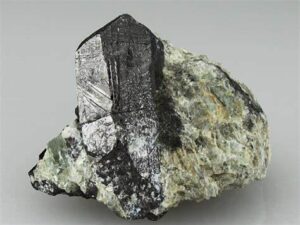

Baddeleyite from Moon Rock Yields Clues to Early Moon

May 11, 2020
An earth sample of baddeleyite. Photo credit: crystalclassics.co.uk.

The formation of ancient rocks on the Moon may be directly linked to large-scale meteorite impacts, concludes a group of international scientists led by the Royal Ontario Museum after research a unique rock collected by NASA astronauts during the 1972 Apollo 17 mission to the Moon. The rock contains mineralogical evidence that it formed at incredibly high temperatures, in excess of 2300 °C/ 4300 °F, that could have been achieved by the melting of the outer layer of a planet in a large-impact event, reports Science Daily.

Researchers discovered in the rock the presence of a mineral known as baddeleyite, a stable phase arising from cubic zirconia, commonly used on earth as a substitute for diamonds in jewelry, which could have been formed only in rocks heated to above 2300 °C. While examining the structure of the crystal, the researchers measured the age of the grain, which reveals the baddeleyite formed over 4.3 billion years ago. Given that the high-temperature cubic zirconia phase must have formed before this then, they concluded that large impacts were critically important to forming new rocks on the early Moon.

“Rocks on Earth are constantly being recycled, but the Moon doesn’t exhibit plate tectonics or volcanism, allowing older rocks to be preserved,” explains Dr. Lee White, Hatch Postdoctoral Fellow at the Museum. “By studying the Moon, we can better understand the earliest history of our planet. If large, super-heated impacts were creating rocks on the Moon, the same process was probably happening here on Earth.”

Adds Dr. James Darling, a reader at the University of Portsmouth and co-author of the study. “These unimaginably violent meteorite impacts helped to build the lunar crust, not only destroy it.”

Stress Testing Lunar Habitats on Earth

May 10, 2020
Shirley Dyke, head of Purdue’s RETH Institute

Purdue University’s “RETH (Resilient ExtraTerrestrial Habitats) Institute is working with NASA to put lunar habitat concepts through testing on earth to see how well they would survive hazards such as getting radiation-bombed, blasted by meteoroids or shaken by a moonquake, reports SyFyWire. Some of the tests happen completely onscreen. Other tests incorporate realistic quarter-scale habitats.

These trials can do things that would be physically impossible on the Moon, says Shirley Dyke, head of the program. You can change the circumstances in a cyber physical test faster than you ever would be able to in real life. If you’re testing out a habitat in a lunar lava tube, you can change the location to the Moon’s surface without physically rebuilding the entire thing.

Dyke is looking for habitat characteristics such as resilience, intelligence and autonomy. She says that smart habitats need to maintain and repair themselves — and when to send for emergency-response robots. “Eventually,” she said, “we want to develop smart habitats that can respond to changes, damage and anything that could go wrong during a mission and still maintain the integrity and safety of the science inside.”

Carbon More Abundant on Moon than Thought

May 7, 2020
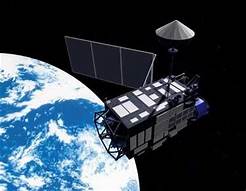
Kaguya Satellite. Image credit: Aero-News.net

Confounding the long-held view that the Moon is depleted of carbon and other volatile elements, a Japanese satellite has detected a steady stream of carbon ions emanating from the lunar surface. Scientists believe the carbon has been there since the Moon’s formation roughly 4.5 billion years ago.

The finding comes from the Japanese Aerospace Exploration Agency’s Kaguya spacecraft, which spent a year-and-a-half in orbit around the Moon a decade ago. One of its instruments was a mass spectrometer, which mapped lunar ions including carbon. Recent analysis of the data, according to Science Alert, identified the carbon traces.

The concentration of carbon ions could not be explained by the deposition of carbon by solar wind, nor by the delivery of carbon on micrometeorites. Concentrations varied: Younger volcanic basalt plains on the lunar near side emitted more carbon ions than the older highlands, which suggests that the carbon is embedded in volcanic lunar glasses.

That’s a problem for the widely held theory that the Moon was formed by a large body colliding with Earth. The so-called Theia collision would have generated temperatures in the range of 4,000 to 6,000 Kelvin, which would have boiled away the volatiles and produced a volatile-depleted “dry Moon.” Instead, the Kaguya measurements suggest that the Moon could be a volatile-rich “wet” Moon.

The implications for lunar colonization are significant as well. Carbon is an essential element in biological processes. Abundant carbon would support the presence of plants and crops without the necessity of transporting it from Earth.

U.S. Backs Artemis Accords to Bypass U.N. Space Treaty

May 7, 2020
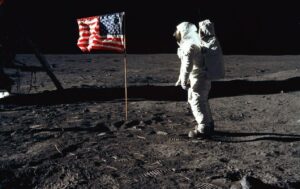
Buzz Aldrin on the lunar surface. Is there such a concept in international space law as “firsties”?

The 1967 Outer Space Treaty states that celestial bodies and the Moon are not subject to “national appropriation by claim of sovereignty, by means of use of occupation, or by any other means.” Critics contend that the restriction will put a serious damper on lunar mining and colonization. Now the Trump administration is backing a new international agreement called the Artemis Accords to cerate standards of behavior for moon mining practices, reports Just the News.

In 2015, the U.S. passed a law granting private companies ownership over any resources they mine in outer space. Similar laws do not exist anywhere else in the world. The Artemis Accords with other potentially spacefaring nations would bypass the United Nations treaty process, which would require getting buy-in from non-spacefaring nations.

Says Just the News: “The key conceit of the accords will be establishing ‘safety zones’ surrounding future moon bases, preventing damage and conflict between different countries with outlets on the moon.”

Protecting the Moon’s Archaeological Heritage

April 7, 2020
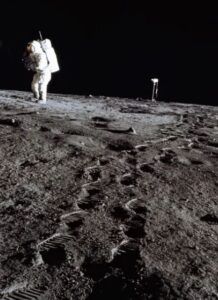
Early footprints on the Moon — an archaeological treasure to be preserved?

It’s not too early to start thinking about the archaeology of the Moon, contends space archaeologist Alice Gorman in an interview in The New Lean.

The Apollo 12 mission in 1969 marked the first encounter with an archaeological artifact on the Moon. Astronauts landed 180 meters away from Surveyor 3, a robotic landing craft sent to the Moon in 1967. they removed a camera and other bits and pieces to take back to Earth, When NASA analyzed the materials, they found that the Surveyor 3 and Apollo 12 landings stirred up enough lunar dust to abrade the surfaces.

Future missions are planning to visit the Apollo sites and remove samples for analysis to gauge the impact on the lunar environment on human materials. What concerns Gorman is  the prospect of erasing all those original footprints and causing further damage by stirring up more dust.

There is an archaeological principle that you never excavate all of a site. You always leave an unexcavated deposit, or you leave rock art on the walls. You leave material for future scientists to sample because we don’t know what techniques will be available in the future. more “Protecting the Moon’s Archaeological Heritage”

Recycling Pee into Lunar Building Materials

March 30, 2020
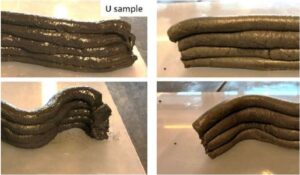
Ewwww…. experimental urea-based construction material

European researchers have found that the urea in human urine can be used as a “plasticizer” to combine with lunar regolith to make building materials.

The cost of transporting building materials to the Moon is so expensive — roughly $10,000 per pound — that scientists are looking for ways to utilize materials readily available on the Moon. Dutch, Norwegian, Spanish and Italian researchers theorized that urea could be incorporated into concrete to soften the initial mixture and make it more liable before it hardens, reports Phys.org.

“To make geopolymer concrete that will be used on the moon, the idea is to use what is already there: regolith (loose material from the moon’s surface) and the water from the ice present in some areas,” explains one of the authors, Ramón Pamies, a professor at the Polytechnic University of Cartagena (Murcia). “But moreover, with this study, we have seen that a waste product, such as the urine of the personnel who occupy the moon bases, could also be used. The two main components of urine are water and urea, a molecule that allows the hydrogen bonds to be broken and, therefore, reduces the viscosities of many aqueous mixtures.”

Using material similar to regolith mixed with urea, researchers have manufactured concrete cylinders using a 3-D printer. The urea mixture supported heavy weights and remained almost stable in shape. Resistance was tested at a temperature of 80°C, and was found to increase even after eight freeze-thaw cycles like those on the Moon.

Next step: figuring out how to extract the urea from the urine.

Fungi as Building Material for Lunar Habitats

March 7, 2020

The humble fungus has remarkable properties that researchers at NASA’s Ames Research facility think could make it a useful material for building human habitats on the Moon and Mars. The mycelium — the branching, thread-like part of a fungus — has a higher bend strength than reinforced concrete and a higher compression strength than lumber. It acts as a fire retardant, and it is capable of growing and repairing itself.

“Right now, traditional habitat designs for Mars are like a turtle — carrying our homes with us on our backs – a reliable plan, but with huge energy costs,” principal investigator Lynn Rothschild tells SciTechDaily. “Instead, we can harness mycelia to grow these habitats ourselves when we get there.”

Researchers envision human explorers taking along a compact habitat built of a lightweight materials supplemented with dormant fungi. Upon arrival, they would unfold the structure and add water, and the fungi would grow around the framework into a functional human habitat. Writes SciTechDaily:

Just like the astronauts, fungal mycelia is a lifeform that has to eat and breathe. That’s where something called cyanobacteria comes in – a kind of bacterium that can use energy from the Sun to convert water and carbon dioxide into oxygen and fungus food.

These pieces come together in an elegant habitat concept with a three-layered dome. The outer-most layer is made up of frozen water ice, perhaps tapped from the resources on the Moon or Mars. That water serves as a protection from radiation and trickles down to the second layer – the cyanobacteria. This layer can take that water and photosynthesize using the outside light that shines through the icy layer to produce oxygen for astronauts and nutrients for the final layer of mycelia.

That last layer of mycelia is what organically grows into a sturdy home, first activated to grow in a contained environment and then baked to kill the lifeforms – providing structural integrity and ensuring no life contaminates Mars and any microbial life that’s already there. Even if some mycelia somehow escaped, they will be genetically altered to be incapable of surviving outside the habitat.

The Ames team also imagines mycelia being used for water filtration and biomining systems that extract minerals from wastewater.

Mapping the Moon’s South Pole

March 6, 2020

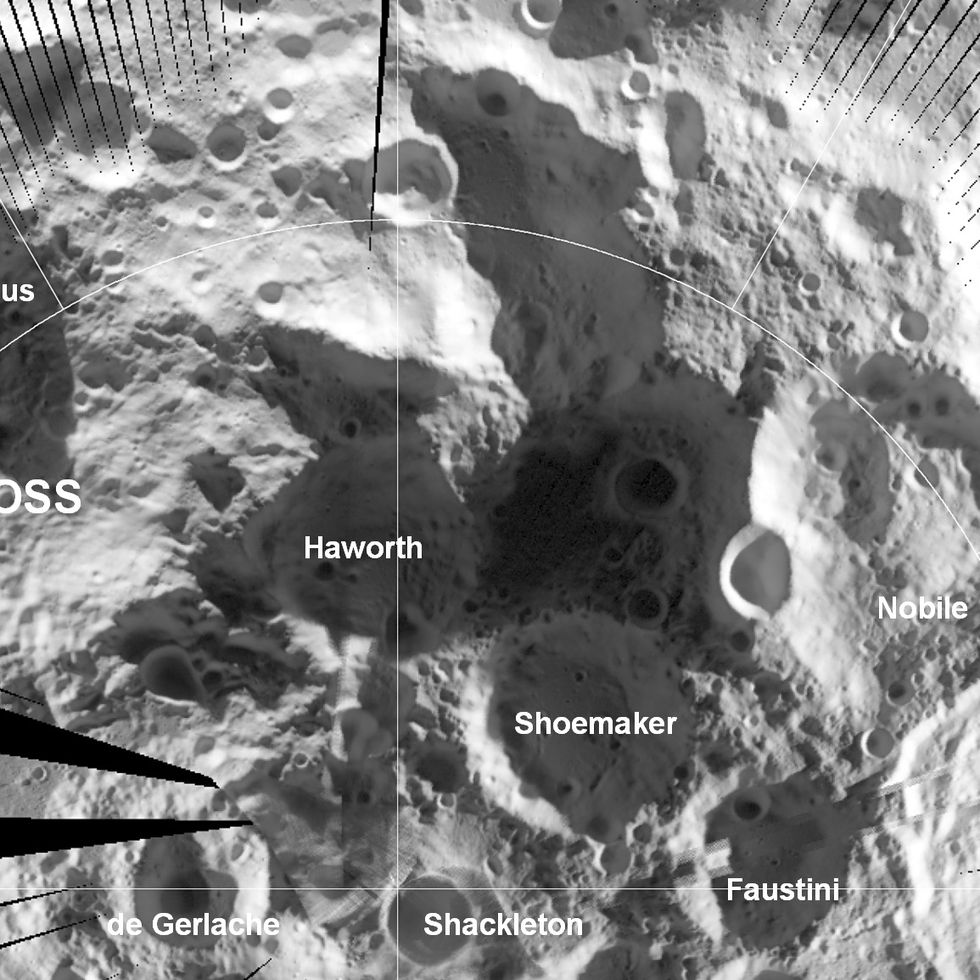
Scientists at NASA’s Solar System Exploration Research Virtual Institute (SSERVI) have created the Lunar South Pole Atlas, a detail chart of the Moon’s underbelly, in preparation for the upcoming Artemis mission. The south pole is the subject of intense interest because there is reason to believe that it contains the Moon’s largest reserves of H2O, which, because they are captured in craters that are never exposed to the sun, never melt.

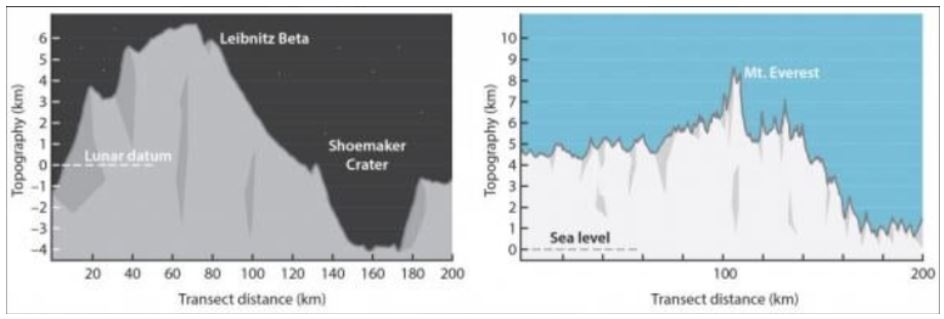
Photography indicates the presence of two towering massifs (or mountains) — Malapert Massif and Leinbiz Beta — comparable to Earth’s Mount Everest. Writes Popular Mechanics:

The difference in elevation between the tip of Malapert Massif and the base of Hawthorne crater is about 5 miles. For context, that’s almost as tall as Mount Everest, which stretches nearly 5.5 miles into the sky. In the case of Leibniz Beta, which lies next to Shoemaker crater, the elevation difference is a whopping 6.2 miles—far higher than Earth’s tallest mountain.

The craters are home to some of the coldest temperatures ever recorded in the solar system.

It Takes a Tough Tire to Drive on the Moon

February 19, 2020
But can it burn rubber?

Vehicle maintenance on the lunar surface will be a significant challenge for explorers and colonists. Lunar regolith, a mix of dust, rock and debris, is superfine, ultra-abrasive, and can lodge itself in the tiniest crevasses. Not only that, but it carries an electrostatic charge. Bridgestone, the Japanese tire company, is looking ahead… far ahead… at the market opportunities. The company is working with the Japan Aerospace Exploration Agency (JAXA) to develop a specialized rover, reports Popular Mechanics.

JAXA’s rover will shuttle up to four astronauts and could log as many as 6,000 miles on the lunar surface, compared to 22 miles reached by the Apollo-era rovers.

The Apollo rovers were coated in a mesh of zinc-coated piano wire and wrapped in titanium treads. Bridgestone has revealed a wheel design consisting of two lobes of braided steel woven together — inspired by the toes of a camel.

“It’s biomimicry,” Bridgestone America’s chief technology officer, Nizar Trigui, told Popular Science. “The pattern helps the tire carry the load without penetrating too deeply into the sand.”

The new tire design is being tested under simulated lunar conditions with crushed lava rock and broken glass.