
Indians Will Give Moonshot Another Try

January 1, 2020
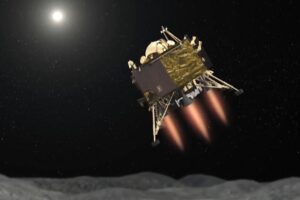
Chandrayaan-2 module. Image credit: ESRO

Despite the demise of the Chandrayaan-2 spacecraft in a crash landing on the Moon, the Indian Space research Organization will attempt another soft landing in the near future. The third lunar mission, Chandrayaan-3, could launch by the end of this year, although 2021 is a possibility, reports C/Net.

The Chandrayaan-3 mission will be much cheaper, about 6.15 billion rupees ($86.2 million) compared to 9.6 billion rupees for its ill-fated predecessor. The new mission, which include a rover and lander, will aim for the same spot on the south pole where vast water deposits are believed to exist.

Chandrayaan-2 was launched July 22, 2019, and consisted of three components: a lunar orbiter, a lunar lander and a rover. Though the lander and rover were lost during the crash landing, says C/Net, the orbiter still orbits the moon and is expected to continue surveying for seven years.

Early Moon Had More Water than We Thought

December 24, 2019
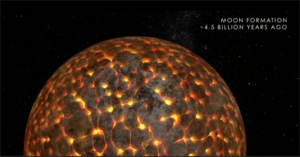
Early Moon. Image credit: Ars Technica.

The early Moon likely contained significant volumes of water mixed into its global ocean of molten rock, theorize scientists from VU Amsterdam.

According to the conventional view, the Moon was formed by a collision of a small planetary-sized body with the young Earth that created a swirling mass of debris from which the Earth and the Moon condensed. In a process parallel to Earth’s, the Moon started as a mass of molten rock that slowly cooled over the ages. As it cooled, different minerals solidified at different temperatures and depths.

The Dutch scientists  began asking how various mineral mixes behaved under extreme temperatures and pressures. Their models indicate that the Moon must have started with water mixed with the magma. Explains Ars Technica:

“How do you model an entire ocean of molten rock? You start with the known composition of the Moon and use that to create a mix of the appropriate minerals. Then you expose those minerals to extreme pressures and temperatures well beyond the melting point of rock. For these experiments, the temperatures ranged up to 1,550 degrees Celsius. Since the magma ocean was potentially hundreds of kilometers deep (current estimates range from 400 to 1,000 kilometers), pressures ranged up to 3 GigaPascals, which is nearly 30,000 atmospheres.” more “Early Moon Had More Water than We Thought”

Russians Plan Robotic Post to Track Asteroids

December 21, 2019
Image credit: Space.com

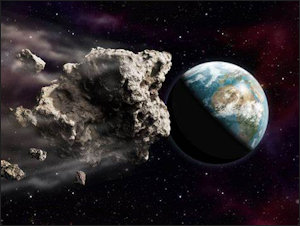
Roscosmos, the Russian space agency, plans to install a nuclear-powered observatory on the south pole of the Moon to help spot meteorites on a collision course with Earth, reports the U.K.’s Express.

The base will operate in conjunction with asteroid-hunting telescopes to survey potentially hazardous space rocks.Said Alexander Bloshenko, executive director for science and long-term programs, “There are plans to install equipment on this base to study deep space — and special telescopes to track asteroids and comets that pose a danger of colliding with Earth.”

The base, he said, also will be used for Russia to test space-faring equipment. Cosmonauts will be sent only “to do the tasks that the robots are incapable of doing.”

A South Pole location has been selected for its favorable conditions, in particular sufficient light to power solar panels and craters containing ice reserves for fuel and raw material.

Video Overview of NASA’s Artemis Project in Five Short Minutes

December 21, 2019

It’s encouraging to see how far NASA has come in its thinking.

My only gripe: NASA still sees planting an outpost on the Moon primarily as a stepping stone to Mars rather than the first stage in full-scale lunar colonization as an adjunct to exploiting cislunar space. Mars may have scientific value, but it has no strategic value. The Moon offers both.

Geologic Mystery: How Old Is Mare Crisium?

December 14, 2019

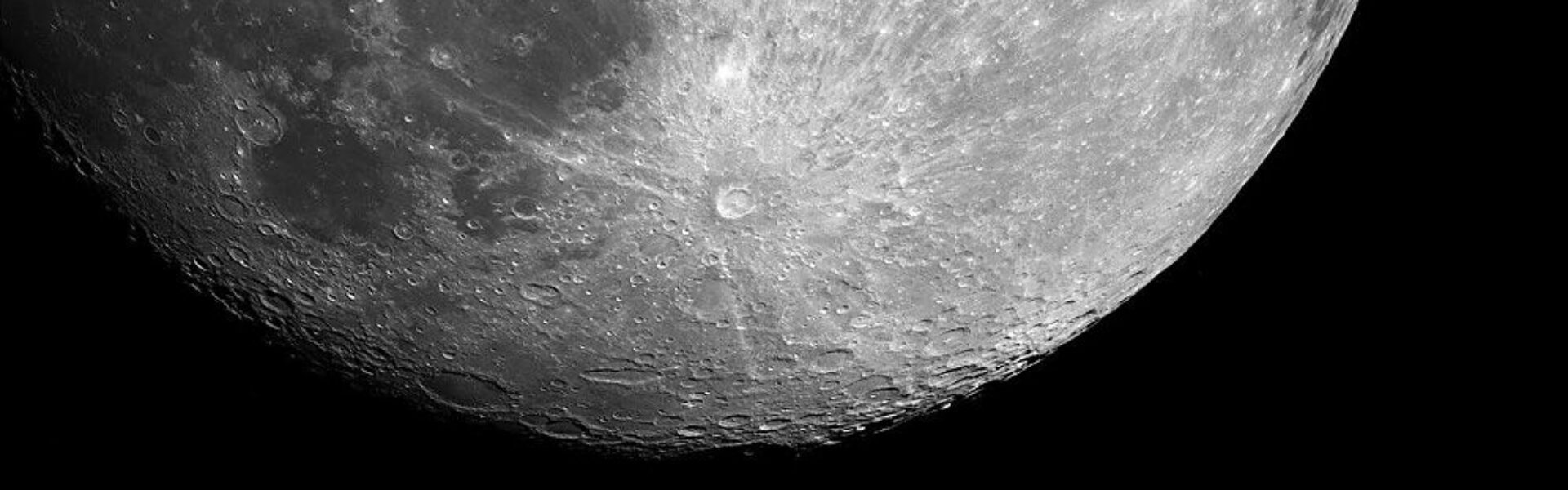
After the solar system formed 4.6 billion year ago, an object slammed into the Moon and formed a 620-mile-wide indentation now known as the Crisium basin. Scientists examining the region say they’ve spotted a crater within the basin that appears to contain pristine impact melt of volcanic rock, reports National Geographic.
Not only might the geologic feature yield clues about the frenzied meteor bombardment during the early history of the Earth and Moon, the basin holds a geologic blister the size of Washington, D.C., unlike any other feature seen in the the solar system. The volcanic lump appears to have been cracked open by underground magmatic activity.

Rocks recovered by U.S. Apollo missions and Russian robotic missions are estimated to be between 3.8 and 4.0 billion years old, leading scientists to theorize that there was spike in the number of impacts on the Moon during a period known as the Late Heavy Bombardment. But that conventional wisdom has come into question. Why was there a 700-million-year quiet period before then?

The Crisium basin could shed light on that mystery. The original impact that formed the basin was so powerful that it created a melt sheet up to 9.3 miles thick. Later, profuse eruptions of lava flooded the basin beginning about 3.6 billion years ago, forming a volcanic sea known as Mare Crisium that covered up much of the original melt. But “islands” of rock within the basin, known as Kipukas, survived the lava inundation. As lunar scientists examined the region, one Kipuka stuck out. Close examination showed that much of it was made of frozen volcanic rock. The research team conjectures that the lump was pushed upward by subsurface volcanic activity, but the origin remains a mystery. more “Geologic Mystery: How Old Is Mare Crisium?”

NASA SLS Rockets Could Cost $800 Million to $1.6 Billion a Pop

December 13, 2019

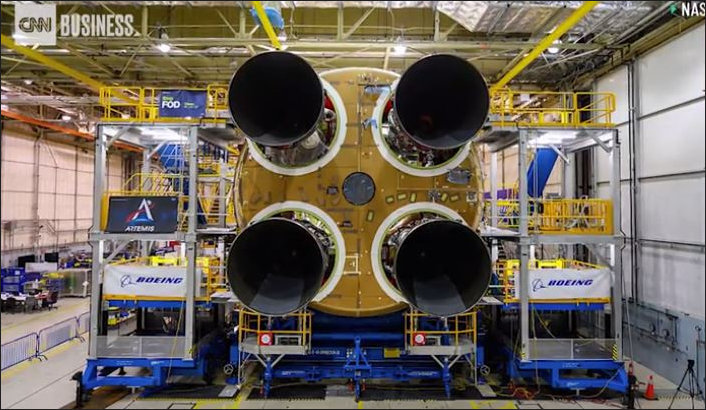
The Space Launch System (SLS) will be the most powerful rocket NASA has ever built. When completed, it will be able to take astronauts to the Moon and beyond. Indeed, according to NASA Administrator Jim Bridenstine, it will be the only rocket “qualified” to take astronauts to the Moon.

NASA is under contract with Boeing to build two SLS rockets with the goal of putting astronauts back on the Moon by 2024: specifically, landing the next man and woman on the south pole of the Moon, after which it will need a third rocket, and perhaps more.

CNN Business asked a pertinent question: How much will the rockets cost?

Said Bridenstine:

When we think about the cost of an SLS rocket per launch, it really, quite frankly, depends upon how many we buy in a certain package. If you buy one SLS rocket, it’s going to be very expensive. I’d say on the order of $1.6 billion. If we buy multiple SLS rockets, say as many as ten, or twelve, it can get down under a billion dollars, $800 million per copy. But, look, these are all estimates at this point. NASA needs to sit down with its prime contractor Boeing to negotiate the best solution to the right mix to the number of rockets and the cost per rocket.

Bridenstine added that he would like to have a cadre of astronauts dedicated to the Artemis project. “I want the astronauts that we send to the Moon this time to be like the Mercury Seven where the astronauts have names and faces and backgrounds and histories and personalities.”

According to Science Alert, the SLS is the tallest rocket stage NASA has built since the Saturn V stages for the Apollo missions. It is also the most powerful, designed to reach a speed of Mach 23 before separating from its upper stage, the Orion crew capsule.

The project has suffered by delays and cost overruns. The first flight was scheduled for November 2018, and the price tag has risen from $6.2 billion to $8 billion. NASA has spent roughly $34 billion on the SLS, Orion, and the Exploration Ground Systems Program through 2018, a sum that is projected to increase to more than $50 billion by 2024.

Air Force Solicits Proposals to Advance Operations into Cislunar Space

December 12, 2019
Artist’s rendering of solar electric propulsion for moving an asteroid to cislunar orbit.

The Air Force Small Business Innovation Research program is soliciting proposals so support operations beyond geosynchronous Earth orbit. Cislunar operations is one of three space-focus areas in a pre-solicitation notice released Dec. 10 by the Air Force technology accelerator known as AFWERX.

Space News reports that the Air Force wants: payloads for providing space domain awareness from the lunar surface, lightweight sensors for space-based space domain awareness; methodologies for orbit determination and catalog maintenance in cislunar space; concepts for providing position, navigatiion and timing solutions for cislunar space operations; visualization of cislulnar orbits; and terrestrial-based concepts for achieving space domain awareness of cislunar space.

The Air Force also is seeking technologies to improve the performance of small satellites, which can be manufactured and launched quickly. Space News elaborates: more “Air Force Solicits Proposals to Advance Operations into Cislunar Space”

The Big Barrier to Low-Earth-Orbit Satellites: Ground Antenna

December 10, 2019
SpaceX Falcon rocket

The near-term business model of SpaceX is to build a constellation of satellites to deliver cheap, space-based broadband service. The biggest obstacle may not be putting the 100-plus satellites into orbit, reports CNN. It may be connecting with the ground.

The big question is how customers will access the network. Customers of the Starlink service would need high-tech antennas they can stick on the roofs or yards to establish an Internet connection. The technology exists. But SpaceX needs to build terminals that are affordable, reliable and low maintenance.

The company is putting “a lot of engineering” resources into developing the terminals, said Gwynne Shotwell in a recent meeting with reporters. “Because if we don’t get it right, we’re in deep doo-doo.”

In the 1990s several well-funded ventures attempted to build satellite constellations to service roughly half the world’s population lacking access to traditional Wi-Fi and cell services. All of them changed plans, went bankrupt or liquidated after realizing it would be impractical. Antenna technology has come a long way since the 1990s, but observers predict it will be difficult for SpaceX to build terminals at price points needed to grow the market enough to turn a profit.

Telecom services like Dish Network rely upon satellites in geosynchronous orbit about 20,000 miles from Earth. The drawback is that traveling 20,000 miles and back creates frustrating delays for users. SpaceX would solve the latency issue by using satellites that orbit about 340 miles overhead. But that creates a new problem. The antennas on the ground have to maintain connections with the satellites as they streak across the sky.

Bill Milroy, chief technology officer at U.S.-based antenna maker ThinKom, thinks it could get the price of a terminal down to $1,000, about the price of an iPhone 11. But attracting customers in poor regions of the globe at that price would be difficult. SpaceX would need to get the price down to $150 a piece to make significant inroads.

Blue Origin Unveils Lunar Lander

December 10, 2019

Jeff Bezos, founder of Blue Origin, unveiled a lunar land last week that he said will transport equipment and possibly human beings to the south pole of the Moon by 2024.

In a a presentation in the state of Washington, Bezos said the lander can transport 3.6 metric tons to the lunar surface. Under development for the past three years, the lander will be capable of carrying scientific instruments as well as rovers for exploration, reports Republic World.

Bezos also unveiled the company’s BE-7 rocket engine, which he declared will be test-fired soon. Many parts of engine were 3D printed.

Said Bezos: “We were given a gift — this nearby body called the moon. The moon is a good place to being manufacturing in space due to its lower gravity than the Earth. Getting resources from the moon takes 24 times less energy to get it off the surface compared to the Earth, and that is a huge lever.” more “Blue Origin Unveils Lunar Lander”