
Skip to content

Luna 2076

The Geopolitics of Lunar Colonization

  • About
  • The Book
  • Essays
  • Online Resources
Luna 2076

Category: Mining and Manufacturing

This Rock-Eating Bacteria Does Not Lose Its Appetite in Low-G

November 13, 2020

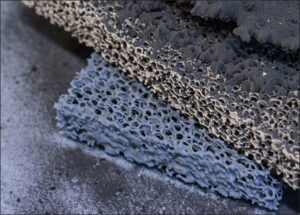
Earth-bound mining companies sometimes use microbes to extract valuable minerals from rock. About 20% of the world’s copper and gold production is aided by rock-chewing bacteria. Researchers began wondering how well they would fare in the vacuum and low gravity of space.

In a first-of-its-kind experiment in 2019, astronauts on the International Space Station last year activated a series of miniaturized, matchbox-sized mining devices with small blocks of basalt, a volcanic rock that is common on the Moon. Three types of bacteria were selected to munch on the rocks for about three weeks while spun in centrifuges mimicking gravitational conditions on the Moon, Mars and Earth.

Researchers measured how much iron, magnesium and a dozen other elements the bacteria pulled out of the rock samples. Of the three, one stood out: Sphingomonas  desiccabilis. It displayed 70% efficiency in extracting neodymium and cerium, two so-called rare earth minerals.

“We were surprised that there was no significant effect of the different gravities on the biomining, given that microgravity is known to influence the behavior of fluids,” astrobiologist and study co-lead author Charles Cockell told Space.com.

Said Cockell:

I think we should continue exploring the types of microbes that would give us the best results in extracting useful elements from materials to be found in space, such as on asteroids, the moon and Mars, and we should continue to develop the technology for optimizing these sorts of biologically enhanced industrial processes in space.

Mining and Manufacturing

Metalysis Announces Breakthrough in Extracting Oxygen from Lunar Rock

November 10, 2020
Schematic of an oxygen molecule

Metalysis, a Sheffield, England-based manufacturer of metal and alloy powders, has won a European Space Agency contract to develop a process to turn Moon dust into oxygen along with aluminum, iron and other metal powders that lunar colonists can use for construction, reports The Guardian.

Oxygen makes up about 45% of the molecular weight of rocks brought back from the Moon. The rest is mainly iron, aluminum and silicon. Earlier this year scientists at Metalysis and the University of Glasgow announced they could extract 95% of the oxygen from simulated lunar soil, leaving useful metal alloy powders behind.

The ESA contract will fund Metalysis for nine months to perfect an electrochemical process that extracts oxygen from dust and rocks by sending an electrical current through the material. The process is already in use in Earth, but oxygen is an unneeded byproduct. The story is quite different on the Moon, where oxygen is a major constituent of two extremely scarce commodities: breathable air and rocket fuel.

“Oxygen is useful not only for astronauts to breathe, but also as an oxidiser in rocket propulsion systems,” said Mark Symes, with the University of Glasgow. “There is no free oxygen on the moon, so astronauts would have to take all their own oxygen with them to the moon, for life support and to enable their return journey, and this adds considerably to the weight and hence expense of rocket launches bound for the moon.”

Bacon’s bottom line: The industrial-scale manufacture of oxygen and metals on the Moon will transform lunar economics by creating a virtually unlimited supply of the critical element. While this breakthrough will facilitate travel between the Moon and back, it is not enough by itself to support large-scale colonization there. Pure oxygen is poisonous to humans and must be diluted with other elements — most notably nitrogen in Earth’s atmosphere — to be breathable. Also, oxygen requires a supply of hydrogen with which to interact to function as a rocket fuel. Scientists and engineers will need to identify abundant sources of these elements in order to free the Moon from the immense expense of lifting materials out of Earth’s gravity well.

Lunar Resources, Mining and Manufacturing

Mining for Water on the Moon

August 1, 2020
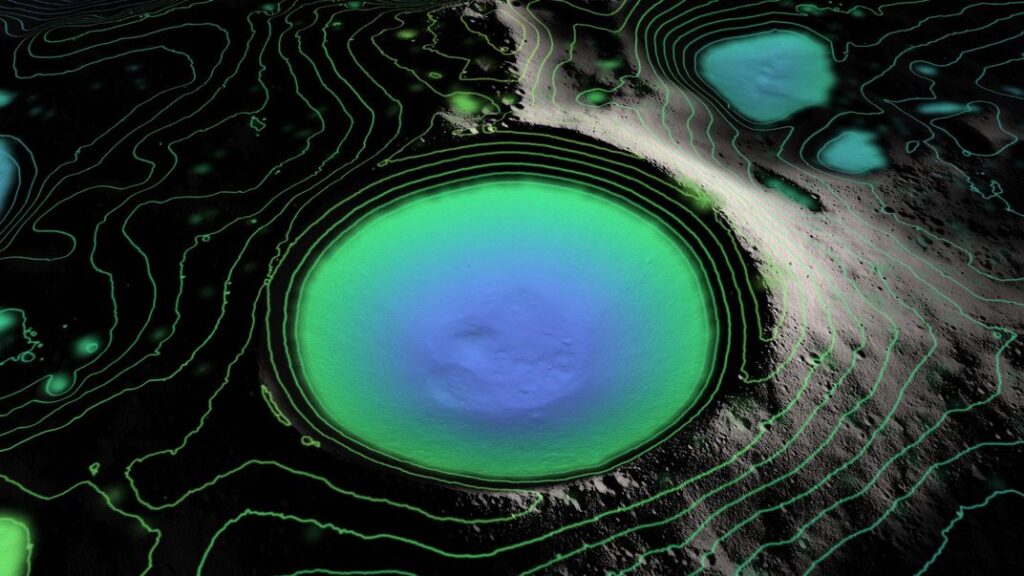
View of Shackleton Crater, measuring 2.5 miles deep, using color to depict elevation measurements. The Lunar Reconnaissance Orbiter found possible evidence of ice deposits. Credit: NASA

Scientists are increasingly confident that there is a significant amount of water on the Moon, but there is still uncertainty as to how much. Moon-orbiting satellites that rely upon ultraviolet, visible of near-infrared light to identify ice deposits can sense only a slice of the lunar surface measurable in a few millimeters.

“You really don’t know if it’s just a very thin frost or if it extends deeper,” says Kevin Cannon, a postdoctoral scholar at the University of Central Florida, who has written a paper for non-academics, “Ice Prospecting: Your Guide to Getting Rich on the Moon.” Orbiting instruments that potentially could detect ice deposits beneath the surface — such as radar and neutron spectroscopy — have much much lower spatial resolutions.”

To get better data, NASA has begun planning a mission to send a rover to the Moon with mining instruments, hopefully by late 2023. The golf cart-sized rover will survey and map ice deposits in the lunar south pole. One of the instruments is a one-meter drill called TRIDENT (The Regolith and Ice Drill for Exploring New Terrain), reports Air & Space. Building a drill capable of penetrating the Moon’s surface in subzero temperatures is fraught with challenges. Lunar regolith, highly impacted over billions of years of bombardments, is dense. Add ice, and the soil could be harder than concrete. more “Mining for Water on the Moon”

Lunar Resources, Mining and Manufacturing

How to Extract Ice on the Moon

May 18, 2020
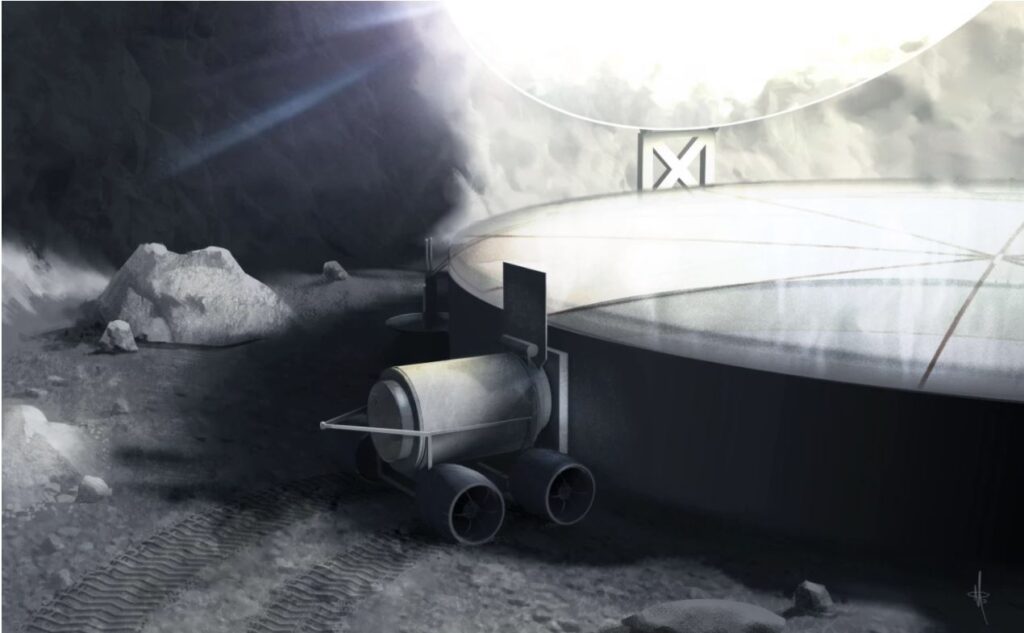
Lunar ice water extractor. Concept art credit: George Sowers and MIT Technology Review

Water is essential to space exploration and colonization. Now that it has been demonstrated that billions of gallons of ice and molecular water are found on the Moon, the challenge is to figure out how to extract it.

In MIT Technology Review, space reporter Neel V. Patel lists the obstacles. Super-cold temperatures and radiation could endanger humans and degrade equipment. Lunar dust sticks to everything, wrecking machinery and posing safety issues to workers in spacesuits. And, of course, astronaut miners would have to be housed and supported on the Moon.

Lunar water comes in the form of tiny icy grained mixed with the soil, mostly in permanently shaded regions of craters in temperatures of 40 K (-233.15 °C). To be useful as a rocket fuel the material, only 5.6% water by weight, would require aggressive processing to rid contaminants.

One proposed method would be to build large towers with concave mirrors on the top that could reflect sunlight into the shadowed regions of lunar craters trapping the water. The energy would heat the lunar soil enough to get the ice to sublimate into vapor. A tent (transparent so the light could get through) would capture the vapor, which could be moved into units where it would freeze back into ice, and then purified at a separate location. Ultimately, the water would be separated into oxygen and hydrogen by electrolysis, and then liquified to the constituents used as rocket propellant.

Although humans have demonstrated the ability to operate rovers and landers that can withstand conditions on the Moon, no one knows if industrial infrastructure would hold up. Writes Patel: “It’s not easy to just wake a piece of technology from a 40 K slumber.” more “How to Extract Ice on the Moon”

Lunar Resources, Mining and Manufacturing

A Closeup Look at Offworld’s Autonomous Robots

January 2, 2020

Video credit: Voice of America

AI and Robots, Mining and Manufacturing

Made in Space to Test 3D Printing in Earth Orbit

December 4, 2019


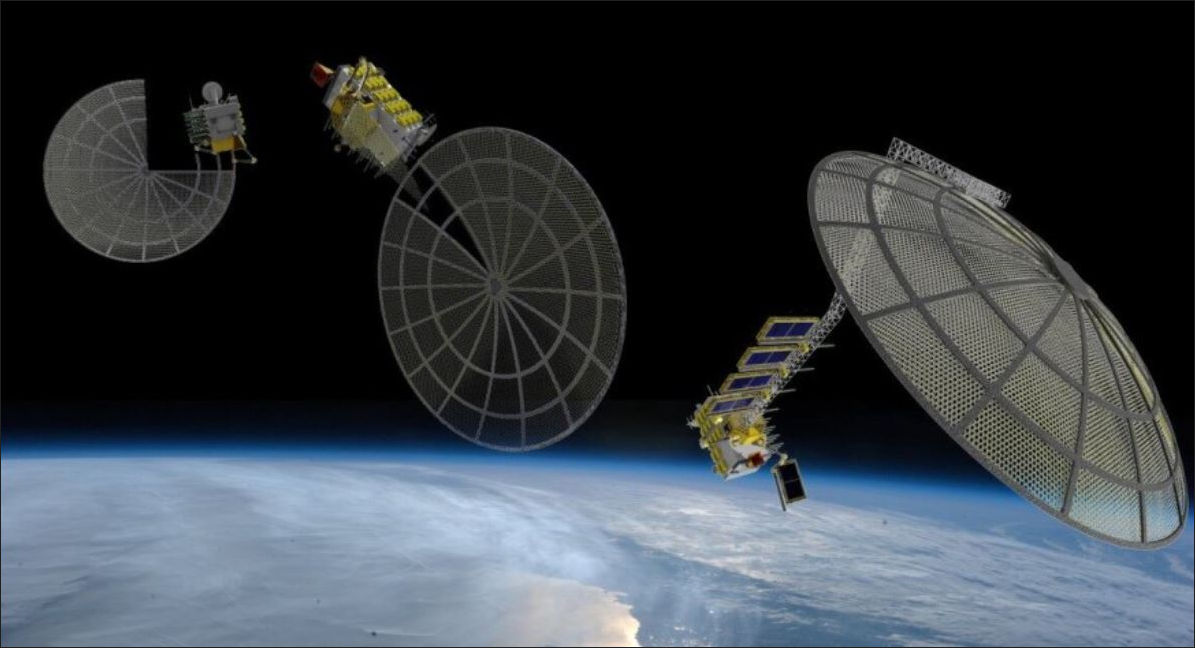
Made in Space, developer of technologies for manufacturing in space, will test its Archinaut One spacecraft with the help of $73.7 million in NASA funding. The craft will 3D print two 32-foot-long beams in Earth orbit, one on either side of the spacecraft, which will then unfurl solar arrays that can generate five times more power than traditional panels used by similar-sized spacecraft.

As NASA anticipates putting humans on the Moon by 2024, the agency hopes to develop a manufacturing capability on the lunar surface, according to Space.com. “This is how we see in-space manufacturing moving forward,” said Raymond Clinton, NASA associate director of science and technology. “And as the agency has said, we are going to the surface of the moon to demonstrate the technologies we will need when we go to Mars. That is the next step.”

Missions will help astronauts “live off of the land” on the Moon by exploiting lunar resources, including the extraction of water from the regolith. more “Made in Space to Test 3D Printing in Earth Orbit”

Mining and Manufacturing

Offworld’s Vision for Smart Robots in Space Settlement

November 3, 2019
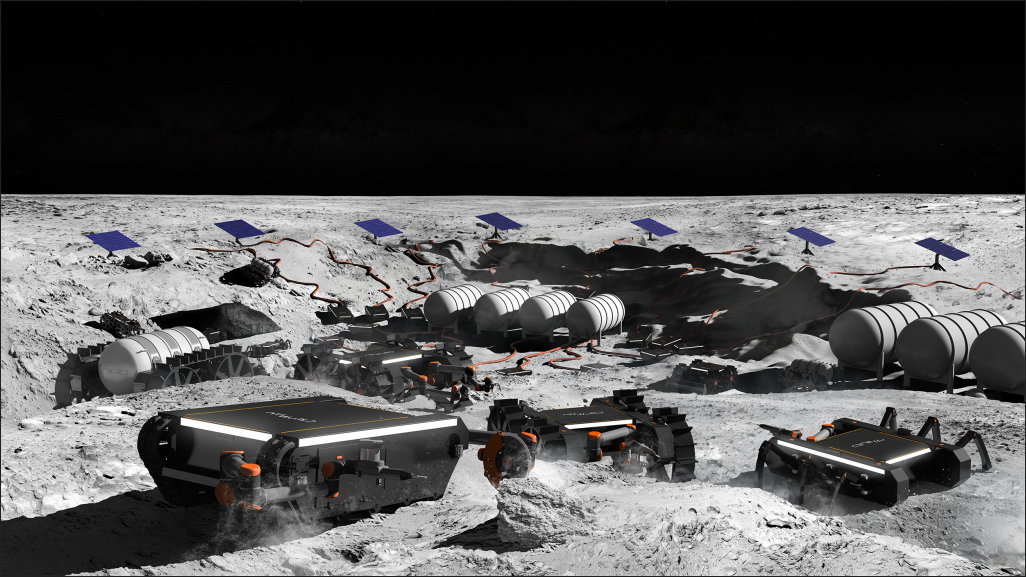
Image credit: Offworld

California-based Offworld, a company developing smart robots to aid in the human settlement of space, has begun deploying its robots in mines, construction sites, tunnels and other infrastructure projects on Earth to provide insight into how the hardware operates in different environments, CEO Jim Keravala has told Space.com.

It is too early to say when Offworld’s robots will be ready to leave the planet, Keravala said, but he would be pleased if the company’s robots could assist NASA’s astronauts when they land on the surface of the Moon, a mission scheduled for 2024. “At some point in time — I hope it’s before we have our first woman and man on the surface — we will be deploying our lunar variants to the lunar surface.”

Offworld’s “Master Plan” describes the use of smart robots, capable of machine learning, to do the heavy work of readying settlements for humans.

The first thing on Offworld’s agenda is to extract water ice for applications from producing drinking water for humans to making rocket fuel.“They operate in swarms, collaborating together, making decisions on their own,” Keravala said. “They can sense where the minerals and ore exist …. and act accordingly.” more “Offworld’s Vision for Smart Robots in Space Settlement”

AI and Robots, Mining and Manufacturing

Caterpillar Eyes Lunar Market for Autonomous Vehicles

October 23, 2019

Caterpillar Inc., the manufacturer of bright yellow mining trucks, bulldozers, and graders, has pioneered self-driving, remote-controlled mining equipment on Earth. Some of that technology may find a home on the Moon, reports CNBC.

The company’s R&D autonomous-vehicle R&D efforts data back to 1985. By the 1990s, Caterpillar had two autonomous hauling trucks running at a Texas quarry. The industry wasn’t ready for autonomy at the time, but Caterpillar stuck to its strategy. Its patience paid off. Today, Zion Market Research indicates that the global mining automation market will double to more than $6 billion in 2025. Writes CNBC:

Caterpillar is leading the autonomy revolution with both its vehicles and operational software. “We now have seven customers and we’re on 11 different sites,” Johnson said, “mining oil sands, iron ore, copper and gold and soon coal.” Cat has deployed 220 of its own trucks, both brand-new autonomous vehicles — costing from $3.5 million to $5 million each — and existing ones that have been retrofitted.

“We’re also converting competitors’ trucks,” Johnson said. “Our solution needs to be interoperable. It’s a competitive decision we don’t take lightly, because we recognize there are other [autonomy] providers.”

The idea of extracting mineral resources and propelling them back to Earth is far-fetched. Likewise, the economics of manufacturing the equipment on Earth and transporting it to the Moon don’t look promising. The logistics still need to be worked out. But Caterpillar is in the game for the long haul. It waited years for a market to emerge for autonomous vehicles on Earth, and it’s willing to wait years for a market to materialize in space. In the meantime, it continues its research and sponsors NASA’s annual Robotic Mining Competition, in which more than 45 collegiate teams design and build remote-controlled mining robots to traverse a simulated Martian terrain.

AI and Robots, Mining and Manufacturing

The Compelling Economics of Lunar-Built Bricks

July 19, 2017

Early settlers on the Moon will need to protect themselves against radiation, which will entails covering habitats with meters-thick layer of protective regolith. Professor Matthias Sperl, with the German Aerospace Center, imagines the necessity of transforming loose dust into sturdy bricks. Because the Moon lacks the components of mortar to bind the bricks together, they will have to be unterlockable, similar to Lego toys.

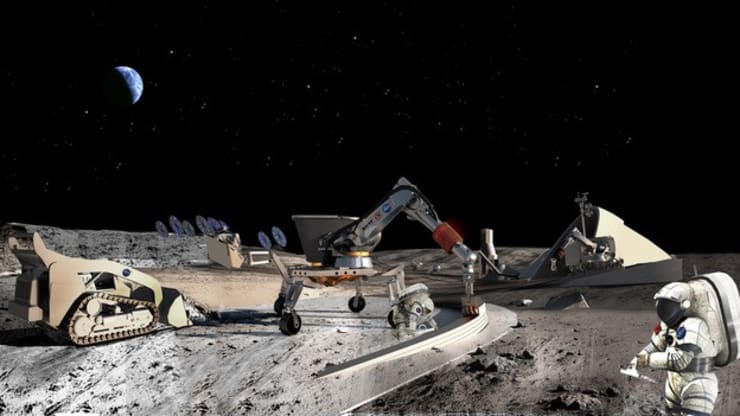
Given the economics of lifting building materials out of Earth’s gravity well, it would make far more sense fabricate the bricks on the Moon, said Sperl in an article in Horizon, the European Union research & innovation magazine, Using solar energy and 3D printing could bring down the cost tremendously.

Here’s how the economics shake out:

‘If you bring something up to the space station you may think about a cost between EUR 5 000 to EUR 10 000 to bring one kilogram of material. To such an order of magnitude you can easily add a factor of 10 if you go to the moon.

‘Imagine that you have a machine that you put on the lunar surface to build the bricks, something similar to the rovers we put on Mars. Such machines weigh about 200 kilograms, which would cost you roughly EUR 20 million. If you need to bring additional infrastructure such as shoveling devices, you can assume a cost of EUR 100-200 million.

‘Now imagine building bricks and other elements worth 10 tons of upload (material taken to space) on earth, as you will easily need a couple of thousand bricks for one building. To ship all of that to the moon, the estimated cost would be EUR 1 billion.

Of course, once you’ve paid to put machines on the Moon, they can build bricks to protect more than one habitat.

Mining and Manufacturing

Dust Mites: A Second American Revolution

The year: 2075. The American colonies on the Moon are getting restless.

Now available for sale in paperback or Kindle at Amazon.com

Recent Posts

  • How to Blockade the Moon Without Really Trying May 6, 2026
  • Second Edition May 5, 2026
  • An Exclusive Interview with the Author of “Dust Mites” June 9, 2022
  • The Most Fuel-Efficient Route to the Moon May Not Be a Straight Line May 26, 2022
  • Data Centers in Lava Tubes — an Economic Driver for the Moon? May 26, 2022

Categories

Archives

Idealist by NewMediaThemes