
Skip to content

Luna 2076

The Geopolitics of Lunar Colonization

  • About
  • The Book
  • Essays
  • Online Resources
Luna 2076

Category: AI and Robots

Robots to Fabricate Solar Panels on the Moon

January 29, 2020

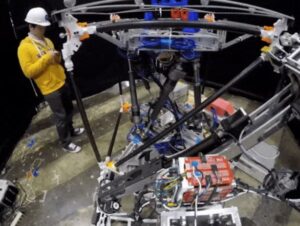
Foreseeable needs for space exploration exceed projected payroll-launch capacity, so NASA envisions the need for robotic manufacturing on the Moon. A newly funded project called The Assemblers envisions a swarm of robots fabricating solar arrays and undertaking other assembly tasks on the surface of the Moon or Mars.
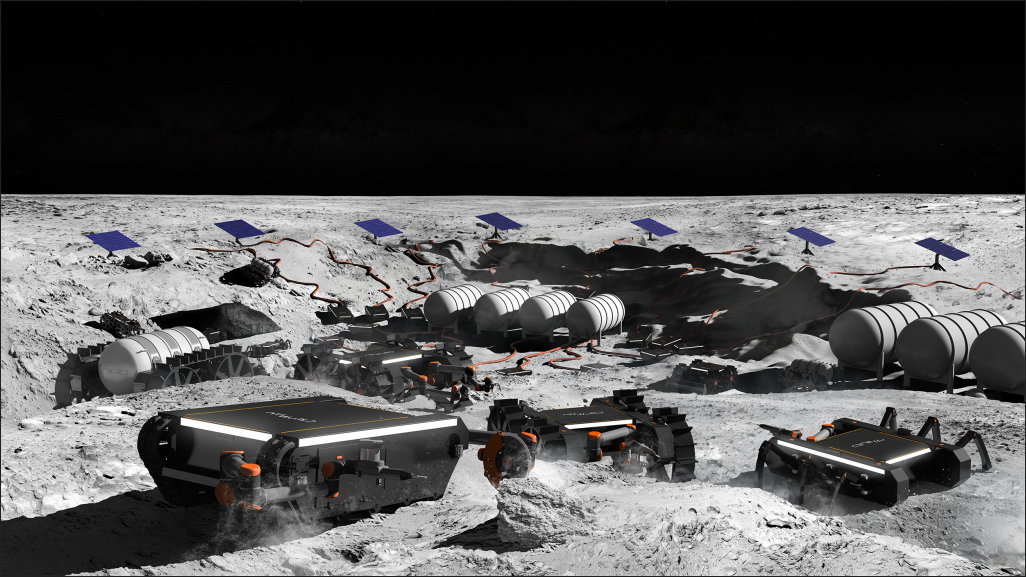

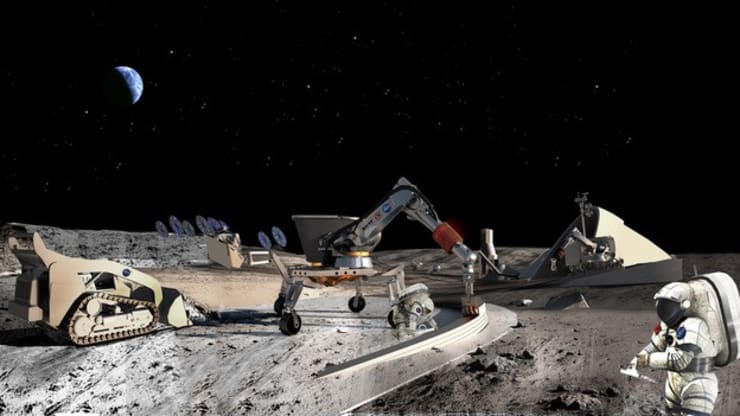
A new video published on Space.com shows how the assembly would look from a robot’s point of view as it examines a structure and targets certain areas for more work. On Earth, they are functioning under the watchful eye of engineers, but in time they will work autonomously.

“The project goal is to increase the technology readiness level for the modular robot, autonomous in-space assembly, and develop a robotic prototype for ground testing,” principal investigator James Neilan, a computer engineer at the NASA Langley Research Center in Hampton, Virginia, said in a statement.

The deliverable for the $2.5 million project will be a prototype that can manipulate items and assemble components in a space environment. The assemblers will use task-management software to keep tabs on errors and address issues as they arise. Writes Space.com:

The Assembler robots are a series of stacked platforms with actuators in between the platforms, as well as sensors that help each robot figure out where its components are located. “The team is working on algorithms for software so that the robots could choose how many platforms to stack and the right tool for the task at hand,” NASA officials said in the statement.

AI and Robots

A Closeup Look at Offworld’s Autonomous Robots

January 2, 2020

Video credit: Voice of America

AI and Robots, Mining and Manufacturing

Offworld’s Vision for Smart Robots in Space Settlement

November 3, 2019
Image credit: Offworld

California-based Offworld, a company developing smart robots to aid in the human settlement of space, has begun deploying its robots in mines, construction sites, tunnels and other infrastructure projects on Earth to provide insight into how the hardware operates in different environments, CEO Jim Keravala has told Space.com.

It is too early to say when Offworld’s robots will be ready to leave the planet, Keravala said, but he would be pleased if the company’s robots could assist NASA’s astronauts when they land on the surface of the Moon, a mission scheduled for 2024. “At some point in time — I hope it’s before we have our first woman and man on the surface — we will be deploying our lunar variants to the lunar surface.”

Offworld’s “Master Plan” describes the use of smart robots, capable of machine learning, to do the heavy work of readying settlements for humans.

The first thing on Offworld’s agenda is to extract water ice for applications from producing drinking water for humans to making rocket fuel.“They operate in swarms, collaborating together, making decisions on their own,” Keravala said. “They can sense where the minerals and ore exist …. and act accordingly.” more “Offworld’s Vision for Smart Robots in Space Settlement”

AI and Robots, Mining and Manufacturing

VIPER Robot to Locate Water Resources on Moon

November 1, 2019
Water is believed to reside in the permanent shadow of Shackleton Crater.

NASA has announced its intention to send a mobile robot, the Volatiles Investigating Polar Exploration Rover (VIPER) to the Moon’s southern pole to identify the location and concentration of water ice in the region.

“The key to living on the Moon is water — the same as here on Earth,” said Daniel Andrews, project manager of the VIPER mission, reports Forbes. “Since the confirmation of lunar water-ice ten years ago, the question now is if the Moon could really contain the amount of resources we need to live off-world.”

Moon water also would make Mars missions more affordable, Mars enthusiasts contend.“Creating space fuel depots would allow spacecraft to travel much farther and allow missions and satellites to sustain operations,” says Karen Panetta, IEEE Fellow, Dean for Graduate Education, Tufts University. “Rather than transporting water into space in heavy loads on rockets, the goal is to extract it (mine it) from the moon and asteroids.” more “VIPER Robot to Locate Water Resources on Moon”

AI and Robots

Caterpillar Eyes Lunar Market for Autonomous Vehicles

October 23, 2019

Caterpillar Inc., the manufacturer of bright yellow mining trucks, bulldozers, and graders, has pioneered self-driving, remote-controlled mining equipment on Earth. Some of that technology may find a home on the Moon, reports CNBC.

The company’s R&D autonomous-vehicle R&D efforts data back to 1985. By the 1990s, Caterpillar had two autonomous hauling trucks running at a Texas quarry. The industry wasn’t ready for autonomy at the time, but Caterpillar stuck to its strategy. Its patience paid off. Today, Zion Market Research indicates that the global mining automation market will double to more than $6 billion in 2025. Writes CNBC:

Caterpillar is leading the autonomy revolution with both its vehicles and operational software. “We now have seven customers and we’re on 11 different sites,” Johnson said, “mining oil sands, iron ore, copper and gold and soon coal.” Cat has deployed 220 of its own trucks, both brand-new autonomous vehicles — costing from $3.5 million to $5 million each — and existing ones that have been retrofitted.

“We’re also converting competitors’ trucks,” Johnson said. “Our solution needs to be interoperable. It’s a competitive decision we don’t take lightly, because we recognize there are other [autonomy] providers.”

The idea of extracting mineral resources and propelling them back to Earth is far-fetched. Likewise, the economics of manufacturing the equipment on Earth and transporting it to the Moon don’t look promising. The logistics still need to be worked out. But Caterpillar is in the game for the long haul. It waited years for a market to emerge for autonomous vehicles on Earth, and it’s willing to wait years for a market to materialize in space. In the meantime, it continues its research and sponsors NASA’s annual Robotic Mining Competition, in which more than 45 collegiate teams design and build remote-controlled mining robots to traverse a simulated Martian terrain.

AI and Robots, Mining and Manufacturing

Dust Mites: A Second American Revolution

The year: 2075. The American colonies on the Moon are getting restless.

Now available for sale in paperback or Kindle at Amazon.com

Recent Posts

  • How to Blockade the Moon Without Really Trying May 6, 2026
  • Second Edition May 5, 2026
  • An Exclusive Interview with the Author of “Dust Mites” June 9, 2022
  • The Most Fuel-Efficient Route to the Moon May Not Be a Straight Line May 26, 2022
  • Data Centers in Lava Tubes — an Economic Driver for the Moon? May 26, 2022

Categories

Archives

Idealist by NewMediaThemes