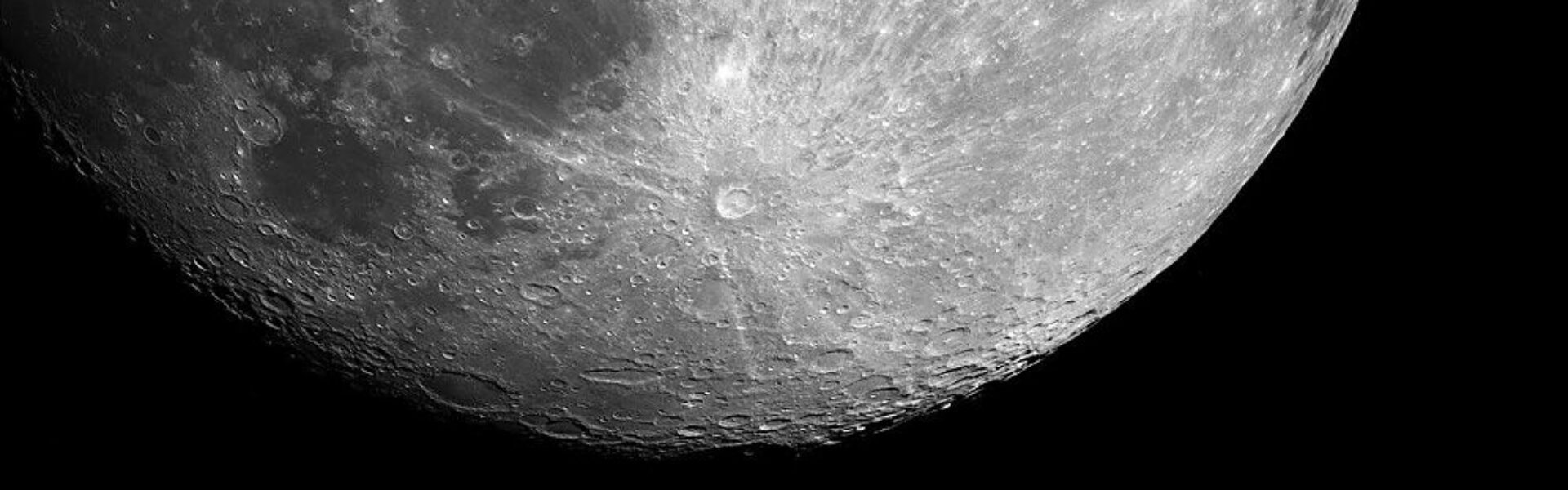
Isaac Arthur gets it — he really gets it. He understands how economics — not the romance of exploration, or the nobility of science — will be the driving force behind the settlement of the Moon. I came across his recent post, “The Great Lunar Boom — Building a Civilization on the Moon,” and I recommend it highly for anyone seeking insight on how the population and development of the Moon as Earth’s “eighth continent” will unfold.
Many people view the Moon as a steppingstone — a kind of cosmic gas station where rocket ships can fuel up for trips to other planets and the stars. Arthur, president of the National Space Society and producer of the popular “Science and Futurism” YouTube channel, sees Earth’s satellite as an integral part of a larger Earth-Moon economic system.
“The Moon isn’t important because it helps us leave Earth,” he says. “It’s important because it’s the first place where leaving Earth actually starts to make economic sense.”
We tend to picture a space settlement as something driven by bold explorers and big destinations. But civilizations don’t grow that way. They grow because moving goods gets cheaper, energy becomes more abundant, infrastructure starts paying for itself, and people actually want to live there.
The first stage of lunar exploitation will be undertaken mainly by machines and robots. Human settlement will follow.
[Colonization] starts with machines quietly chewing up regolith, sorting atoms, and spitting out oxygen, metals, glass and fuel, alongside power stations that never have to worry about weather, refiners that don’t care if anyone’s watching, and launch systems that throw cargo into orbit day after day, because that’s what they were built to do. Once that process starts, it doesn’t need grand speeches to continue. It snowballs.
The lunar economy will be integrated with Earth’s economy in a way that, say, settlements on Mars never could,” he contends. “A trip to the Moon takes days, not months. … Communication lag is measured in seconds, not minutes. Rescue, resupply and political attention are all real possibilities, not abstract promises.”
Several differentiators will give the Moon a competitive edge for investment as human activity moves into cis-lunar space. First and foremost, a position on the edge of Earthy’s gravity well gives the Moon a huge advantage for supplying raw materials that can be extracted with cheap, abundant energy from lunar regolith and rock. Mass drivers, space elevators and tethers will make it ludicrously inexpensive to launch materials into cis-lunar space.
“Launching from Earth is like climbing a mountain with a backpack full of lead. Launching from the Moon is like stepping off a ridge and coasting downhill.” At some point, Arthur observes, “the Moon becomes the place you launch mass. And when mass becomes cheap in orbit, scale follows. Bigger stations, bigger ships, bigger ambitions.”
The Moon, he predicts, will evolve from a supplier of raw materials into a major Earth-Moon logistics hub. “Earth, the Moon and the space between them [will be] bound together by constant traffic.”
In the world of “Dust Mites,” economics is the dominant force behind settlement of the Moon — not the only one, but the dominant one. Geopolitics also will play a significant role as the United States and China jockey for military primacy on the Moon and, by extension, cis-lunar space. So will, I expect, the human desire to escape the “old” world and recreate new societies on the Moon. Economics will establish the parameters of what is feasible. Profit seeking will be the rocket fuel that propels the conquest of Earth’s nearest neighbor.