Skip to content

Luna 2076

The Geopolitics of Lunar Colonization

  • About
  • The Book
  • Essays
  • Online Resources
Luna 2076

Category: Lunar Environment

Do Small Magnetic Fields Protect Pockets of Lunar Ice?

April 11, 2022
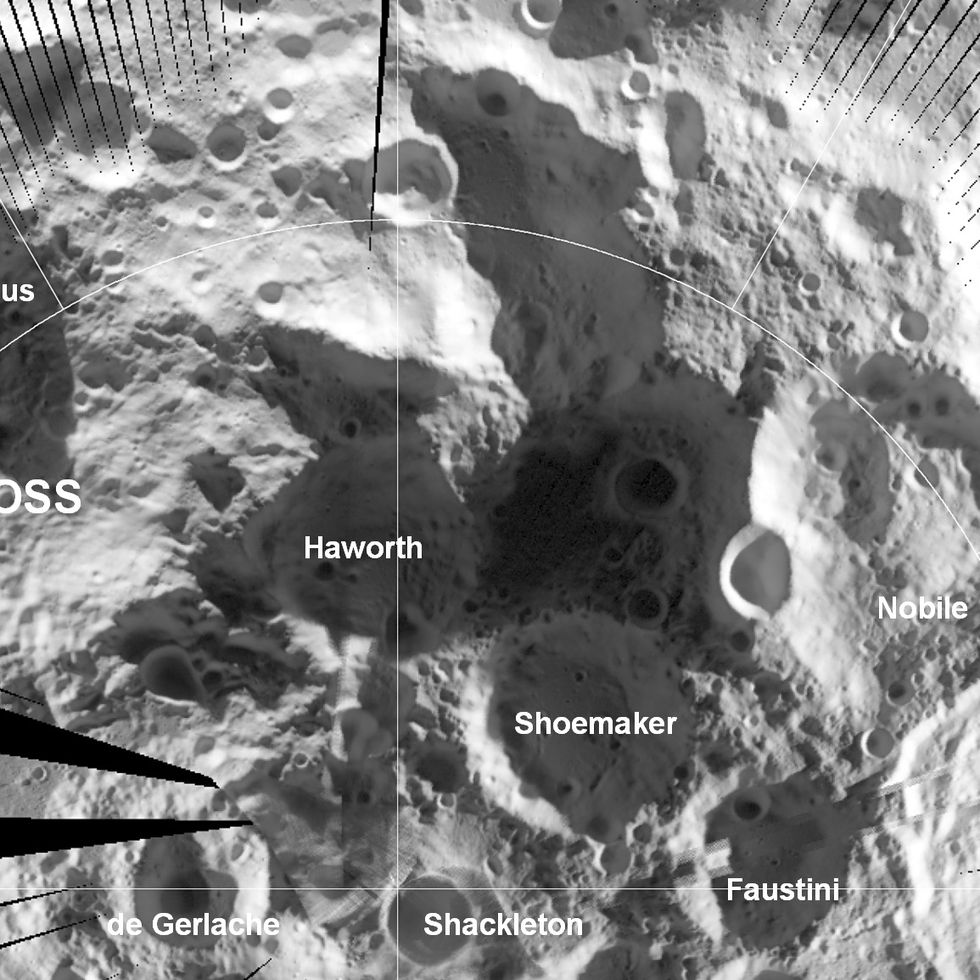
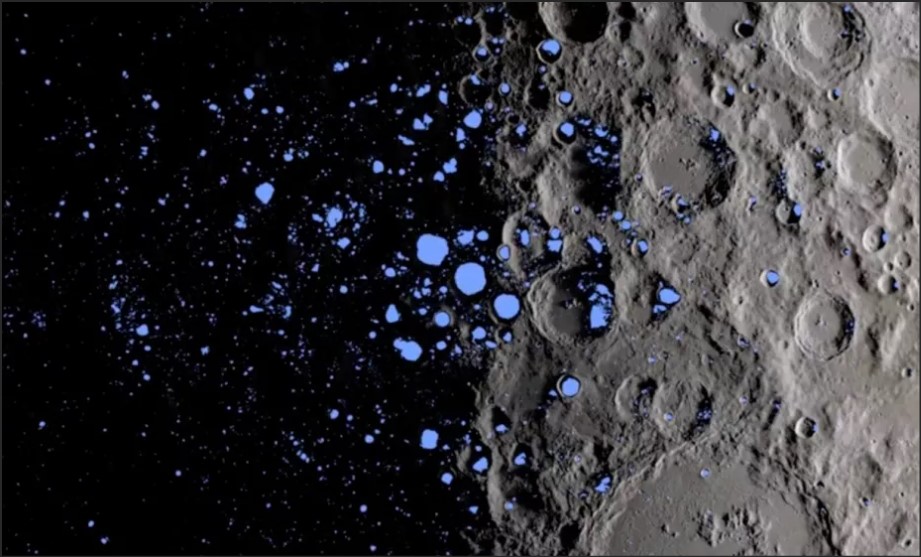
This NASA Goddard map shows permanently shadowed craters near the Moon’s south pole. (Credit: LiveScience)

In 2018 scientists documented the first evidence of water ice on the Moon that was trapped in the bottom of craters at the north and south poles locked in perpetual shadow. Discovery of the ice created new questions. While the craters are protected from direct sunlight, they aren’t shielded from solar wind. The ionized particles from the Sun is highly erosive and, unlike the Earth, the Moon has no magnetic shield to protect it. By some peoples’ reckoning, the solar wind should have destroyed the ice long ago.

In research presented at the Lunar and Planetary Science Conference last month, University of Arizona scientists shared their map of magnetic anomalies, regions of the lunar surface with unusually strong magnetic fields, reports LiveScience.

These anomalies may serve as tiny magnetic shields.”These anomalies can deflect the solar wind,” Lon Hood, a planetary scientist at the University of Arizona, told Science. “We think they could be quite significant in shielding the permanently shadowed regions.” more “Do Small Magnetic Fields Protect Pockets of Lunar Ice?”
Lunar Environment, Lunar Resources

Scientists Probe Mystery of Lunar Swirls

March 23, 2022
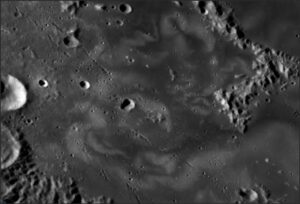
Photo taken by the Lunar Reconnaissance Orbiter camera showing the swirl region within Mare Ingenii NASA/GSFC/ASU

Scientists have identified a topographical phenomenon on the lunar surface: bright swirls resembling cream being stirred into coffee. The features, which range in size from a few meters across to more than 50 kilometers, are found across from the Moon. Summarizes NewScientist: “We don’t know what causes [the swirls], but a new analysis has discovered surprising hints that they are found where the ground is lower.”

Lunar Environment

The Coldest Place in the Solar System?

March 14, 2022
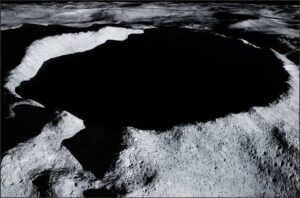
Shackleton crater sits at the moon’s south pole. Jorge Mañes Rubio. Spatial design & visualisation in collaboration with DITISHOE

Double-shadowed craters near the Moon’s south pole may be so dark that they would be among the coldest places in the solar system. The small tilt of the Moon as it orbits the Earth, only 1.5 degrees, means that it has hundreds of craters where direct sunlight never reaches. Double-shadowed craters make it impossible for even reflected sunlight to touch some areas. Temperatures can drop below  -170°C.

NewScientist has the story behind a paywall.

Lunar Environment

Earth, Moon Shared Magnetosphere 4 Billion Years Ago

October 15, 2020
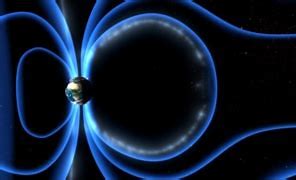
Earth’s magnetosphere. Credit: Futurismic.com

The Earth and Moon shared the same magnetic field some 3.5 billion to 4.1 billion years ago, and the Moon’s field helped shield the Earth from solar radiation that might have stripped away its atmosphere, concludes a NASA-led study published in the journal Science Advances.

“The Moon seems to have presented a substantial protective barrier against the solar wind for the Earth, which was critical to Earth’s ability to maintain its atmosphere during this time,” said Jim Green, NASA’s chief scientist and lead author of the study, as reported by Business Insider India.

The scientists created a computer model to simulate the behavior of the magnetic fields of the two orbs. The magnetospheres of the Moon and Earth would have been magnetically connected in the polar regions of each body. At certain times, the Moon’s magnetosphere would have served as a barrier to harsh solar radiation bombarding the Earth-Moon system.

The model also suggests that there was some atmospheric exchange as well. The Sun’s radiation would have charged neutral particles in the Earth’s upper atmosphere, enabling them to travel to the Moon along the lunar magnetic lines. The process might have contributed to the Moon maintaining a thin atmosphere, including nitrogen.

As the Moon cooled and lost its magnetosphere, solar wind stripped the atmosphere away.

Lunar Environment

China Probe Discovers New Moon Substance

July 7, 2020
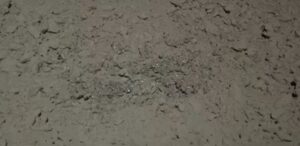
Nothing to see here, move along now! Image captured by China’s Yutu 2 moon rover.

A team with China’s Chang’e 4 mission to the far side of the Moon has discovered a curious substance, which it describes (translated) as “gel-like.” They describe the material as dark greenish and glistening impact melt breccia, measuring 20 inches by six inches — signs of possible presence of glasses resulting from meteor impact melts or volcanic eruptions.

According to a report by Our Space, a Chinese-language science-outreach publication (and reported on by Space.com), the breccia — broken fragments of minerals cemented together — was formed by impact-generated welding, cementing and agglutinating of lunar regolith and breccia.

The paper also looks at the surrounding area, writes Space.com. The authors suggest that the lunar regolith consists of a mixture from multiple sources, including ejecta from the impact that created the nearby Finsen crater and possible contributions from Alder crater. more “China Probe Discovers New Moon Substance”

Lunar Environment

Japanese Scientists Develop Model for Testing Solar Flares

July 1, 2020
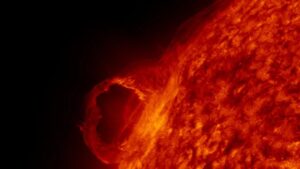
Solar flare. Photo credit: Pxhere.com

Radiation will be a major hazard of living on the Moon, especially for anyone not behind protective shielding. The release of energy from solar flares has been difficult to forecast. Now four Japanese scientists with Nagoya University and the National Astronomical Observatory of Japan have developed a model, based on observations of the sun from 2008 to 2018, for predicting large solar flares. In an article published in Science, they say that “in most cases” the model correctly identifies the region of the sun that will produce large flares within 20 hours and, within limits, how powerful it will be.

However, say the authors, the model does produce some false positives and false negatives. “Accurate predictions of solar flares could improve forecasts of space weather conditions around Earth,” they say. Presumably, those predictions apply to the Moon as well. Here is the abstract for the paper in Science.

Solar flares are highly energetic events in the Sun’s corona that affect Earth’s space weather. The mechanism that drives the onset of solar flares is unknown, hampering efforts to forecast them, which mostly rely on empirical methods. We present the κ-scheme, a physics-based model to predict large solar flares through a critical condition of magnetohydrodynamic instability, triggered by magnetic reconnection. Analysis of the largest (X-class) flares from 2008 to 2019 (during solar cycle 24) shows that the κ-scheme predicts most imminent large solar flares, with a small number of exceptions for confined flares. We conclude that magnetic twist flux density, close to a magnetic polarity inversion line on the solar surface, determines when and where solar flares may occur and how large they can be.

Lunar Environment

Mapping the Moon’s South Pole

March 6, 2020

Scientists at NASA’s Solar System Exploration Research Virtual Institute (SSERVI) have created the Lunar South Pole Atlas, a detail chart of the Moon’s underbelly, in preparation for the upcoming Artemis mission. The south pole is the subject of intense interest because there is reason to believe that it contains the Moon’s largest reserves of H2O, which, because they are captured in craters that are never exposed to the sun, never melt.

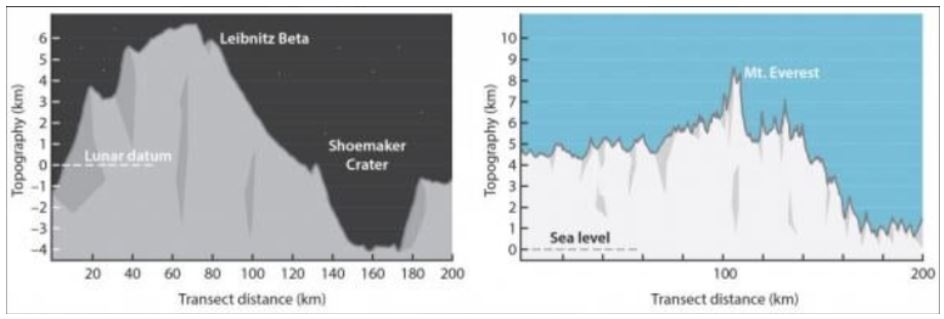
Photography indicates the presence of two towering massifs (or mountains) — Malapert Massif and Leinbiz Beta — comparable to Earth’s Mount Everest. Writes Popular Mechanics:

The difference in elevation between the tip of Malapert Massif and the base of Hawthorne crater is about 5 miles. For context, that’s almost as tall as Mount Everest, which stretches nearly 5.5 miles into the sky. In the case of Leibniz Beta, which lies next to Shoemaker crater, the elevation difference is a whopping 6.2 miles—far higher than Earth’s tallest mountain.

The craters are home to some of the coldest temperatures ever recorded in the solar system.

Lunar Environment

Geologic Mystery: How Old Is Mare Crisium?

December 14, 2019

After the solar system formed 4.6 billion year ago, an object slammed into the Moon and formed a 620-mile-wide indentation now known as the Crisium basin. Scientists examining the region say they’ve spotted a crater within the basin that appears to contain pristine impact melt of volcanic rock, reports National Geographic.
Not only might the geologic feature yield clues about the frenzied meteor bombardment during the early history of the Earth and Moon, the basin holds a geologic blister the size of Washington, D.C., unlike any other feature seen in the the solar system. The volcanic lump appears to have been cracked open by underground magmatic activity.

Rocks recovered by U.S. Apollo missions and Russian robotic missions are estimated to be between 3.8 and 4.0 billion years old, leading scientists to theorize that there was spike in the number of impacts on the Moon during a period known as the Late Heavy Bombardment. But that conventional wisdom has come into question. Why was there a 700-million-year quiet period before then?

The Crisium basin could shed light on that mystery. The original impact that formed the basin was so powerful that it created a melt sheet up to 9.3 miles thick. Later, profuse eruptions of lava flooded the basin beginning about 3.6 billion years ago, forming a volcanic sea known as Mare Crisium that covered up much of the original melt. But “islands” of rock within the basin, known as Kipukas, survived the lava inundation. As lunar scientists examined the region, one Kipuka stuck out. Close examination showed that much of it was made of frozen volcanic rock. The research team conjectures that the lump was pushed upward by subsurface volcanic activity, but the origin remains a mystery. more “Geologic Mystery: How Old Is Mare Crisium?”

Lunar Environment

Parker Probe Plumbs Secrets of Solar Wind

December 7, 2019

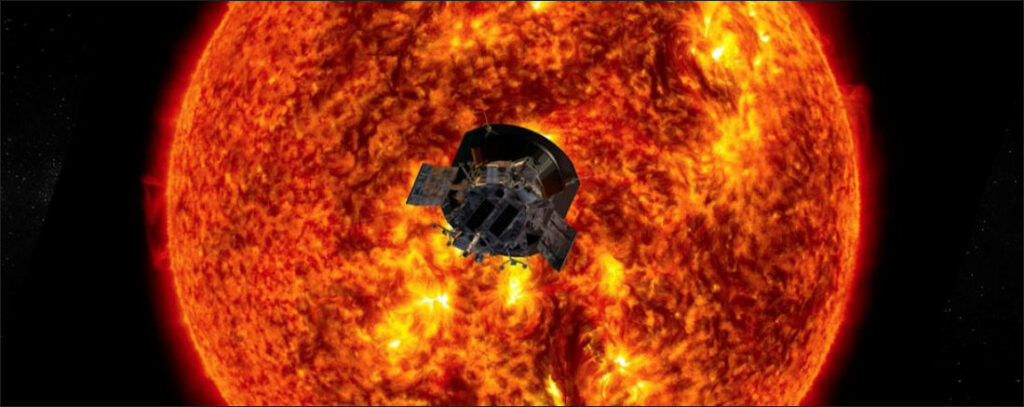
The Parker Solar Probe has yielded considerable insight into the formation and structure of solar winds, providing scientists that hopefully will help them better predict when mammoth ejections of solar material will occur. Coronal mass ejections can disable communications and defense satellites and can harm astronauts outside of Earth’s protective electromagnetic field.

Launched in August 2018, the probe has passed closer to the sun than at any previous spacecraft in history. The vessel is equipped with a suite of high-tech instruments engineered to withstand the sun’s blistering heat — it will pass within 15 million miles of the sun, compared to the 36 million miles of Mercury’s orbit. Instruments include five antennas, an image maker, and devices that measure the energies of different particles.

The mission’s goal is to “understand the sources and structure of the solar wind up close right as it leaves the sun,” said physicist Stuart Bale of the University of California-Berkeley, in the press conference reported by Popular Mechanics. “What Parker has done has got us closer than ever to the Sun and now we can really see a lot of structure and we can see in this case we can clearly see a source of the wind.”

Among the key findings so far: more “Parker Probe Plumbs Secrets of Solar Wind”

Lunar Environment

NASA Proposes Drones to Explore Lava Tubes

November 28, 2019
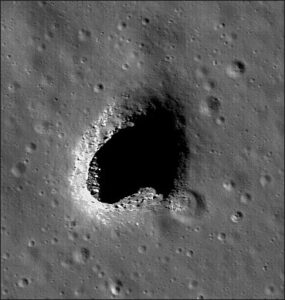
Lave tube where the entrance caved in. Source: Daily Mail

NASA engineers have proposed sending autonomous drones to the Moon to explore the potential of using lava tubes and caves for human habitation. It is theorized that ancient lava flows from volcanoes left miles of lava tubes up to 30 feet across, reports the Daily Mail.

Meanwhile, researchers at the Morgridge Institute for Research in Madison, Wisc., are developing camera technology to explore the tubes from an orbiting satellite.

States project leader Andreas Velten:

Geologists are interested because they would provide access to subsurface geology without actually having to dig, which would be very difficult. What’s interesting for space travel is you can’t have people on the surface for long periods because of the temperature extremes, and because of radiation. But in these caves, people could survive for a long time with consistent temperatures and no radiation. Some of these may actually be quite deep, under 50-60 metres of rock.

Earlier these year, says the Daily Mail, NASA announced its Periscope Project, with the goal of mapping the tubes by peering into the 200 or so “skylights” that have been discovered so far.

Lunar Environment Lava tubes

Posts pagination

1 2 Next

Dust Mites: A Second American Revolution

The year: 2075. The American colonies on the Moon are getting restless.

Now available for sale in paperback or Kindle at Amazon.com

Recent Posts

  • Nashville, Tenn: a Template for Urban Development on the Moon September 8, 2026
  • Bot Bottlenecks September 7, 2026
  • Will the Laser Revolution Trump the Drone Revolution? September 4, 2026
  • Beating Fiction to the Punch: FBI Quantum Unit September 3, 2026
  • On the Tech Time Horizon: Quantum Sensors September 2, 2026

Categories

Archives

Idealist by NewMediaThemes