Skip to content

Luna 2076

The Geopolitics of Lunar Colonization

  • About
  • The Book
  • Essays
  • Online Resources
Luna 2076

Category: Lunar Environment

222 New Impact Craters Measured over Six Months

October 12, 2016
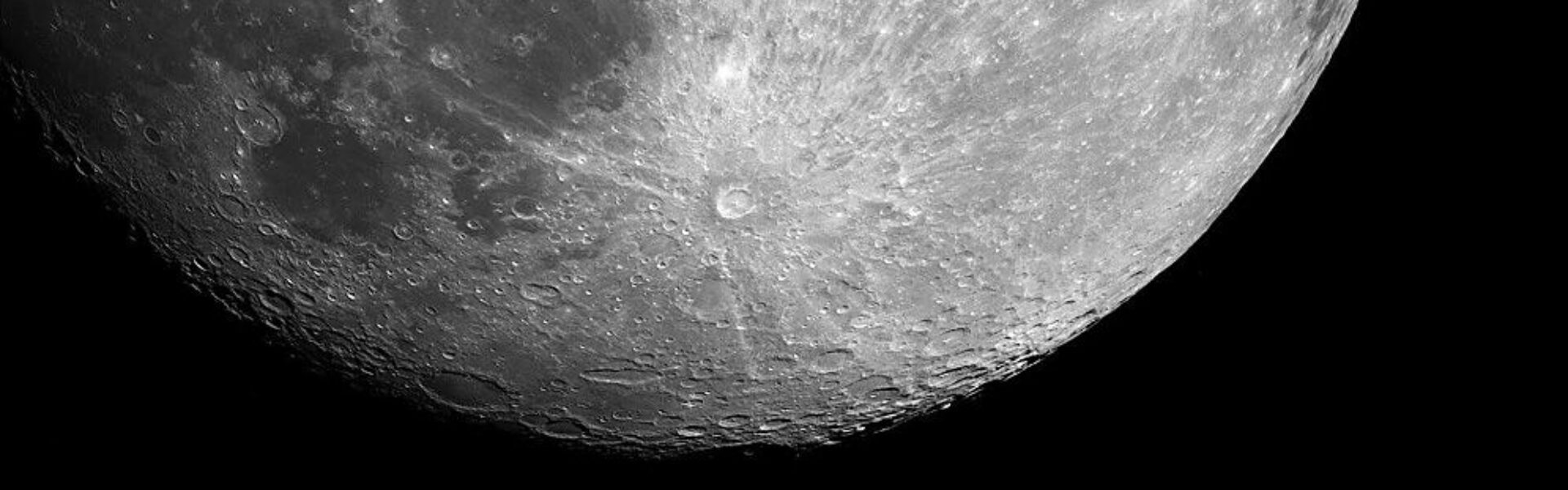
Photo credit: NASA/GSFC/Arizona State University

A count of new crater formations on the Moon has turned up 33% more than predicted, researchers at Arizona State University have found.

Meteors regularly impact the Earth but they usually burn up in the atmosphere. On the Moon, which has no atmosphere, they constantly form craters and impact basins. Bombardment by small meteors could post hazards to future lunar settlements.

Emerson Speyerer and his Arizona State colleagues compared 14,000 photos taken between Oct. 25, 2012 and April 21, 2013 by the high-resolution camera on the Lunar Reconnaissance Orbiter (LRO), reports New Scientist. They found 222 new impact craters more than 10 meters wide, a third more than predicted. They also found 47,000 new splotches, Speyerer’s term for splatter-like changes in reflectance on the surface caused by dust and rock thrown off by the initial meteoric impact.

The largest new crater was 43 meters in diameter. more “222 New Impact Craters Measured over Six Months”
Lunar Environment

Solar Wind Interacts with Moon’s Surface

December 1, 2015
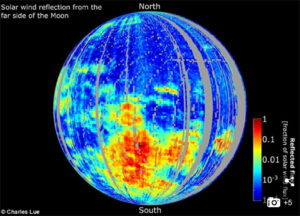
Areas in red mark where solar wind is reflected the most. (Click for larger image.)

The Moon may not have an atmosphere, but it does have “weather” after a fashion. Researchers have found that the particles in solar wind appear to interact with the Moon in an unexpected way, reports the Daily Mail.

The solar particles interact with the Earth’s magnetic field to create the aurora borealis. But the Moon lacks a magnetic field, so scientists thought it passively absorbed the solar wind. But measurements made by Indian’s Chandrayaan-1 lunar orbiter have revealed that 10% of the solar wind is reflected back into space, creating turbulence as solar wind streams past the Moon. Vortexes billow onto the dark side of the Moon.

Charles Lue, a researcher at the Swedish Institute of Space Physics, has found that the reflection of solar wind varies with localized magnetic fields on the lunar surface.

Explains the Daily Mail:

In areas with strong magnetism, caused by iron in the crust, the solar wind flow is restricted, while adjacent areas receive increased flow. This results in unusual spirals of ions streaming off the dayside of the moon, where the solar wind strikes first, to the nightside.

The weathering of the moon’s surface by the solar wind may be less than previously predicted, which could mean there is less water hidden beneath the crust. Said Lue: “The reduced solar wind weathering allows us to separate micro-meteorite and solar wind-inducing weathering, including the effects of different solar wind species, differently well shielded.”

Lunar Environment, Lunar Resources

Mystery: If the Moon Has No Plate Tectonics, Why Does it Have Moonquakes?

September 21, 2015

In 1972 America’s astronauts left seismic sensors on the Moon. Gathering data for five years, they transmitted evidence of 12,000 moonquakes, reports The Atlantic.

Scientists have identified four classifications of moonquakes: deep moonquakes, thermal moonquakes, meteroid impacts, and shallow moonquakes. Deep moonquakes are the most common. Scientists counted 7,000 of them. Likely caused by the Earth’s tidal pulls, they occur about every 27 days and usually measure 2 or smaller in magnitude. Thermal quakes occur in response to the temperature changing from lunar day to night. Meteoric quakes are triggered by the impact of meteors.

The really interesting moon quakes are the “shallow” moonquakes. Seven of the 28 recorded up to 1977 exceeded magnitude 5. They last longer than earthquakes, where underground water helps dampen them. On the Moon, which is incredibly dry, seismic energy is more efficiently propagated.

Another factor differentiating shallow moonquakes from earthquakes: Unlike the Earth, the moon has no active tectonics.

The cause of shallow moonquakes remains a mystery.

Lunar Environment

Earth Gravitation Effects Scarp Formation on Moon

September 16, 2015
Lunar wrinkles, or scarps

Humans have long observed the effect of the Moon’s gravitational force on the ocean tides. it turns out that the Earth has a gravitational effect on the Moon as well. Earth gravitation is shaping formations of cliffs that form as the Moon slowly shrinks, reports C/Net.

The core of the Moon is cooling. As the core cools, the partially molten regions in mantle solidify and the Moon shrinks slightly, a process that wrinkles the crust. The wrinkles form a type of cliff called “lobate scarps,” usually less than six miles long and tens of yards high.

NASA’s Lunar Reconnaissance Orbiter has identified 3,200 scarps randomly scattered across the Moon’s surface.

“There is a pattern in the orientations of the thousands of faults and it suggests something else is influencing their formation, something that’s also acting on a global scale — ‘massaging’ and realigning them,” explained study lead author and Smithsonian senior scientist Thomas Watters of the National Air and Space Museum in Washington.

That force comes from the gravitational pull of the Earth.

Because the Moon’s core is still cooling, the scarps are likely still forming. Seismic activity is likely to peak when the Earth and Moon are furthest apart. NASA hopes to be able to monitor the hypothesized moonquakes with a lunar seismic network..

Lunar Environment

Neon Found in Lunar Atmosphere

August 17, 2015
Artist’s concept of NASA’s Lunar Atmosphere and Dust Environment Explorer (LADEE) spacecraft. Source: NASA

The Moon’s thin atmosphere contains neon, NASA’s Lunar Atmosphere and Dust Environment Explorer (LADEE) spacecraft has confirmed.

“The presence of neon in the exosphere of the moon has been a subject of speculation since the Apollo missions, but no credible detections were made,” said Mehdi Benna of NASA’s Goddard Space Flight Center in Greenbelt, Maryland and the University of Maryland, Baltimore County in a NASA press release. “We were very pleased to not only finally confirm its presence, but to show that it is relatively abundant.”

Because the Moon’s atmosphere is so tenuous, about 100 trillion times less dense than Earth’s atmosphere are sea level, the volume of neon is minute.

Most of the gases in the exosphere — primarily neon, argon, and helium — comes from the solar win, a stream of electrically conducting gas blown from the surface of the sun into space at about one million miles per hour. All of these elements impact the Moon, but only helium, neon and argon are volatile enough to return to space. A portion of the helium, argon, and neon in the lunar exosphere comes from naturally occurring radioactive potassium-40, thorium, and uranium found naturally in lunar rocks. more “Neon Found in Lunar Atmosphere”

Lunar Environment Argon, Helium, Neon

Posts pagination

Prev 1 2

Dust Mites: A Second American Revolution

The year: 2075. The American colonies on the Moon are getting restless.

Now available for sale in paperback or Kindle at Amazon.com

Recent Posts

  • NAS Identifies Four Priorities for Manned Moon Missions October 22, 2026
  • Will Resource Constraints Throttle Settlement Growth on the Moon? October 18, 2026
  • Notes on Lunar Warfare October 16, 2026
  • Natural Intelligence & the Logic of Consciousness October 15, 2026
  • America’s Competitive Advantage in Space October 11, 2026

Categories

Archives

Idealist by NewMediaThemes