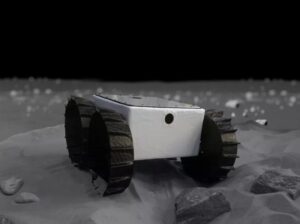
Harkening back to the success of cubesats, small, standardized satellites, NASA will launch a small rover. Iris, that it hopes will also be inexpensive to produce.
NASA, Astrobotic, and Carnegie Mellon University are teaming up in the CubeRover project, which targets a 2021 launch date in a private delivery run paralleling the agency’s Artemis program to return to the Moon by 2024.
Iris is about the size of a shoebox, reports Space.com, and weighs less than 5 lbs. (2.3 kilograms). It travels on four wheels.
If all goes well, the rover will drive about 160 feet (49 meters), approximately the width of a football field, a journey that should tell engineers more about how best to travel over the moon’s dusty surface. The drive will take the rover far enough away from its landing site to study how the landing itself alters the surface of the moon.
Iris will support other science and technology payloads on the surface with power, portability and communications.
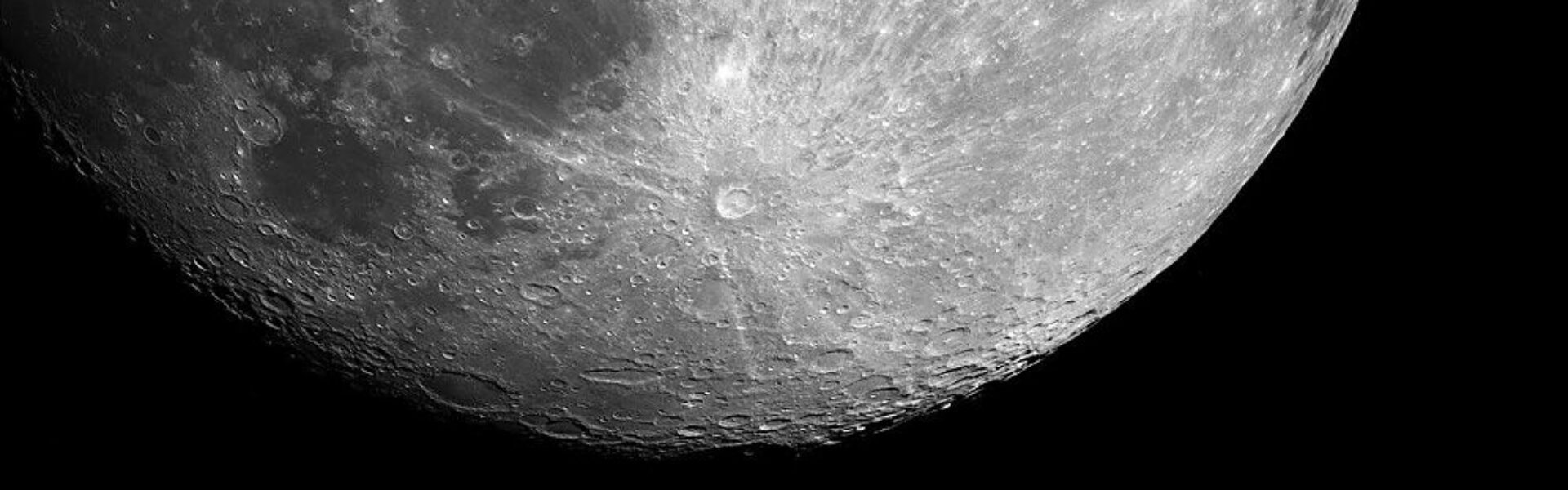
Using the Miniature Radio Frequency (Mini-RF) instrument on NASA’s Lunar Reconnaissance Orbiter spacecraft, mission members have found evidence that the Moon’s subsurface may be richer in minerals like iron and titanium than previously thought.
The Moon is widely believed to have originated from the collision of a Mars-sized proto-plant with the young Earth. In theory, the Moon’s bulk chemical composition should resemble that of the Earth. But many parts of the surface, such as the lunar highlands, appear to be metal-poor.
The mini-RF, explains NASA, allowed scientists to measure an electrical property known as the dielectric constant within lunar soil piled on crater floors in the Moon’s northern hemisphere.
The research team noticed that the property increased with crater size — up to a certain point. When the craters reached three to twelve miles in diameter, the property remained constant. No one expected to find the relationship. Says the NASA article:
Discovery of this pattern opened a door to a new possibility. Because meteors that form larger craters also dig deeper into the Moon’s subsurface, the team reasoned that the increasing dielectric constant of the dust in larger craters could be the result of meteors excavating iron and titanium oxides that lie below the surface. Dielectric properties are directly linked to the concentration of these metal minerals.
If their hypothesis were true, it would mean only the first few hundred meters of the Moon’s surface is scant in iron and titanium oxides, but below the surface, there’s a steady increase to a rich and unexpected bonanza. …
The larger craters, with their increased dielectric material, were also richer in metals, suggesting that more iron and titanium oxides had been excavated from the depths of 0.3 to 1 mile (0.5 to 2 kilometers) than from the upper 0.1 to 0.3 miles (0.2 to 0.5 kilometers) of the lunar subsurface.
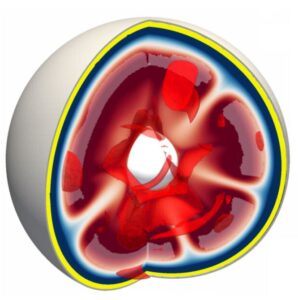
In this simulation of the Moon’s interior, the yellow represents the global magma ocean. A crust (grey) has formed over top. Convection zones can be seen within the mantle, and a solid core (white) sits at the middle. IMage credit: DLR / M. Maurice
According to the latest estimates by a team of researchers with the Technische Universität Berlin, it might have taken ten times longer than previously thought for the early Moon to transform from a ball of super-heated magma into its current form.
The oldest rock found on the Moon, brought to Earth by the Apollo 14 mission, has been dated to 4.51 billion years old, comparing to the estimated 4.54 billion years estimated for the age of the Earth. But minerals can go back only as far as the moment when those minerals formed. To date the Moon, scientists need to know how much time elapsed until the magma ocean solidified, explains Sky & Telescope.
Maxime Maurice and his colleagues at the German university have developed a new thermal evolution model — a detailed computer simulation — to reconstruct the first 200 million years of lunar evolution. Their studies identified two previously underappreciated dynamics: the insulating effect of the primordial lunar crust, and mantle convection that probably started even before the magma ocean completely solidified.
It has been long known that the early Moon formed a crust made of a light mineral called pagioclase, which floated atop the magma ocean. That crust turned out to be an excellent insulator. While previous studies had accounted for that effect, Maxime concluded the insulating effect had been under-estimated.
The other factor was mantle convection. Summarizes Sky & Telescope:
The lunar magma ocean solidified from the bottom up because high pressure at depth forced the magma to solidify even at high temperatures. This process likely solidified 80% of the magma ocean within 1,000 years of the Moon’s formation. If mantle convection started at this point, it could have allowed heat to continue flowing from the depths toward the surface, keeping the magma ocean hot and molten.
On Earth, mantle convection creates the magma that feeds volcanoes. “In this case, it would be exactly the same, but the volcanoes would have spilled their lava into the magma ocean,” Maurice explains.
Until now, van Westrenen says, most lunar evolution scenarios assumed that mantle rocks didn’t start moving until the magma ocean had completely solidified.
According to van Westrenen, the combination of these two processes makes a huge difference for the longer-term survival of the magma ocean.
A slowly crystallizing magma ocean could require a reinterpretation of mineral isotope dating of many lunar samples, and thus for the aging of the Moon-forming impact. The bottom line, the Moon may be 100 million years younger than commonly postulated.
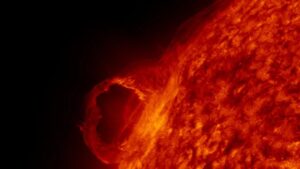
Radiation will be a major hazard of living on the Moon, especially for anyone not behind protective shielding. The release of energy from solar flares has been difficult to forecast. Now four Japanese scientists with Nagoya University and the National Astronomical Observatory of Japan have developed a model, based on observations of the sun from 2008 to 2018, for predicting large solar flares. In an article published in Science, they say that “in most cases” the model correctly identifies the region of the sun that will produce large flares within 20 hours and, within limits, how powerful it will be.
However, say the authors, the model does produce some false positives and false negatives. “Accurate predictions of solar flares could improve forecasts of space weather conditions around Earth,” they say. Presumably, those predictions apply to the Moon as well. Here is the abstract for the paper in Science.
Solar flares are highly energetic events in the Sun’s corona that affect Earth’s space weather. The mechanism that drives the onset of solar flares is unknown, hampering efforts to forecast them, which mostly rely on empirical methods. We present the κ-scheme, a physics-based model to predict large solar flares through a critical condition of magnetohydrodynamic instability, triggered by magnetic reconnection. Analysis of the largest (X-class) flares from 2008 to 2019 (during solar cycle 24) shows that the κ-scheme predicts most imminent large solar flares, with a small number of exceptions for confined flares. We conclude that magnetic twist flux density, close to a magnetic polarity inversion line on the solar surface, determines when and where solar flares may occur and how large they can be.
NASA is offering $35,000 in prizes for anyone who can design a toilet that can be used on the Moon. The specs are demanding, reports CNN Business.
The toilet must be functional in the microgravity of space and the 1/6G of the Moon.
It must accommodate men and women.
It should should conserve water, a scarce and valuable resource, and “help maintain a pristine environment inside the lander that is free of odors and other contaminants,”
The toilet should be easy to clean and maintain.
Serving a crew of two astronauts for 14 days, the toilet should allow for a turnaround time of five minutes or less between uses.more “A Space Loo for Astronaut Poo”
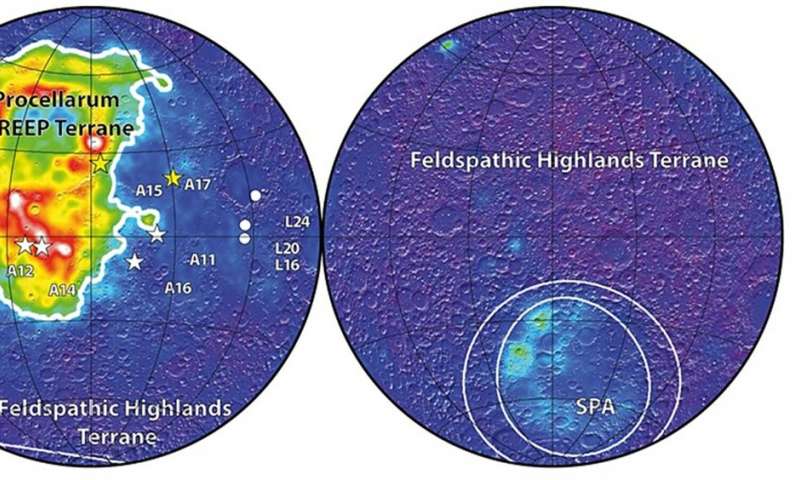
Near side/far side distribution of thorium on the lunar surface. Image credit: Phs.org.
It has been an enduring mystery why the side of the Moon facing the Earth is marked by large dark patches, called maria (or seas, as they once were thought to be) but the far side has very little. Thirty-one percent of the near side consists of maria, but the dark side has only one percent. The maria, which are vast plains of basalt, most likely were formed by volcanic activity early in the Moon’s history.
But why the disparity between the near side and the far side? Scientists think that a clue resides in the distinctive characteristics of the rock. Based on samples that Apollo astronauts brought home from the maria, scientists found that the rock had a unique signature, which they named KREEP — for the presence of potassium (chemical symbol K), rare-earth elements (which include cerium, dysprosium, erbium, europium and others), and phosphorous (chemical symbol P) — as well as uranium and thorium.
By melting KREEP rock in high-temperature experiments, scientists from Tokyo’s Earth‐Life Science Institute (ELSI), the University of Florida, the Carnegie Institution for Science, Towson University, NASA Johnson Space Center and the University of New Mexico think that radioactive decay of some of these elements released heat that could have influenced the timing and volume of volcanic activity.
According to Phys.Org, potassium, thorium and uranium are radioactively unstable elements. appearing in a wide variety of isotopes. When the atoms break down, they yield other elements and produce heat. The heat from this radioactive decay can melt the rocks they are contained in.
Says EKSI’s Matthieu Laneuville: “Because of the relative lack of erosion processes, the moon’s surface records geological events from the solar system’s early history. In particular, regions on the moon’s near side have concentrations of radioactive elements like U and Th unlike anywhere else on the moon. Understanding the origin of these local U and Th enrichments can help explain the early stages of the moon’s formation and, as a consequence, conditions on the early Earth.”
Space Perspective has announced plans to fly passengers and research payloads to the edge of space with its Spaceship Neptune. Flown by a pilot, Neptune will take up to eight passengers on a six-hour journey to 100,000 feet, above 99% of the Earth’s atmosphere, and back.
“We’re committed to fundamentally changing the way people have access to space – both to perform much-needed research to benefit life on Earth and to affect how we view and connect with our planet,” said Space Perspective Founder and Co-CEO Jane Poynter in a press release. “Today, it is more crucial than ever to see Earth as a planet, a spaceship for all humanity and our global biosphere.”
Aside from pitching itself as a rarefied tourist experience, Space Perspective is marketing itself to researchers, educators, and students from academic institutions. The first test flight is scheduled for 2021.
The company has signed a lease with Space Florida, the state’s spaceport development authority.
The principals behind the company, Jane and Taber designed the air, food and water systems for Biosphere 2, the most advanced prototype space base ever built.
Tunable diode laser used for natural gas analysis. Photo credit: Metler Toledo
Whether living in lunar habitats or space ships, human explorers and colonists face a common challenge: maintaining air quality in a confined space. On Earth gases emanating from respiration (carbon dioxide), combustion, or even everyday tasks such as cooking and brewing coffee are allowed to disperse into the atmosphere where they will be diluted. But habitats in space must maintain an early warning detection system to alert occupants before gases build to dangerous levels.
Spacecraft cabins gas sensors in operation on the Skylab and International Space Station use laser-based absorption spectroscopy. However, they are expensive, they’re sensitive, and they consumer a lot of power. The authors recommend the use of light-emitting diodes (LEDs), which feature lower power requirements and can be implemented in a broad range of sensors.
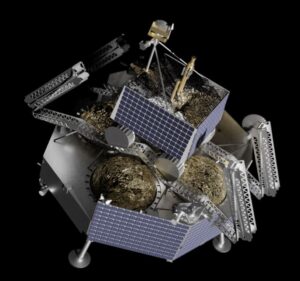
Griffin carrying VIPER during lunar transit. Image credit: Astrobotics
NASA has selected Astrobotic to deliver a water-hunting robot to the Moon’s surface in late 2023, the company has announced. The 13-year-old Pittsburgh company was awarded a $200 million fixed-price contract to build and test a lander spacecraft that can transport NASA’s 1,000-pound robotic rover, VIPER, to the Moon.
The Griffin lunar lander is Astrobotic’s medium capacity lander product line, and is capable of delivering up to 500 kg of mass to the lunar surface.
Said Astrobotic CEO John Thornton: “Astrobotic’s lunar logistics services were created to open a new era on the Moon. Delivering VIPER to look for water and setting the stage for the first human crew since Apollo embodies our mission as a company.”
Only three countries — the U.S., the former Soviet Union, and China — have developed vehicles capable of a soft landing on the Moon. NASA hasn’t sent such a mission with either humans or robots since the Apollo program. The plan is for VIPER to spend 100 days on the Moon searching for water ice.
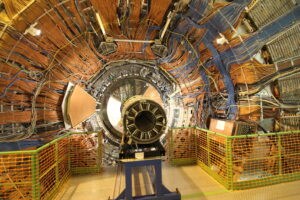
Particle accelerator at CERN in Geneva, Switzerland
High-energy physicists spend billions of dollars building sub-atomic particle colliders on Earth. Among other reasons the facilities are expensive is that they require vacuum conditions and frigid temperatures. As lunar colonization approaches, Nikolai Zaitsev at Cornell University has published a memo suggesting that the Moon might be the most promising location to build a new collider. The Moon may be remote and difficult to reach, but it has several advantages.
First, it’s very cold. Because the Moon has virtually no atmosphere, locations shaded from direct sunlight dip to minus 100 degrees Fahrenheit — in the range of typical cryogenic setups on Earth, summarizes Live Science. Cold temperatures are needed to ensure that the superconducting magnets that accelerate particles to near the speed of light don’t melt down.
Second, atmospheric vacuum comes for free. The Moon has a vacuum 10 times better than anything physicists have manufactured in their experiments, which reduces the number of stray molecules interfering with experiments.
Thirdly, summarizes Live Science, the Moon could serve as a platform for shooting high-energy neutrinos to the Earth and studying how they change “flavors” as they fly. The distance between the Moon and Earth gives them a greater distance to change form but is close enough that it would be possible to capture them in sufficient quantities to study. Similarly, a lunar facility could point particles to Earth for the study of cosmic ray research.
 Harkening back to the success of cubesats, small, standardized satellites, NASA will launch a small rover. Iris, that it hopes will also be inexpensive to produce.
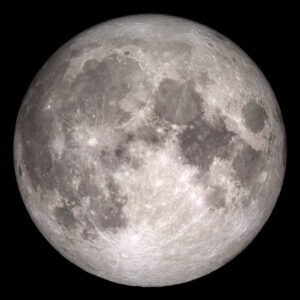 Using the Miniature Radio Frequency (Mini-RF) instrument on NASA’s Lunar Reconnaissance Orbiter spacecraft, mission members have found evidence that the Moon’s subsurface may be richer in minerals like iron and titanium than previously thought.