BBC’s Science Focus magazine provides an interesting spin on the primary challenges behind establishing a Moon base.
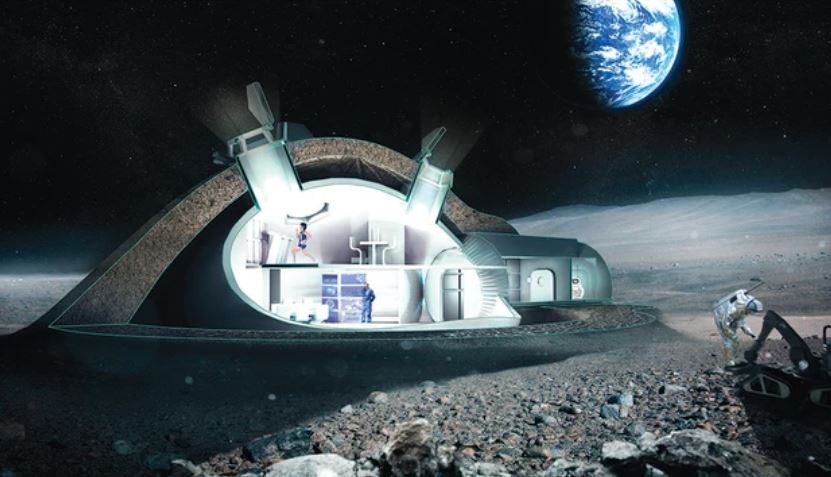
Where to locate. Given the high cost of getting material to the Moon — $10,000 per kilogram just to escape the Earth’s gravity well — the idea is to use materials on hand to the greatest extent possible. That explains the keen interest in settling in the poles where abundant water ice is sequestered in craters that never see the light of day. Another advantage of a polar location is the ability to install solar panels in mountain peaks that are exposed to the sun around the clock.
Building the base. Planners expect to make extensive use of 3D printing. Experiments on Earth with imitation regolith have shown that it is possible to build large structures with the technology. However, it remains to be seen how well the process will work in the Moon’s light gravitational field. more “How to Build a Moon Base”
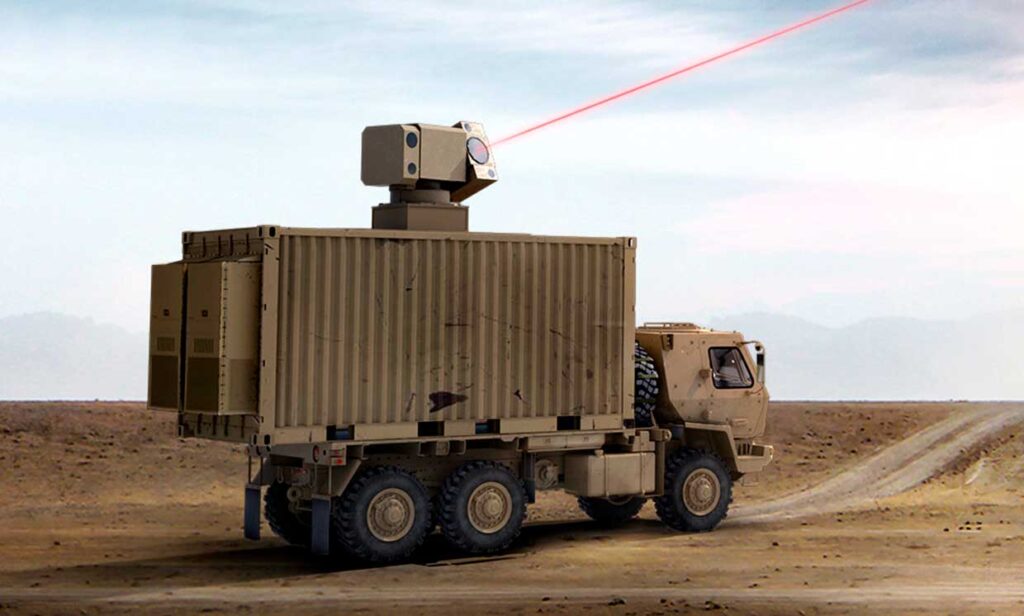
Artist’s conception of a laser weapon and beam director mounted on a truck. (Real lasers emit invisible infrared beams.) Image credit: General Atomics
The Pentagon began developing work on electrically powered solid-state laser weapons two decades ago. By 2013 the Navy was testing a 30-kilowatt fiber laser on a ship. Then focus shifted to fiber lasers in the 50- to 100-kilowatt class. Now aerospace giant Boeing has teamed with General Atomics to build lasers achieving the 250-kilowatt threshold needed to defend against nuclear missiles, reports IEEE Spectrum.
The design of high-energy solid-state lasers entails a tradeoff between size, weight and power, and the problem of dissipating heat. General Atomics had the idea of developing a liquid laser, considered crazy at the time, but DARPA funded it. Liquid lasers are similar to solid-state lasers but they use a cooling liquid that flows through channels integrated into the solid-state laser material. The trick was achieving a perfect match in the refractive index between the liquid and the solid material. more “Boeing, General Atomics to Advance Work on Liquid Lasers”
Recognizing the Moon dust could be one of the biggest problems facing lunar colonists, NASA’s Space Technology Mission Directorate is conducting research in the Mojave Desert to find ways to cope with the ubiquitous substance.
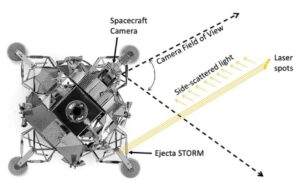
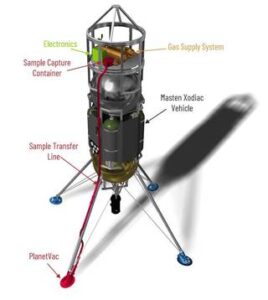
Measuring dust ejecta. One project involves a sensor for measuring the ejecta — gravel, small rocks, and lots of dust — that shoot out from the landing zone when a vehicle lands on the Moon. “This can cause widespread damage from sandblasting spacecraft surfaces and solar cells to actually striking and breaking optical sensors or other instruments, says Philip Metzger, a planetary physicist at the University of Central Florida.
“Having ejecta sensor data from actual lunar missions can help us improve those recommendations and will also help us protect the new spacecraft we’re sending to the Moon and even spacecraft orbiting around it – all of which is important not just to the U.S. but to the international space community as well,” Metzger said in a NASA publication. “And then we can develop physics equations that are truly predictive to inform mitigation strategies.”
Astronauts walking on the surface of the Moon will be exposed to radiation levels 200 times higher than that on Earth,
The first systematically documented measurements of radiation on the Moon were undertaken in January 2019 when China’s Chang’e 4 robotic spacecraft landed on the far side of the Moons, according to an article published in Science Advances. Different sources of lunar radiation include galactic cosmic rays, solar particle events, and neutrons and gamma rays from interactions between space radiation and the lunar soil.
“The radiation levels we measured on the Moon are about 200 times higher than on the surface of the Earth and 5 to 10 times higher than on a flight from New York to Frankfurt,” said Robert Wimmer-Schweingruber, a professor of physics at the University of Kiel in Germany and the corresponding author of the study. “Because astronauts would be exposed to these radiation levels longer than passengers or pilots on transatlantic flights, this is a considerable exposure.”
NASA scientists describe radiation as the “most menacing” of the five main hazards of human space flight, surpassing isolation and confinement, distance from Earth, lack of gravity, and hostile/closed environment.
Chronic exposure to galactic cosmic rays may induce cataracts, cancer or degenerative diseases of the central nervous systems or other organ systems, reports CNN in summarizing the article’s findings. Additionally, the study said, exposure to large solar-particle events without sufficient shielding may cause “severe acute effects.”
Astronauts living on the International Space Station for as long as a year reside within the Earth’s protective magnetic shield. They are exposed to ten times more radiation than what they would experience on Earth, but that’s a small dose compared to what astronauts would be subjected to on the surface of the Moon or in deep space.
As the United States military machine becomes increasingly dependent upon constellations of satellites for its command, control and communications, potential adversaries such as China and Russia have become experimenting with methods to destroy or disable the satellites. Now U.S. strategists are sounding the alarm about anti-satellite weapons, or ASATs, reports GeekWire.
“We built [the command and control satellites] as if we were in a benign domain.” said Lt. Gen. John Shaw, commander of the U.S. Space Force’s Space Operations Command. But it’s becoming increasingly clear that space is becoming “a contested domain.”
Adding complexity to the strategic thinking about space is a potential phenomenon sometimes referred to as the Kessler syndrome. Donald J. Kessler wrote in 1979 how the density of objects in Low EarthOrbit could get high enough that collisions between objects could cause a cascade — creating debris that struck other objects, thus creating more debris. The movie “Gravity” was based on a scenario in which the Russians shot down a defunct satellite, creating a cloud of debris moving at 20,000 to 50,000 miles per hour. Apparently, military thinkers give such a scenario credence.more “Satellite Constellations, the Kessler Effect, and Military Superiority”
An important duty assumed by the embryonic U.S. Space Force will be tracking objects in cislunar space (the area between the Earth and Moon). The Air Force Research Laboratory’s Space Vehicles Directorate is now investigating technologies to undertake the task, reports Space News.
“It’s a brave new world for the [Department of Defense] to embark on,” said Capt. David Buehler, manager of the AFRL experiment named CHPS, for Cislunar Highway Patrol System. Said he:
“If we’re going to protect and defend, the Space Force is going to need to understand the environment, have space domain awareness capabilities to be able to know where everything is out there.”
Tracking objects in cislunar space presents significant technical challenges. One is estimating the trajectory objects that are subject to the gravity of both Earth and the Moon. Said Buehler: “As you go further and further beyond GEO, you start to have these weird, non-closed trajectories, they no longer look like orbits, they’re more open-ended trajectories.”
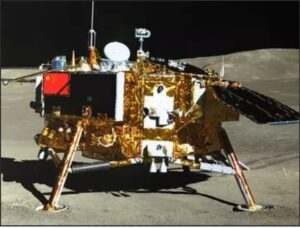
After the success of its Chang’e 4 lander on the far side of the Moon, China has laid out an ambitious roadmap for continued lunar exploration. Chang’e 6 is scheduled to head to the Moon in 2023 or 2024, and Chang’e 7 in 2024 with the aim of landing at the south pole.
Chang’e 7 will have multiple components, including an orbiter, a relay satellite, a lander, a rover, and a mini-flying craft. Scientific payloads will study volatile compounds and isotopes, and measure heat flow through the lunar soil, reports Space.com. The flying craft will carry instrumentation to measure water molecules in permanently shadowed areas.
Chang’e 8, scheduled for the late 2020s, also will focus on the south pole. That mission will test technology for using local resources and 3D-printing manufacturing.
I don’t know… Someone will to have to do better than this if space tourism is going to take off. I can safely say that the zero-G space toilet would dissuade 90% of the women of my acquaintance from ever leaving the Earth. — JAB
NASA has released its five-year, $28 billion budgetary plan to return four astronauts to the surface of the Moon by 2024 — for the first time in more than 50 years. The aggressive timeline hinges on Congress approving $3.2 billion to kick-start development of new lunar landers.
The plan unveiled Monday, reports Spaceflight Now, assumes that crews will lift off on NASA’s Space Launch System (SLS) heavy-lift rocket, fly to the Moon on an Orion capsule, then transfer on a commercially developed lander to shuttle astronauts to and from the lunar surface where they will maintain a base for exploration and scientific investigation.
The Artemis Plan calls for developing a base camp on the lunar South Pole, possibly in Shackleton Crater. Key infrastructure includes the Orion spacecraft to deliver humans to lunar orbit, the Gateway orbiting the Moon to function as a transfer-and-docking station for the lunar lander, and The Habitation and Logistics Outpost (HALO) on the surface of the Moon.
Key elements of the base camp include an unpressurized lunar terrain vehicle, a habitable pressurized rover, a habitation module, power systems, and systems to exploit in situ resources.
NASA also envisions using upgraded spacesuits designed for the lunar surface, allowing more frequent spacewalks, with new-and-improved safety features, custom fitting, simplified maintenance, and better communications. more “NASA Releases Artemis Program Overview”
The Defense Advanced Research Projects Agency (DARPA) has awarded a $14 million task order to Gryphon Technologies to support development of a rocket that can use nuclear thermal propulsion (NTP) in Earth orbit, reports Space.com.
The rocket would use fission reactors to heat propellants to extreme temperatures and eject the gas through nozzles to create thrust. The technology would have a thrust-to-weight ratio about 10,000 times higher than that of electric propulsion systems and a specific impulse, or propellant efficiency, two to five times that of traditional chemical rockets, DARPA documents say.
NASA has lauded the potential of NTP technology as well, suggesting that nuclear-powered spacecraft could reach Mars in three to four months, half the time needed by chemical rockets.
Gryphon Technologies, based in Washington, D.C., bills itself as providing engineering and technical solutions to national security organizations.
 “Having ejecta sensor data from actual lunar missions can help us improve those recommendations and will also help us protect the new spacecraft we’re sending to the Moon and even spacecraft orbiting around it – all of which is important not just to the U.S. but to the international space community as well,” Metzger said in a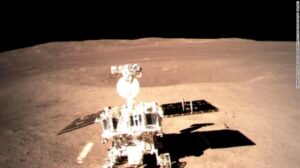

 An important duty assumed by the embryonic U.S. Space Force will be tracking objects in cislunar space (the area between the Earth and Moon). The Air Force Research Laboratory’s Space Vehicles Directorate is now investigating technologies to undertake the task, reports
  After the success of its Chang’e 4 lander on the far side of the Moon, China has laid out an ambitious roadmap for continued lunar exploration. Chang’e 6 is scheduled to head to the Moon in 2023 or 2024, and Chang’e 7 in 2024 with the aim of landing at the south pole.
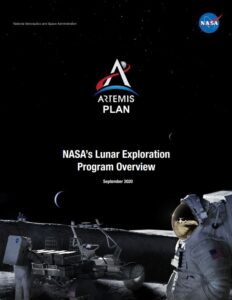 NASA has released its five-year, $28 billion budgetary plan to return four astronauts to the surface of the Moon by 2024 — for the first time in more than 50 years. The aggressive timeline hinges on Congress approving $3.2 billion to kick-start development of new lunar landers.