Skip to content

Luna 2076

The Geopolitics of Lunar Colonization

  • About
  • The Book
  • Essays
  • Online Resources
Luna 2076

Category: Uncategorized

Swineburne Team Grapples with Challenges of Working with Moon Materials

August 12, 2020
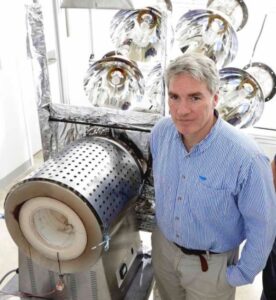
Geoff Brooks, head of the Swinburne University lunar habitation research team.

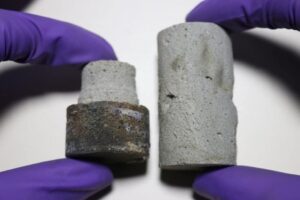
Geoff Brooks, a chemical engineer with Australia’s Swinburne University, has been giving considerable thought to the challenges of building structures under the extreme conditions of the Moon. Temperatures swing from -180° C to 120° as the Moon alternates between intense light and deep darkness. The surface is bombarded by solar and cosmic rays. Glass-like dust particles get everywhere. Even the chemical behavior of materials changes.

“If you think about the way bricks are made, a bit like pottery, imagine trying to make pottery on the moon, where the perfect vacuum changes the way materials heat up and the shape that they take,” Brooks tells Create, an Australian engineering publication. “These are the kinds of experiments we’re now building, to test not only how the materials will react on the moon but how we can work with those conditions to create a structure.”

Humans will need structures to shelter them from cosmic rays and moon dust. “We will need buildings with thick walls to protect space travelers,” he says. “However, on the moon we have only the rocks on the ground and the sun to work with. Everything else is difficult and expensive to get there.”

Other research priorities include finding ways to manage abrasive dust, and recycling space junk. 

Brooks heads a team of approximately 15 academics and PhD students encompassing disciplines such as mechanical engineering, mechatronics, product design, and physics.

Uncategorized

Italian Study Catalogs Lava Tubes on Earth, Moon and Mars

August 11, 2020
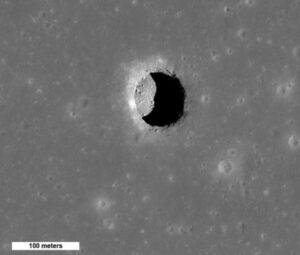
Potential lava tube entrance in Mare Tranquillitatus. Boulders can be seen on the floor of the 100-meter pit. Credit: NASA

Lava tubes are formed by lava flowing through a volcanic vent beneath a hardened surface. If the lava empties, it leaves behind a cave, typically in a long worm-like shape. These tubes have been spotted on Earth, on Mars and on the Moon. On Earth these structures range in diameter between 10 to 100 meters in diameter. Because there appears to be a strong correlation between gravity and tube-depth, Martian tubes are estimated to be 100 times wider, and lunar tubes 1,000 times wider.

In a new study, “Lava tubes on Earth, Moon and Mars: A review of their size and morphology revealed by comparative planetology,” a team of researchers from Italian universities has assembled a database of tubes and potential tubes. Typically, they leave long, sinuous channels that can be spotted on the surface. Sometimes, they leave cave openings.

“We measured the size and gathered the morphology of lunar and Martian collapse chains (collapsed lava tubes), using digital terrain models, which we obtained through satellite stereoscopic images and laser altimetry taken by interplanetary probes,” said Riccardo Pozzobon, as reported by Universe Today. “We then compared these data to topographic studies about similar collapse chains on the Earth’s surface and to laser scans of the inside of lava tubes in Lanzarote and the Galapagos. These data allowed us to establish a … relationship between collapse chains and subsurface cavities that are still intact.”

Many scientists have suggested that lava tubes on the Moon may make favorable spots for human habitation because they would be protected from cosmic and solar radiation and they would experience less temperature variability between long lunar days and nights. A major concern, however, is how stable the structures are. Many orbital photographs show collapsed tubes. The Italians believe they are most likely stable, thanks to low gravity on the Moon. Collapses are likely due to meteor impacts.

NASA is working on plans for robotic exploration of the tubes. The proposed “Moon Diver” mission would use a rover tethered to a lander to explore the tubes. Thelander would land near a skylight, then a tethered rover would climb its way down to the tube floor.

Uncategorized

Air Force Cadets Ponder the Future of the Military in Space

July 15, 2020
Image credit: Department of the Air Force

Nearly 90 of this year’s roughly 1,000 Air Force Academy graduates will become commissioned officers in the newly created Space Force. Some are  members of an academy group, the Institute for Applied Space Policy and Strategy (IASPS), which features weekly speakers and formal research projects. The group, according to Science, is dedicated to gaming out the policies and philosophies that could guide military space activity.

One big question cadets ask is if the Space Force might someday have a military presence on the Moon. Such a thought might conflict with the pacifist worldview of many scientists, who regard cislunar space as a place for commerce and scientific inquiry, but in a world driven by geopolitical competition, someone needs to be thinking about it. In an interview with Science, IASPS President J.P. Byrne, who will graduate in 2021, offered a number of insights in the realm of “astropolitics.”

How can the United States, he asks, best mitigate the problem of space debris through space situational awareness and space traffic management.

Will mining be realistic, and if so when?

Will deterrence in space reflect deterrence on Earth? If something happens to a satellite in space, does that warrant a space response or an Earth response?

Will it be necessary, or even possible, for the military to sustain a presence on the Moon?

“The group was really interested in finding out what future role Space Force might have on the military-on-the-Moon concept 20 years or so down the line,” says Byrne. “Intergovernmental agency cooperation is paramount to having some future lunar base. Maybe [in this scenario], Space Force would select astronaut candidates who would complete training through NASA.”


Uncategorized

NASA Seeks Small Business Solutions for Water Mining on Moon

July 14, 2020
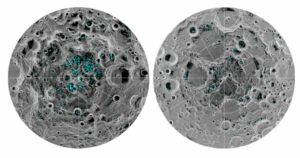
This NASA image shows distribution of surface ice at the Moon’s north south and north poles.

Looking for creative approaches to tap lunar resources to meet the needs of astronauts on the Moon, NASA has reached out to small businesses and nonprofit research institutes for ideas. Working through its small business programs, the agency has winnowed down 409 proposals for Phase 1 development.

Consistent with NASA’s goals for Project Artemis, the proposals are focused on extraction and processing of water ice from lunar regolith to create oxygen, drinking water and rocket fuel, according to Universe Today.

Projects to receive funding under the Small Business Innovation Research Program include: more “NASA Seeks Small Business Solutions for Water Mining on Moon”

Lunar Resources, Uncategorized

Lunapolitics — the Geopolitics of Cislunar Space

July 10, 2020
An artist’s concept of Canadarm3, Canada’s smart robotic system in orbit around the Moon. (Credits: Canadian Space Agency, NASA)

John B. Sheldon has coined the term “lunapolitics” to describe the extension of geopolitics, or the competition between national powers, into cislunar space. The U.S., China and other powers aspire to establishing a permanent human presence on the Moon to exploit lunar resources for economic benefit. Lunapolitics, he writes, will keep diplomats, executives, and strategists busy for decades to come.

In a SpaceNews.com op-ed, Sheldon offers 10 principles to to consider as Earth leaders create the political and economic framework for mankind’s future on the Moon.

  1. Political and economic competition for the Moon is a positive. But competition needs rules of the road undergirded by widely accepted space law. “The alternative risks a zero-sum, overtly militarized scramble for the Moon that benefits no one over the long term. lunapolitics is essentially the management of this competition.”
  2. Currently, the United States is the prime mover of lunapolitics. America is the only space power today capable of mustering the technology, financial resources and diplomatic will to establish the foundation for a lunapolitical framework. But it will be isolated if it disregards the interests of China, Russia, Europe, and other space-faring powers.
  3. Lunapolitical power is predicated on geopolitical power. The conditions favoring countries to become space powers include space launch facilities that provide routine access to cislunar space, an educated workforce, a vibrant and developed business climate, and an advanced industrial/technological base. The United States and China likely will be the leading lunapolitical powers.
  4. Lunapolitics have an economic dimension. A lunaeconomic agenda will require a deep understanding of the evolving political economy and business dynamics on the Moon. Narrow business interests should not dictate the strategic interests of lunar powers.
  5. Freedom of passage is a core principle for a lunar economy. A lunapolitical architecture should ensure freedom of passage and navigation between the Earth and the Moon for any country or company capable of doing so.
  6. Protect the lunar environment. Humanity’s poor environmental legacy on Earth should not be replicated on the Moon, the Solar System, or beyond.
  7. Lunapolitical alliances will constantly evolve. Lunapolitical alliances will be transient, shifting with political and economic interests. A durable lunapolitical architecture should be able to withstand shifting interests and alliances.
  8. Avoid excessive militarization of space. A lunapolitical architecture should advance a predominantly civil and economic agenda. Overt militarization by any country will undermine legitimacy and provoke adverse international reaction. The proper role of the military should be to ensure freedom of passage and navigation, search and rescue, and enforcing internationally accepted standards of conduct.
  9. Lunapolitics is normal; lunapolitik is not. Unbounded, rapacious, zero-sum and overtly militarized “lunapolitik” is antithetical to other goals.
  10. Lunapoalitics is a long game, not an election-cycle issue. Lunapolitics requires long-term, strategic thinking based on prudence and enlightened self-interest.

“The future is shapeable,” concludes Sheldon, “and it is our collective choice whether lunapolitics opens up new economic opportunities and scientific possibilities, or whether our future in space ends before it could even begin.”

Sheldon’s website can be found at lunapolitics.com.

Geopolitics, Uncategorized

Protecting the Moon from Earth Germs

July 9, 2020

NASA has published new directives to protect the Moon and Mars from contamination by Earth germs carried by human voyagers. The purpose is to protect the planetary bodies from biological contamination from Earth — and to protect Earth from organisms originating on Mars.
“We’re trying to balance the interests of the science community, the interest of the human exploration community and the interest of the commercial community,” NASA Administrator Jim Bridenstine announced during a “Moon Dialogs” webinar. NASA’s Office of Planetary Protection, housed within the Office of Safety and Mission Assurance, is tasked with ensuring will that the directives are complied with.

Bridenstine said it is important the future missions leave behind a “pristine environment” so humans know that what they discover in the future was not left there by other humans, as reported by Space.com. “We have to make sure that we are inventorying every kind of biological substance and even nonbiological substance — organics for example — that could leave something behind on the moon that could be problematic for future research.” more “Protecting the Moon from Earth Germs”

Uncategorized

Solar Shock Waves Can Affect Shape of Earth’s Magnetosphere

July 3, 2020
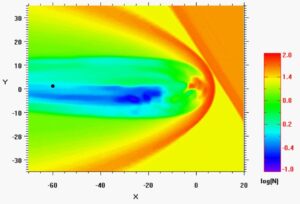
This image from a simulation by Q.Q. Shi, Shandong University, shows how the Earth’s magnetosphere has a long tail under the pressure of solar wind just before a radiative shock wave (the orange mass at right) approaches at 1.7 million miles per hour.

The Earth’s magnetosphere protects the plant from bursts of solar wind — high-speed particles emanating from the sun — and the Moon as well, at least during the 25% of the time when the Earth stands between it and the sun. However, NASA scientists have discovered that solar wind can cause the tail of Earth’s protective magnetic bubble to flap like a windsock in a high breeze, pulling the tail so far out of line that the Moon loses its shelter.

The finding is significant because solar radiation may be the greatest hazard facing explorers and settlers on the Moon, and their equipment, making the ability to predict bursts of radiation a critical necessity.

Summarizing new research in the Journal of Geophysical Research: Space Physics, NASA’s Goddard Space Flight writes in SciTechDaily says that the findings came from compiling data measured by spacecraft at multiple locations in cislunar space and on the Moon. States the article: more “Solar Shock Waves Can Affect Shape of Earth’s Magnetosphere”

Uncategorized

Shoebox-Sized Rovers Heading to the Moon

July 2, 2020

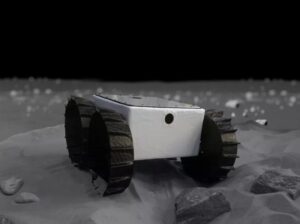
Harkening back to the success of cubesats, small, standardized satellites, NASA will launch a small rover. Iris, that it hopes will also be inexpensive to produce.

NASA, Astrobotic, and Carnegie Mellon University are teaming up in the CubeRover project, which targets a 2021 launch date in a private delivery run paralleling the agency’s Artemis program to return to the Moon by 2024.

Iris is about the size of a shoebox, reports Space.com, and weighs less than 5 lbs. (2.3 kilograms). It travels on four wheels.

If all goes well, the rover will drive about 160 feet (49 meters), approximately the width of a football field, a journey that should tell engineers more about how best to travel over the moon’s dusty surface. The drive will take the rover far enough away from its landing site to study how the landing itself alters the surface of the moon.

Iris will support other science and technology payloads on the surface with power, portability and communications.

Uncategorized

Moon’s Magma Ocean May Have Lasted 200 Million Years

July 1, 2020
In this simulation of the Moon’s interior, the yellow represents the global magma ocean. A crust (grey) has formed over top. Convection zones can be seen within the mantle, and a solid core (white) sits at the middle. IMage credit: DLR / M. Maurice

According to the latest estimates by a team of researchers with the Technische Universität Berlin, it might have taken ten times longer than previously thought for the early Moon to transform from a ball of super-heated magma into its current form.

The oldest rock found on the Moon, brought to Earth by the Apollo 14 mission, has been dated to 4.51 billion years old, comparing to the estimated 4.54 billion years estimated for the age of the Earth. But minerals can go back only as far as the moment when those minerals formed. To date the Moon, scientists need to know how much time elapsed until the magma ocean solidified, explains Sky & Telescope.

Maxime Maurice and his colleagues at the German university have developed a new thermal evolution model — a detailed computer simulation — to reconstruct the first 200 million years of lunar evolution. Their studies identified two previously underappreciated dynamics: the insulating effect of the primordial lunar crust, and mantle convection that probably started even before the magma ocean completely solidified.

It has been long known that the early Moon formed a crust made of a light mineral called pagioclase, which floated atop the magma ocean. That crust turned out to be an excellent insulator. While previous studies had accounted for that effect, Maxime concluded the insulating effect had been under-estimated.

The other factor was mantle convection. Summarizes Sky & Telescope:

The lunar magma ocean solidified from the bottom up because high pressure at depth forced the magma to solidify even at high temperatures. This process likely solidified 80% of the magma ocean within 1,000 years of the Moon’s formation. If mantle convection started at this point, it could have allowed heat to continue flowing from the depths toward the surface, keeping the magma ocean hot and molten.

On Earth, mantle convection creates the magma that feeds volcanoes. “In this case, it would be exactly the same, but the volcanoes would have spilled their lava into the magma ocean,” Maurice explains.

Until now, van Westrenen says, most lunar evolution scenarios assumed that mantle rocks didn’t start moving until the magma ocean had completely solidified.

According to van Westrenen, the combination of these two processes makes a huge difference for the longer-term survival of the magma ocean.

A slowly crystallizing magma ocean could require a reinterpretation of mineral isotope dating of many lunar samples, and thus for the aging of the Moon-forming impact. The bottom line, the Moon may be 100 million years younger than commonly postulated.

Uncategorized

A Space Loo for Astronaut Poo

June 26, 2020
Photo credit: NASA

NASA is offering $35,000 in prizes for anyone who can design a toilet that can be used on the Moon. The specs are demanding, reports CNN Business.

The toilet must be functional in the microgravity of space and the 1/6G of the Moon.

It must accommodate men and women.

It should should conserve water, a scarce and valuable resource, and “help maintain a pristine environment inside the lander that is free of odors and other contaminants,”

The toilet should be easy to clean and maintain.

Serving a crew of two astronauts for 14 days, the toilet should allow for a turnaround time of five minutes or less between uses. more “A Space Loo for Astronaut Poo”

Uncategorized

Posts pagination

Prev 1 2 3 4 … 6 Next

Dust Mites: A Second American Revolution

The year: 2075. The American colonies on the Moon are getting restless.

Now available for sale in paperback or Kindle at Amazon.com

Recent Posts

  • How to Blockade the Moon Without Really Trying May 6, 2026
  • Second Edition May 5, 2026
  • An Exclusive Interview with the Author of “Dust Mites” June 9, 2022
  • The Most Fuel-Efficient Route to the Moon May Not Be a Straight Line May 26, 2022
  • Data Centers in Lava Tubes — an Economic Driver for the Moon? May 26, 2022

Categories

Archives

Idealist by NewMediaThemes