Skip to content

Luna 2076

The Geopolitics of Lunar Colonization

  • About
  • The Book
  • Essays
  • Online Resources
Luna 2076

Category: Uncategorized

Thorium, KREEP and Lunar Volcanism

June 22, 2020
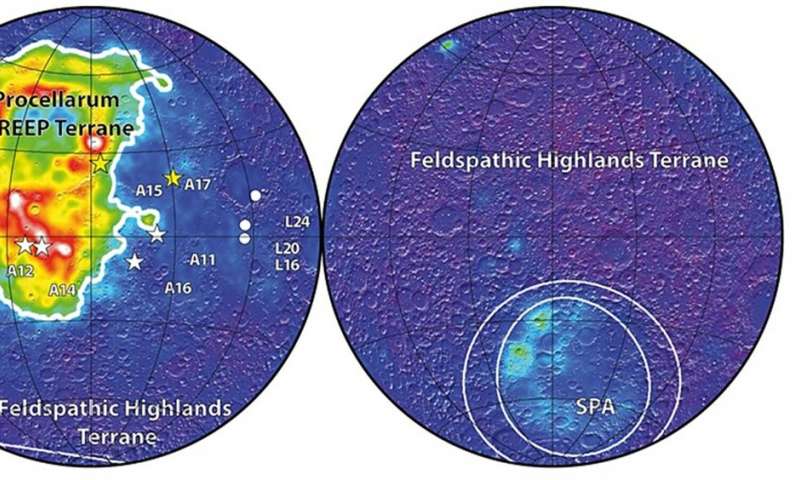
Near side/far side distribution of thorium on the lunar surface. Image credit: Phs.org.

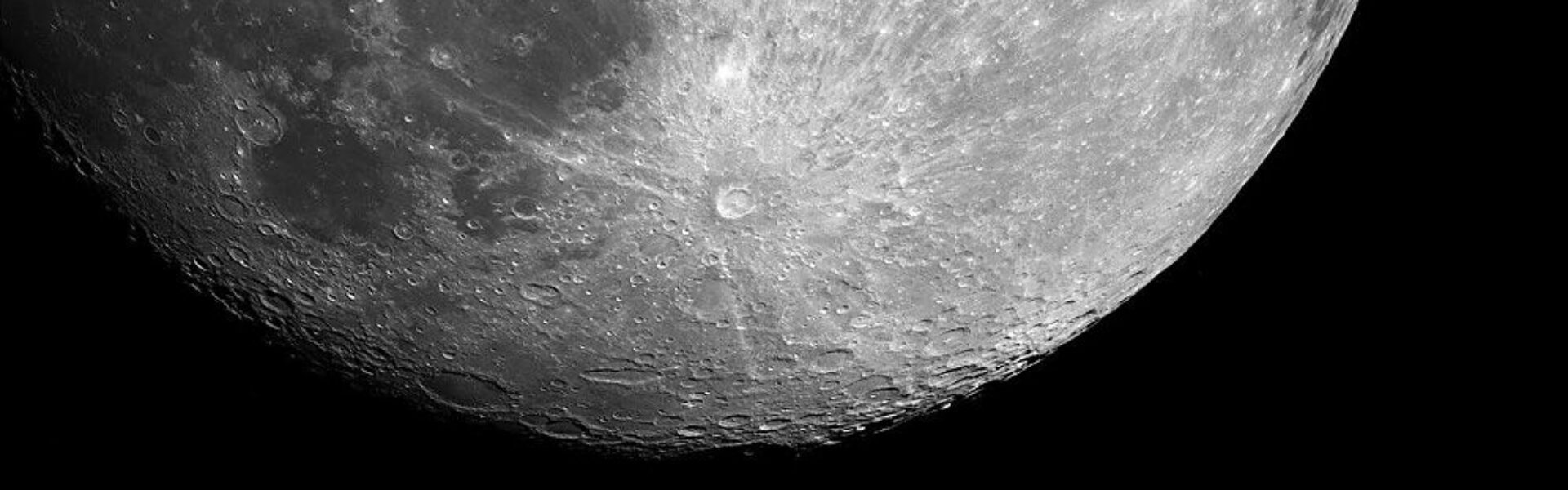
It has been an enduring mystery why the side of the Moon facing the Earth is marked by large dark patches, called maria (or seas, as they once were thought to be) but the far side has very little. Thirty-one percent of the near side consists of maria, but the dark side has only one percent. The maria, which are vast plains of basalt, most likely were formed by volcanic activity early in the Moon’s history.

But why the disparity between the near side and the far side? Scientists think that a clue resides in the distinctive characteristics of the rock. Based on samples that Apollo astronauts brought home from the maria, scientists found that the rock had a unique signature, which they named KREEP — for the presence of potassium (chemical symbol K), rare-earth elements (which include cerium, dysprosium, erbium, europium and others), and phosphorous (chemical symbol P) — as well as uranium and thorium.

By melting KREEP rock in high-temperature experiments, scientists from Tokyo’s Earth‐Life Science Institute (ELSI), the University of Florida, the Carnegie Institution for Science, Towson University, NASA Johnson Space Center and the University of New Mexico think that radioactive decay of some of these elements released heat that could have influenced the timing and volume of volcanic activity.

According to Phys.Org, potassium, thorium and uranium are radioactively unstable elements. appearing in a wide variety of isotopes. When the atoms break down, they yield other elements and produce heat. The heat from this radioactive decay can melt the rocks they are contained in.

Says EKSI’s Matthieu Laneuville: “Because of the relative lack of erosion processes, the moon’s surface records geological events from the solar system’s early history. In particular, regions on the moon’s near side have concentrations of radioactive elements like U and Th unlike anywhere else on the moon. Understanding the origin of these local U and Th enrichments can help explain the early stages of the moon’s formation and, as a consequence, conditions on the early Earth.”

Uncategorized

Using LEDs as Gas Detectors in Confined Habitats

June 12, 2020
Tunable diode laser used for natural gas analysis. Photo credit: Metler Toledo

Whether living in lunar habitats or space ships, human explorers and colonists face a common challenge: maintaining air quality in a confined space. On Earth gases emanating from respiration (carbon dioxide), combustion, or even everyday tasks such as cooking and brewing coffee are allowed to disperse into the atmosphere where they will be diluted. But habitats in space must maintain an early warning detection system to alert occupants before gases build to dangerous levels.

Existing residential and commercial fire detectors are useless, say the authors of a paper in New Space, “Multispecies Single Light-Emitting Diode Mid-Infrared Gas Sensor for Space Habitats and Vehicles.”

Spacecraft cabins gas sensors in operation on the Skylab and International Space Station use laser-based absorption spectroscopy. However, they are expensive, they’re sensitive, and they consumer a lot of power. The authors recommend the use of light-emitting diodes (LEDs), which feature lower power requirements and can be implemented in a broad range of sensors.

Uncategorized

Astrobotic to Deliver VIPER to Lunar Surface

June 11, 2020
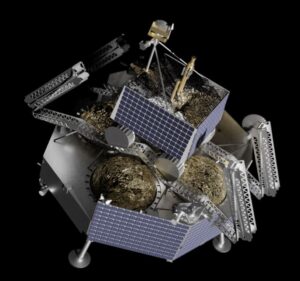
Griffin carrying VIPER during lunar transit. Image credit: Astrobotics

NASA has selected Astrobotic to deliver a water-hunting robot to the Moon’s surface in late 2023, the company has announced. The 13-year-old Pittsburgh company was awarded a $200 million fixed-price contract to build and test a lander spacecraft that can transport NASA’s 1,000-pound robotic rover, VIPER, to the Moon.

The Griffin lunar lander is Astrobotic’s medium capacity lander product line, and is capable of delivering up to 500 kg of mass to the lunar surface.

Said Astrobotic CEO John Thornton: “Astrobotic’s lunar logistics services were created to open a new era on the Moon. Delivering VIPER to look for water and setting the stage for the first human crew since Apollo embodies our mission as a company.”

Only three countries — the U.S., the former Soviet Union, and China — have developed vehicles capable of a soft landing on the Moon.  NASA hasn’t sent such a mission with either humans or robots since the Apollo program. The plan is for VIPER to spend 100 days on the Moon searching for water ice.

Uncategorized

Baddeleyite from Moon Rock Yields Clues to Early Moon

May 11, 2020
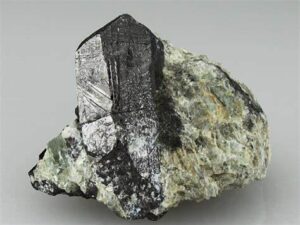
An earth sample of baddeleyite. Photo credit: crystalclassics.co.uk.

The formation of ancient rocks on the Moon may be directly linked to large-scale meteorite impacts, concludes a group of international scientists led by the Royal Ontario Museum after research a unique rock collected by NASA astronauts during the 1972 Apollo 17 mission to the Moon. The rock contains mineralogical evidence that it formed at incredibly high temperatures, in excess of 2300 °C/ 4300 °F, that could have been achieved by the melting of the outer layer of a planet in a large-impact event, reports Science Daily.

Researchers discovered in the rock the presence of a mineral known as baddeleyite, a stable phase arising from cubic zirconia, commonly used on earth as a substitute for diamonds in jewelry, which could have been formed only in rocks heated to above 2300 °C. While examining the structure of the crystal, the researchers measured the age of the grain, which reveals the baddeleyite formed over 4.3 billion years ago. Given that the high-temperature cubic zirconia phase must have formed before this then, they concluded that large impacts were critically important to forming new rocks on the early Moon.

“Rocks on Earth are constantly being recycled, but the Moon doesn’t exhibit plate tectonics or volcanism, allowing older rocks to be preserved,” explains Dr. Lee White, Hatch Postdoctoral Fellow at the Museum. “By studying the Moon, we can better understand the earliest history of our planet. If large, super-heated impacts were creating rocks on the Moon, the same process was probably happening here on Earth.”

Adds Dr. James Darling, a reader at the University of Portsmouth and co-author of the study. “These unimaginably violent meteorite impacts helped to build the lunar crust, not only destroy it.”

Uncategorized

Recycling Pee into Lunar Building Materials

March 30, 2020
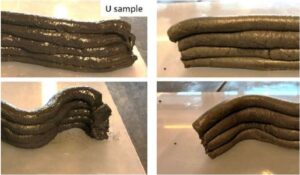
Ewwww…. experimental urea-based construction material

European researchers have found that the urea in human urine can be used as a “plasticizer” to combine with lunar regolith to make building materials.

The cost of transporting building materials to the Moon is so expensive — roughly $10,000 per pound — that scientists are looking for ways to utilize materials readily available on the Moon. Dutch, Norwegian, Spanish and Italian researchers theorized that urea could be incorporated into concrete to soften the initial mixture and make it more liable before it hardens, reports Phys.org.

“To make geopolymer concrete that will be used on the moon, the idea is to use what is already there: regolith (loose material from the moon’s surface) and the water from the ice present in some areas,” explains one of the authors, Ramón Pamies, a professor at the Polytechnic University of Cartagena (Murcia). “But moreover, with this study, we have seen that a waste product, such as the urine of the personnel who occupy the moon bases, could also be used. The two main components of urine are water and urea, a molecule that allows the hydrogen bonds to be broken and, therefore, reduces the viscosities of many aqueous mixtures.”

Using material similar to regolith mixed with urea, researchers have manufactured concrete cylinders using a 3-D printer. The urea mixture supported heavy weights and remained almost stable in shape. Resistance was tested at a temperature of 80°C, and was found to increase even after eight freeze-thaw cycles like those on the Moon.

Next step: figuring out how to extract the urea from the urine.

Uncategorized

Fungi as Building Material for Lunar Habitats

March 7, 2020

The humble fungus has remarkable properties that researchers at NASA’s Ames Research facility think could make it a useful material for building human habitats on the Moon and Mars. The mycelium — the branching, thread-like part of a fungus — has a higher bend strength than reinforced concrete and a higher compression strength than lumber. It acts as a fire retardant, and it is capable of growing and repairing itself.

“Right now, traditional habitat designs for Mars are like a turtle — carrying our homes with us on our backs – a reliable plan, but with huge energy costs,” principal investigator Lynn Rothschild tells SciTechDaily. “Instead, we can harness mycelia to grow these habitats ourselves when we get there.”

Researchers envision human explorers taking along a compact habitat built of a lightweight materials supplemented with dormant fungi. Upon arrival, they would unfold the structure and add water, and the fungi would grow around the framework into a functional human habitat. Writes SciTechDaily:

Just like the astronauts, fungal mycelia is a lifeform that has to eat and breathe. That’s where something called cyanobacteria comes in – a kind of bacterium that can use energy from the Sun to convert water and carbon dioxide into oxygen and fungus food.

These pieces come together in an elegant habitat concept with a three-layered dome. The outer-most layer is made up of frozen water ice, perhaps tapped from the resources on the Moon or Mars. That water serves as a protection from radiation and trickles down to the second layer – the cyanobacteria. This layer can take that water and photosynthesize using the outside light that shines through the icy layer to produce oxygen for astronauts and nutrients for the final layer of mycelia.

That last layer of mycelia is what organically grows into a sturdy home, first activated to grow in a contained environment and then baked to kill the lifeforms – providing structural integrity and ensuring no life contaminates Mars and any microbial life that’s already there. Even if some mycelia somehow escaped, they will be genetically altered to be incapable of surviving outside the habitat.

The Ames team also imagines mycelia being used for water filtration and biomining systems that extract minerals from wastewater.

Uncategorized

It Takes a Tough Tire to Drive on the Moon

February 19, 2020
But can it burn rubber?

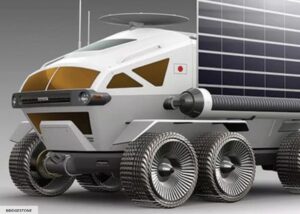
Vehicle maintenance on the lunar surface will be a significant challenge for explorers and colonists. Lunar regolith, a mix of dust, rock and debris, is superfine, ultra-abrasive, and can lodge itself in the tiniest crevasses. Not only that, but it carries an electrostatic charge. Bridgestone, the Japanese tire company, is looking ahead… far ahead… at the market opportunities. The company is working with the Japan Aerospace Exploration Agency (JAXA) to develop a specialized rover, reports Popular Mechanics.

JAXA’s rover will shuttle up to four astronauts and could log as many as 6,000 miles on the lunar surface, compared to 22 miles reached by the Apollo-era rovers.

The Apollo rovers were coated in a mesh of zinc-coated piano wire and wrapped in titanium treads. Bridgestone has revealed a wheel design consisting of two lobes of braided steel woven together — inspired by the toes of a camel.

“It’s biomimicry,” Bridgestone America’s chief technology officer, Nizar Trigui, told Popular Science. “The pattern helps the tire carry the load without penetrating too deeply into the sand.”

The new tire design is being tested under simulated lunar conditions with crushed lava rock and broken glass.

Uncategorized Lunar vehicles

The Moon Once Had Stronger Magnetic Field than Earth

January 3, 2020

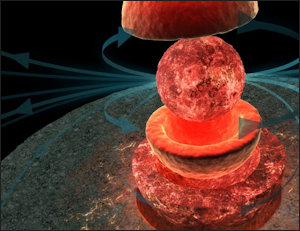
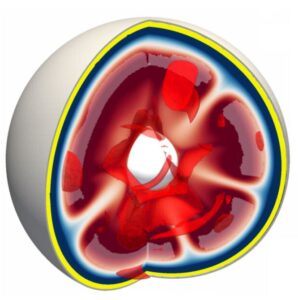
Once upon a time the Moon had a magnetic field, and it was likely stronger than Earth’s is today. That field, generated by a powerful dynamo in the Moon’s core, petered out about one billion years ago.

The latest theory, propagated by MIT scientists in the journal Science Advances, suggests that crystallization of the Moon’s inner iron core stirred the electrically charged fluid and produced the dynamo.

“The magnetic field is this nebulous thing that pervades space, like an invisible force field,” says Benjamin Weiss, professor of earth, atmospheric, and planetary sciences at MIT. “We’ve shown that the dynamo that produced the moon’s magnetic field died somewhere between 1.5 and 1 billion years ago, and seems to have been powered in an Earth-like way.”

Most studies of lunar magnetism have been based on rock samples from the Apollo missions; most of the ancient rocks are estimated to be thee to four billion years old. When they were spewed out as lava, their microscopic grains aligned in the direction of the Moon’s magnetic field. Lunar rocks whose magnetic histories began less than three billion years ago do not show such alignment, which suggests that lunar vulcanism had largely ceased by that time.

The MIT scientists theorize that the early Moon was much closer to the Earth than it is today, and much more susceptible to its gravitational effects. In a phenomenon known as “precession,” the solid outer shell of the cooling Moon wobbled in response to the Earth’s gravity. The wobbling stirred up the fluid in the core, the way swishing a cup of coffee stirs up the liquid inside, explains MIT News.

As the moon moved slowly away from the Earth, the precession effect decreased, weakening the dynamo and the magnetic field. About 2.5 billion years ago, core crystallization became the dominant mechanism by which the lunar dynamo continued, producing a weaker magnetic field that continued to dissipate as the moon’s core eventually fully crystallized.

Uncategorized

Indians Will Give Moonshot Another Try

January 1, 2020
Chandrayaan-2 module. Image credit: ESRO

Despite the demise of the Chandrayaan-2 spacecraft in a crash landing on the Moon, the Indian Space research Organization will attempt another soft landing in the near future. The third lunar mission, Chandrayaan-3, could launch by the end of this year, although 2021 is a possibility, reports C/Net.

The Chandrayaan-3 mission will be much cheaper, about 6.15 billion rupees ($86.2 million) compared to 9.6 billion rupees for its ill-fated predecessor. The new mission, which include a rover and lander, will aim for the same spot on the south pole where vast water deposits are believed to exist.

Chandrayaan-2 was launched July 22, 2019, and consisted of three components: a lunar orbiter, a lunar lander and a rover. Though the lander and rover were lost during the crash landing, says C/Net, the orbiter still orbits the moon and is expected to continue surveying for seven years.

Uncategorized

Early Moon Had More Water than We Thought

December 24, 2019
Early Moon. Image credit: Ars Technica.

The early Moon likely contained significant volumes of water mixed into its global ocean of molten rock, theorize scientists from VU Amsterdam.

According to the conventional view, the Moon was formed by a collision of a small planetary-sized body with the young Earth that created a swirling mass of debris from which the Earth and the Moon condensed. In a process parallel to Earth’s, the Moon started as a mass of molten rock that slowly cooled over the ages. As it cooled, different minerals solidified at different temperatures and depths.

The Dutch scientists  began asking how various mineral mixes behaved under extreme temperatures and pressures. Their models indicate that the Moon must have started with water mixed with the magma. Explains Ars Technica:

“How do you model an entire ocean of molten rock? You start with the known composition of the Moon and use that to create a mix of the appropriate minerals. Then you expose those minerals to extreme pressures and temperatures well beyond the melting point of rock. For these experiments, the temperatures ranged up to 1,550 degrees Celsius. Since the magma ocean was potentially hundreds of kilometers deep (current estimates range from 400 to 1,000 kilometers), pressures ranged up to 3 GigaPascals, which is nearly 30,000 atmospheres.” more “Early Moon Had More Water than We Thought”

Uncategorized

Posts pagination

Prev 1 … 3 4 5 6 Next

Dust Mites: A Second American Revolution

The year: 2075. The American colonies on the Moon are getting restless.

Now available for sale in paperback or Kindle at Amazon.com

Recent Posts

  • How to Blockade the Moon Without Really Trying May 6, 2026
  • Second Edition May 5, 2026
  • An Exclusive Interview with the Author of “Dust Mites” June 9, 2022
  • The Most Fuel-Efficient Route to the Moon May Not Be a Straight Line May 26, 2022
  • Data Centers in Lava Tubes — an Economic Driver for the Moon? May 26, 2022

Categories

Archives

Idealist by NewMediaThemes