Skip to content

Luna 2076

The Geopolitics of Lunar Colonization

  • About
  • The Book
  • Essays
  • Online Resources
Luna 2076

Category: Uncategorized

Video Overview of NASA’s Artemis Project in Five Short Minutes

December 21, 2019

It’s encouraging to see how far NASA has come in its thinking.

My only gripe: NASA still sees planting an outpost on the Moon primarily as a stepping stone to Mars rather than the first stage in full-scale lunar colonization as an adjunct to exploiting cislunar space. Mars may have scientific value, but it has no strategic value. The Moon offers both.

Uncategorized Artemis

NASA SLS Rockets Could Cost $800 Million to $1.6 Billion a Pop

December 13, 2019

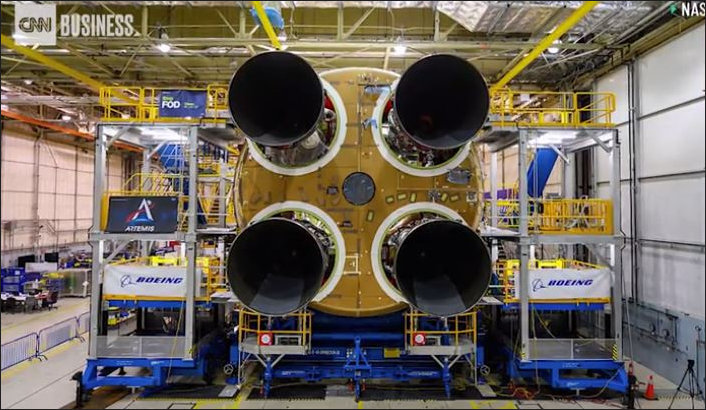
The Space Launch System (SLS) will be the most powerful rocket NASA has ever built. When completed, it will be able to take astronauts to the Moon and beyond. Indeed, according to NASA Administrator Jim Bridenstine, it will be the only rocket “qualified” to take astronauts to the Moon.

NASA is under contract with Boeing to build two SLS rockets with the goal of putting astronauts back on the Moon by 2024: specifically, landing the next man and woman on the south pole of the Moon, after which it will need a third rocket, and perhaps more.

CNN Business asked a pertinent question: How much will the rockets cost?

Said Bridenstine:

When we think about the cost of an SLS rocket per launch, it really, quite frankly, depends upon how many we buy in a certain package. If you buy one SLS rocket, it’s going to be very expensive. I’d say on the order of $1.6 billion. If we buy multiple SLS rockets, say as many as ten, or twelve, it can get down under a billion dollars, $800 million per copy. But, look, these are all estimates at this point. NASA needs to sit down with its prime contractor Boeing to negotiate the best solution to the right mix to the number of rockets and the cost per rocket.

Bridenstine added that he would like to have a cadre of astronauts dedicated to the Artemis project. “I want the astronauts that we send to the Moon this time to be like the Mercury Seven where the astronauts have names and faces and backgrounds and histories and personalities.”

According to Science Alert, the SLS is the tallest rocket stage NASA has built since the Saturn V stages for the Apollo missions. It is also the most powerful, designed to reach a speed of Mach 23 before separating from its upper stage, the Orion crew capsule.

The project has suffered by delays and cost overruns. The first flight was scheduled for November 2018, and the price tag has risen from $6.2 billion to $8 billion. NASA has spent roughly $34 billion on the SLS, Orion, and the Exploration Ground Systems Program through 2018, a sum that is projected to increase to more than $50 billion by 2024.
Uncategorized

Air Force Solicits Proposals to Advance Operations into Cislunar Space

December 12, 2019
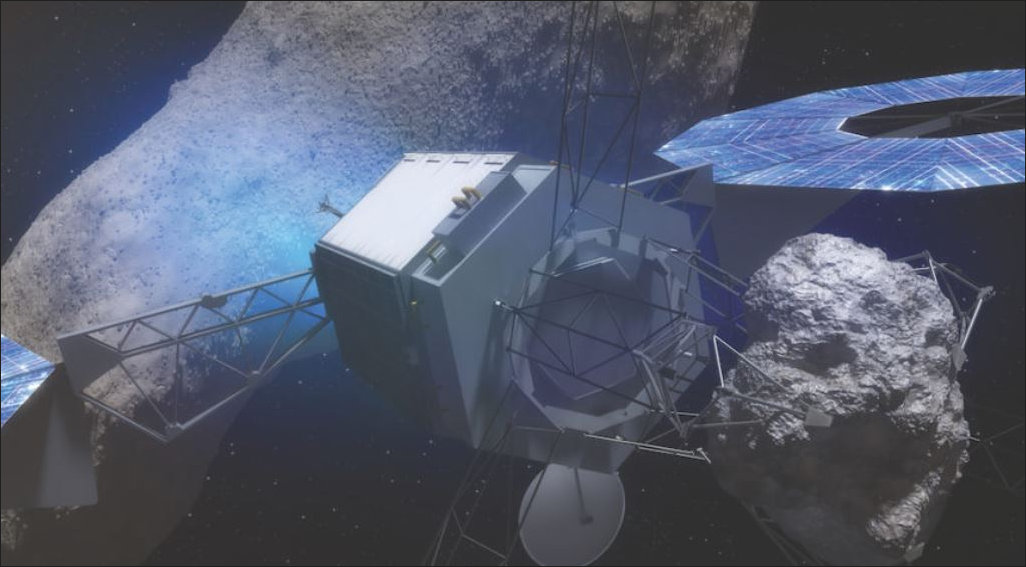
Artist’s rendering of solar electric propulsion for moving an asteroid to cislunar orbit.

The Air Force Small Business Innovation Research program is soliciting proposals so support operations beyond geosynchronous Earth orbit. Cislunar operations is one of three space-focus areas in a pre-solicitation notice released Dec. 10 by the Air Force technology accelerator known as AFWERX.

Space News reports that the Air Force wants: payloads for providing space domain awareness from the lunar surface, lightweight sensors for space-based space domain awareness; methodologies for orbit determination and catalog maintenance in cislunar space; concepts for providing position, navigatiion and timing solutions for cislunar space operations; visualization of cislulnar orbits; and terrestrial-based concepts for achieving space domain awareness of cislunar space.

The Air Force also is seeking technologies to improve the performance of small satellites, which can be manufactured and launched quickly. Space News elaborates: more “Air Force Solicits Proposals to Advance Operations into Cislunar Space”

Uncategorized Satellites

Blue Origin Unveils Lunar Lander

December 10, 2019

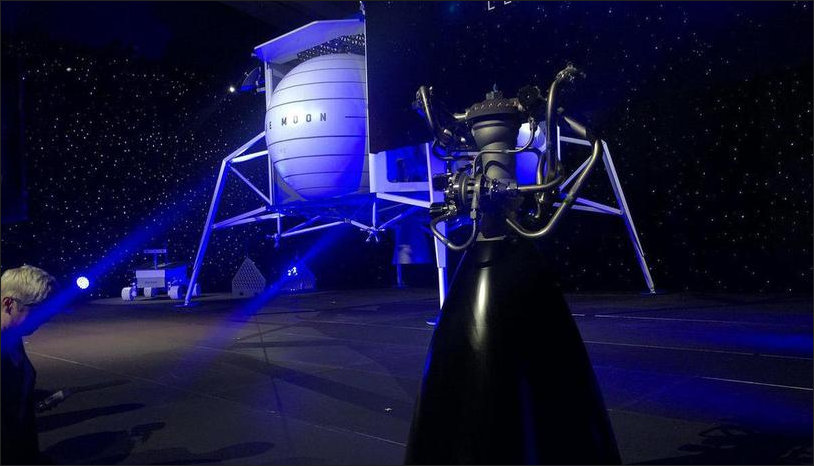
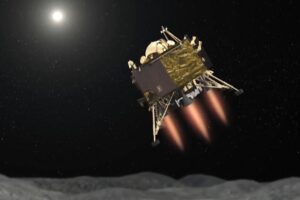
Jeff Bezos, founder of Blue Origin, unveiled a lunar land last week that he said will transport equipment and possibly human beings to the south pole of the Moon by 2024.

In a a presentation in the state of Washington, Bezos said the lander can transport 3.6 metric tons to the lunar surface. Under development for the past three years, the lander will be capable of carrying scientific instruments as well as rovers for exploration, reports Republic World.

Bezos also unveiled the company’s BE-7 rocket engine, which he declared will be test-fired soon. Many parts of engine were 3D printed.

Said Bezos: “We were given a gift — this nearby body called the moon. The moon is a good place to being manufacturing in space due to its lower gravity than the Earth. Getting resources from the moon takes 24 times less energy to get it off the surface compared to the Earth, and that is a huge lever.” more “Blue Origin Unveils Lunar Lander”

Uncategorized

NASA Noodles Concept of Robotic Pallet Lander

December 8, 2019

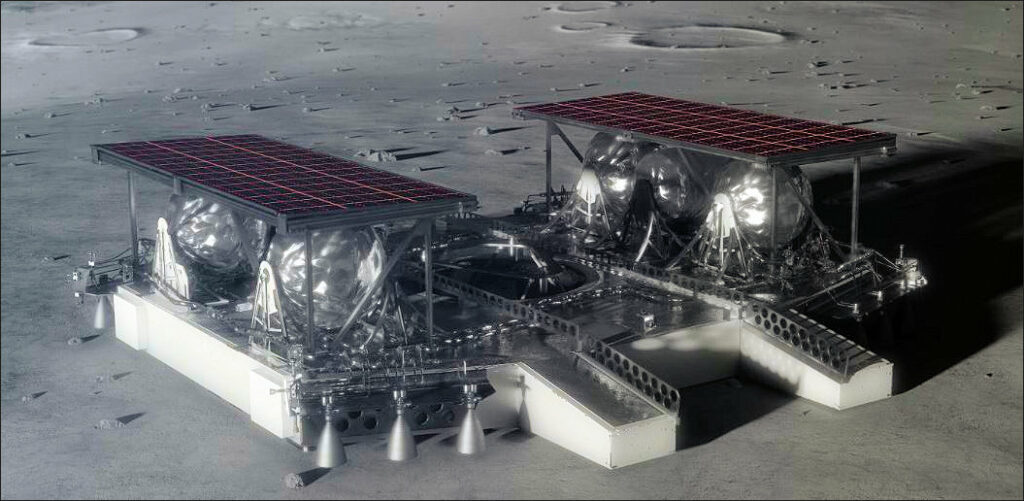
While Earth-based entrepreneurs work on developing reusable launch vehicles to reduce the cost of boosting people and material into space, NASA researchers are working on what a Tech Crunch.describes as robotic “pallet lander” concept to make lunar landings as reliable and cheap as possible,.

“This lander was designed with simplicity in mind to deliver a 300 kilogram rover to a lunar pole,” said Logan Kennedy, the project’s lead systems engineer in a NASA press release. “We used single string systems, minimal mechanisms and existing technology to reduce complexity, though advancements in precision landing were planned to avoid hazards and to benefit rover operations. We keep the rover alive through transit and landing so it can go do its job.”

“While most subsystems use off-the-shelf parts, one emerging technology needed for a lander like this would be Terrain Relative Navigation used for precision landing,” said Kennedy. “Testing is under way!” more “NASA Noodles Concept of Robotic Pallet Lander”

Uncategorized

Moon As Proving Ground for Deep-Space Exploration

December 5, 2019
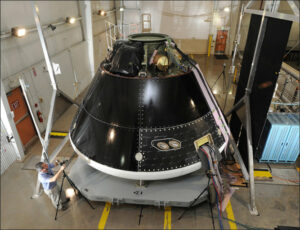
Orion Multi-Purpose Crew Vehicle Assembly. Photo credit: NASA

Dr. Michael Hawes, vice president and Orion program manager for Lockheed Martin Space Systems Company, sees the settlement of the Moon as a proving ground for the ultimate goal of reaching Mars and conducting other deep-space explorations.

The first destination is the Moon, he said at a luncheon hosted by the Webster Business alliance Wednesday, as reported by the Houston Chronicle. “NASA talks about the space around the moon as being the proving ground.” But the ultimate goal is Mars. Said Hawes:

“That’s the horizon goal of deep space exploration. We want to get to Mars but we have to learn how to do a lot of things along the way, Just as we built capability from Mercury through Gemini to Apollo to demonstrate the a lunar landing, we have to do a lot of demonstration of a much broader sense than we did back then to get to Mars. We’re going to do that building from the moon out.”

“We may build a small station on the far side of the moon. We could do science from there. We can actually see the sun and the earth so we could still get power and communications. We’ll go out and look at asteroids. NASA has an asteroid re-direct mission that they’re looking to define that would take a robotics spacecraft to go get a large boulder off an asteroid and bring it back into orbit around the moon. Then, Orion would take the crew out to do the research on the asteroid on that mission.”

The Orion Multi-Purpose Crew Vehicle is NASA’s first spacecraft designed for deep space exploration.

Uncategorized

Researchers Test Drones Controlled by Hand Signals

November 5, 2019

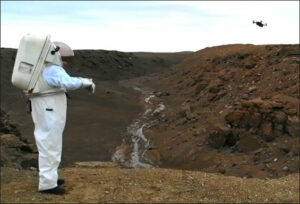
Collins Aerospace and Ntention, a Norwegian startup. are developing “smart gloves” that hopefully will allow astronauts to direct the movements of drones on the Moon and Mars.The collaborators recently conducted their first field test of the gloves at the Haughton-Mars Project Research Station in Canada’s high Arctic, reports Forbes.
The smart glove, embedded with a microcontroller and sensors, allows the the drone to respond to small motions of the fingers, hands, and head.

The vision behind the research project is to equip human explorers on the Moon with machines that can explore, scout, inspect, sample and fetch, reaching lunar caves, flying over mountains, or traversing terrain too tricky for humans to navigate.The robots might be equipped with appendages to do delicate work or bulk up to take on heavy lifting. more “Researchers Test Drones Controlled by Hand Signals”

Uncategorized

Spacebit Touts Legged Rovers for Moon Exploration

November 4, 2019
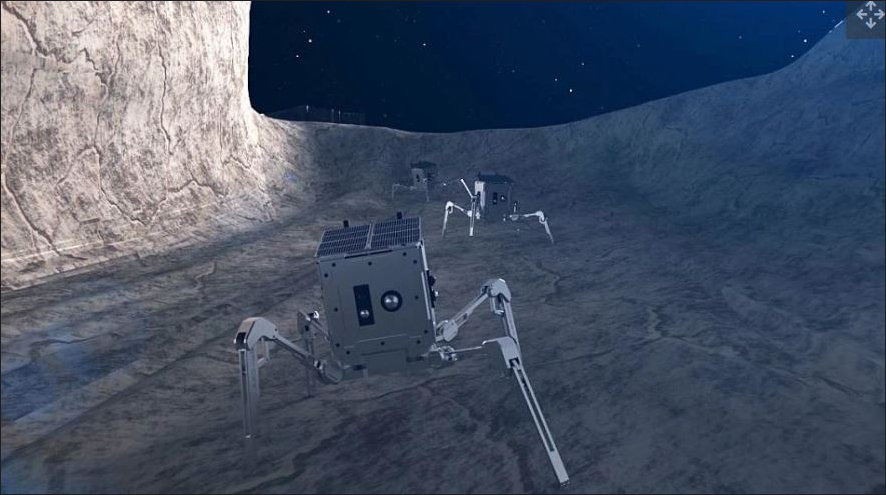
Image credit: Spacebit

Spacebit has announced plans to launch the United Kingdom’s first privately build Moon rover in 2021.

The company has designed robots with legs capable of delving into cracks and crevices inaccessible to flying rovers. The mission design, reports Space.com, calls for a rover to bring as many as eight robots to a drop-off point. Guided by artificial intelligence, the robots leave the “mother ship” in a swarm and explore the environs, including lunar caves.

“We don’t have wheels. We have four legs instead of the wheels, which is a very neat design,” said Spacebit CEO Pavlo Tanasyuk at the International Aeronautical Congress in October.

Costing an estimated $3 million each, the rovers are expected to take six to 12 months to build. “We could have multiple rovers exploring the moon and [its] lava tubes, and even going beyond in the future,” Tanasyuk said.

By using standardized equipment and off-the-shelf components, space exploration will become more affordable, which will stimulate more lunar exploration. “After 50 years’ absence of humans on the moon,” Tanasyuk said, “I believe that robotic missions will play a very major role in our comeback.”

Uncategorized

Russians Identify Mechanism of Water Formation on Moon

May 24, 2019
Image credit: NASA

Russian researchers have discovered a mechanism by which water forms on the Moon, reports the American Society for the Advancement of Science and summarized by the Luna Society International.

Silver hydroxide molecules released from silicon dioxide in the lunar regolith react easily with hydrogen, leading to the formation of water and silver, scientists with the Higher School of Economics and the Space Research Institute of the Russian Academy of Sciences have found.

The implication is that water and silver molecules can be formed on the Moon. In some areas, the proportion of water formed by this mechanism could exceed 6 to 10%.

“The study demonstrates that water may form due to internal, continuously functioning mechanisms. (Comets hitting the lunar surface is a rather rare phenomenon.) It turns out that the water on the Moon can be present not only in cold traps but also in the near-surface lunar soil,” explained Sergey Popel, a study author and head of the laboratory at the Space Research Institute.

Also, said Popel, the presence of water can affect the phototelectric properties of the lunar regolith and the parameters of the plasma-dust system over the Moon.

Uncategorized

Thales Alenia Develops Space Tug Concept

June 2, 2017
Image credit: NASA

A team from Thales Alenia, a Franco-Italian aerospace company, is developing the design for an electric-powered lunar space tug. The reusable vehicle would fly back and forth between Earth and the Moon, transporting cargo and passengers. It would be refueled at a low Earth orbit fuel depot and maintained by astronauts on the Moon and International Space Station. Reports NBC News.

The greatest advantage of the tug is that it would run off Hall Effect Thrusters, which use electric propulsion. In this sense, the tug would be powered much like NASA’s Dawn spacecraft and Japan’s Hayabuse 2.

The space-tug concept is described in an Acta Astronautica paper, “The Lunar Space Tug: a sustainable bridge between low Earth orbits and the Cislunar Habitat.” more “Thales Alenia Develops Space Tug Concept”

Uncategorized

Posts pagination

Prev 1 … 4 5 6 Next

Dust Mites: A Second American Revolution

The year: 2075. The American colonies on the Moon are getting restless.

Now available for sale in paperback or Kindle at Amazon.com

Recent Posts

  • How to Blockade the Moon Without Really Trying May 6, 2026
  • Second Edition May 5, 2026
  • An Exclusive Interview with the Author of “Dust Mites” June 9, 2022
  • The Most Fuel-Efficient Route to the Moon May Not Be a Straight Line May 26, 2022
  • Data Centers in Lava Tubes — an Economic Driver for the Moon? May 26, 2022

Categories

Archives

Idealist by NewMediaThemes