Skip to content

Luna 2076

The Geopolitics of Lunar Colonization

  • About
  • The Book
  • Essays
  • Online Resources
Luna 2076

Category: Warfare and weaponry

Notes on Lunar Warfare

October 16, 2026
This essay was published originally as an appendix to “Trogs.” 

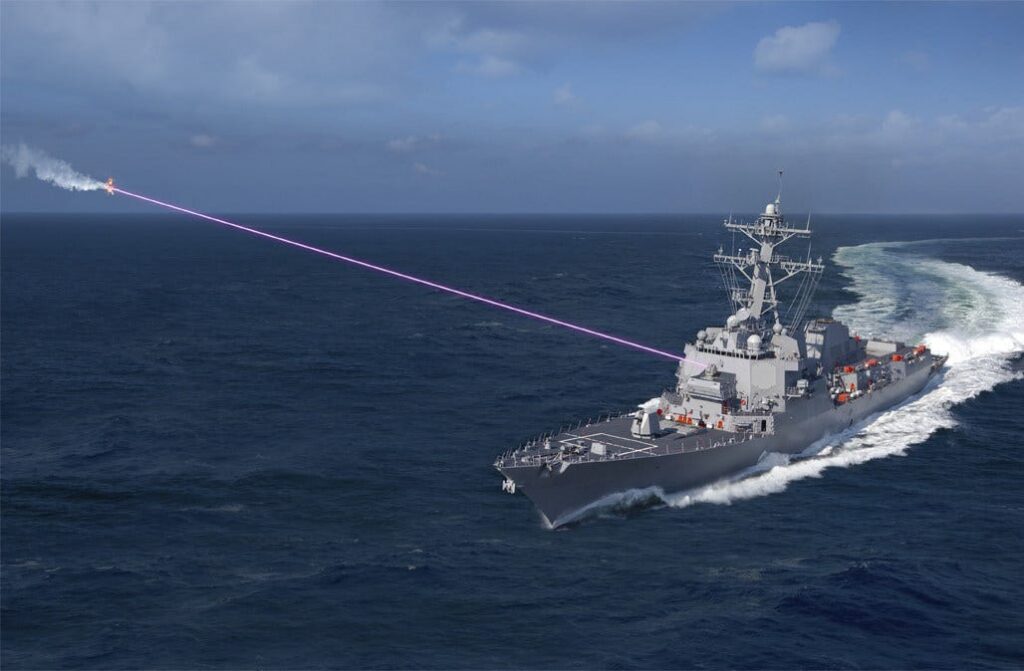
AV’s LOCUST X3 laser weapon system. (Colin Demarest), by way of Laser Wars

“Trogs” weaves together several themes, the most important of which describes Galileo Station’s military struggle for independence from the United States. A major challenge I had in writing the book was imagining what lunar warfare might look like. What new military technologies will emerge over the next 50 years? What challenges will humans encounter in a hostile lunar environment? How far will Artificial Intelligence and robotics advance in five decades of accelerating progress?

Readers should not take the world (and moon) described by “Trogs” as an effort to predict the future. My aim is modest: to imagine a plausible future that (1) is consistent with where we are now, what we can see on the near horizon, and what we can reasonably extrapolate 50 years ahead; (2) is within the bounds of chemistry, physics and economic feasibility; and (3) conforms to the constraints of the lunar environment. While my vision likely will not pan out in all particulars, none of what I describe is wave-a-magic-wand fantasy.

The Future of Earth warfare is now

Many technologies deemed futuristic only a few years ago are being deployed today. Continue reading.

Uncategorized, Warfare and weaponry

From the Seabed to the Moon

October 5, 2026
Grok imagines what a lunar-based electro-magnetic cannon might look like.

“Today’s modern battlefield operates from the seabed to cislunar space, Gen. Dan Caine, chairman of the Joint Chiefs of Staff, told the Air, Space & Cyber Conference in Maryland last month.

As Mike Wall reminds us in Space.com, where he reports the story, cislunar space extends from Earth to the orbit of the Moon and includes the lunar surface.

It seems all but inevitable that the U.S. Space Force will embrace the Dust Mites/Trogs mantra that he who controls the Moon controls cislunar space, and he who controls cisnlunar space controls the Earth.

Caine provided no details about what the cislunar battlefield might look like. (Wall thinks it will be entirely robotic, focused on taking out the enemy’s satellites). But the general did say this:

Future conflicts will demand that we operate without the assumptions of uncontested access, secure rare areas, or uninterrupted or uncontested sustainment. Our task, my friends. is to adapt right now, so the joint force is prepared to fight, endure and win in global contested environments, from the seabed to cislunar space.

We must continue to ensure that the United States of America can strike anywhere on the globe at the time and place of our choosing, and sustain that force. Our United States Space Force must provide unrivaled space superiority and sustain the associated networks, domain awareness [and] data advantage that the joint force needs to win in space, both now and in the future.

Wall quotes Gen. Douglas Schiess, who also spoke at the conference: “Let me be crystal clear: Today, guardians operate on-orbit weapons that can defend the joint force against space-enabled attacks.” (Guardians are the official name of members of the Space Force.)

Schiess, according to Wall, implied that these on-orbit weapons are electromagnetic rather than kinetic in nature — designed to knock out key systems of adversaries’ satellites rather than destroy the entire spacecraft.

My spin: When will the Moon itself become a battleground?

more “From the Seabed to the Moon”
Warfare and weaponry

Will the Laser Revolution Trump the Drone Revolution?

September 4, 2026
Department of War illustration. Take this with a grain of salt. Laser beams are invisible. But invisible laser beams don’t make dramatic photos.

Drones are revolutionizing warfare. Drones are so revolutionary that they’re outdating all legacy weapon systems. Swarms of super-cheap drones will overwhelm elegant but super-expensive missile defenses. Aircraft carriers are as vulnerable and obsolete today as World War II showed battleships to be. So goes the new conventional wisdom.

Maybe, maybe not.

Back in March, the United States Navy deployed the HELIOS (High-Energy Laser with Integrated Optical Dazzler and Surveillance) directed-energy weapon system on an Arleigh Burke-class destroyer operating in waters near Iran. The technology destroyed four drones in live tests early in the year. Unofficial reports contend that HELIOS have engaged Iranian drones in live fire, although Department of War officials have declined to confirm them.

Here are new economics of warfare. Conventional interceptor missiles cost anywhere between $6 million and $35 million each. Attack drones cost $30,000. But Israel’s newly operational Iron Beam laser costs $2 per shot, argues Ron D. Martin in the Rod Martin Report.

Under President Trump, this is moving fast into deployment, production, and a broad-based defense architecture — alongside expanded missile production, AI-enabled battle management, and a national nuclear-power renaissance. Golden Dome and the Golden Fleet are already being designed around directed energy systems, making the fleet — and ultimately the American people — increasingly invulnerable to attack from above.

Far from making aircraft carriers and other big ships obsolete, laser weaponry makes them virtually impregnable, Martin contends.

more “Will the Laser Revolution Trump the Drone Revolution?”
Warfare and weaponry

On the Tech Time Horizon: Quantum Sensors

September 2, 2026

THE PENTAGON IS PREPARING FOR A WORLD WITHOUT GPS.

QUANTUM IS THE SOLUTION.

Every plane, ship, missile, ATM, and phone depends on GPS. Although it can be switched off. Adversaries do it daily now by jamming and spoofing are routine over the Baltic, the Middle East, and Ukraine,… pic.twitter.com/KEzfsuZwf0

— QuantumAnalysis (@Qtumanalysis) September 1, 2026

The future is coming at us faster than even a science fiction writer can handle it. Sensors play a significant military role in my “Trogs” novel, to be published next week. But Trogs contains no mention of quantum sensors. Consider the X post above. The Pentagon, writes QuantumAnalysis, has launched Project Farseer with $200 million to push commercialization of:

  • “Quantum clocks. Portable atomic clocks so precise a vehicle tracks its own position by timing alone. …
  • “Quantum gravimeters. Every place on earth has a unique gravitational fingerprint. Read it, match it to a map, know where you are. Farseer’s spec: sensors under 20 kilograms, accurate enough to find things underground.
  • “Quantum magnetometers. Navigate by the earth’s magnetic field. Detect submarines and buried structures by the field they disturb.
  • “Rydberg atom sensors. Radios that use atoms instead of antennas, hearing the entire spectrum at once, through jamming.”

Knowing nothing about quantum clocks, I queried Copilot how they might work. GPS receivers use quartz clocks that drift quickly. To correct for the drift, GPS receivers must receive signals from at least four satellites (which carry more precise atomic clocks). With quantum clock navigation, a vehicle carries its own atomic clock. It measures location by measuring the “sent time” and the “return time” of a signal traveling at the speed of light to and from a satellite. Atomic clocks are so extraordinarily sensitive that they capture microsecond differences in that travel time. The nice thing (from a military perspective) about quantum clocks is that they are resistant to spoofing and jamming by adversaries.

more “On the Tech Time Horizon: Quantum Sensors”
Warfare and weaponry

The Powered Armor Fantasy

August 27, 2026
Image from Iron Man

Hollywood movies such as Iron Man, sci-fi novels such as Robert Heinlein’s “Starship Troopers,” and computer games such as Starcraft have popularized the image of space-era warriors wearing heavily armored battle suits. Dreaming of something similar, Pentagon planners have poured countless dollars into power-armor R&D. As Jared Keller points out in his website Laser Wars, none of it has worked out.

Designing power suits, it turns out, is incredibly difficult, Keller concludes in tracing the history of failed efforts since the 1960s. Speaking of the Tactical Assault Light Operators Suit (TALOS) launched in 2013, he writes:

TALOS failed not by lack of ambition, but by what its overseers diagnosed as the fatal flaw of every powered exoskeleton before it: “complex subsystem interdependencies.” Too many disparate and complex systems simply couldn’t operate seamlessly together in a way that felt, as Heinlein promised, like simply wearing clothes.

“Decade after decade, the Pentagon stands up a new program, pours in money and engineering talent, and watches each effort collapse under the same recurring challenges,” he says. “And yet, on battlefields and in logistics depots around the world, the dream of military exoskeletons lives on.”

more “The Powered Armor Fantasy”
Warfare and weaponry

How to Blockade the Moon Without Really Trying

May 6, 2026
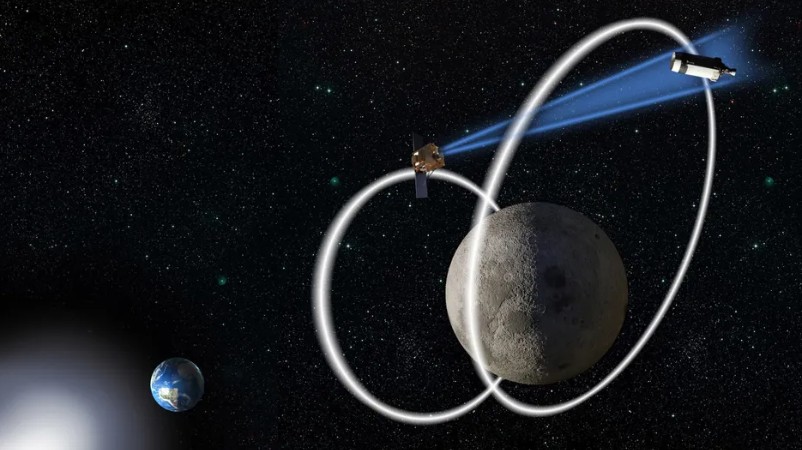
An illustration of the U.S. Air Force Research Laboratory’s Cislunar Highway Patrol System (CHPS), a spaceflight experiment designed to keep track of objects entering, operating in, or leaving cislunar space. (Image credit: U.S. Air Force Capt. David Buehler), by way of Space Insider.

To the layman, there looks to be a lot of wide-open space between Earth and the Moon, so the idea of someone conducting a Straits of Hormuz-style blockade of transit between the two is not a possibility that comes readily to mind. But Leonard David writing in Space Insider warns that it’s an all-too-real possibility.

Blockading cis-lunar space is not a problem we’ll need to worry about in the short term. But with the space economy on a geometric growth track, the Moon is destined to become an integral extension of Earth’s economy. Satellites, He-3 mining, solar power, data centers, chip fabrication and pharmaceutical manufacturing — you know the drill.

“Just as the Strait of Hormuz is a narrow waterway, cislunar space, though seemingly large, actually contains a few unique and exclusive points of transit through which all lunar travel must pass,” David quotes Marc Feldman, executive director of the Center for the Study of Space Crime, Piracy & Governance, as saying.

The article does not elaborate on what those choke points might be, However, CoPilot suggests the following:

The key “choke points” in cislunar space are the Lagrange points and the narrow gravitational transfer corridors that spacecraft must use to move efficiently between Earth and the Moon. These are the few stable or semi‑stable regions where traffic naturally concentrates, making them analogous to maritime chokepoints like the Strait of Hormuz.

more “How to Blockade the Moon Without Really Trying”
Warfare and weaponry

Dust Mites: A Second American Revolution

The year: 2075. The American colonies on the Moon are getting restless.

Now available for sale in paperback or Kindle at Amazon.com

Recent Posts

  • NAS Identifies Four Priorities for Manned Moon Missions October 22, 2026
  • Will Resource Constraints Throttle Settlement Growth on the Moon? October 18, 2026
  • Notes on Lunar Warfare October 16, 2026
  • Natural Intelligence & the Logic of Consciousness October 15, 2026
  • America’s Competitive Advantage in Space October 11, 2026

Categories

Archives

Idealist by NewMediaThemes