
Drones are revolutionizing warfare. Drones are so revolutionary that they’re outdating all legacy weapon systems. Swarms of super-cheap drones will overwhelm elegant but super-expensive missile defenses. Aircraft carriers are as vulnerable and obsolete today as World War II showed battleships to be. So goes the new conventional wisdom.
Maybe, maybe not.
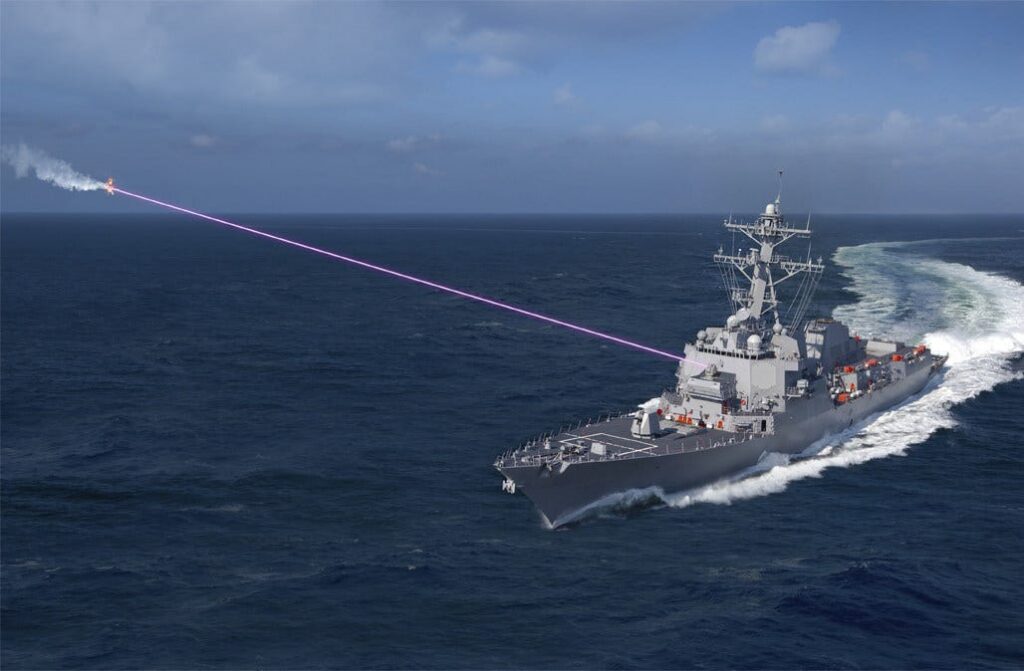
Back in March, the United States Navy deployed the HELIOS (High-Energy Laser with Integrated Optical Dazzler and Surveillance) directed-energy weapon system on an Arleigh Burke-class destroyer operating in waters near Iran. The technology destroyed four drones in live tests early in the year. Unofficial reports contend that HELIOS have engaged Iranian drones in live fire, although Department of War officials have declined to confirm them.
Here are new economics of warfare. Conventional interceptor missiles cost anywhere between $6 million and $35 million each. Attack drones cost $30,000. But Israel’s newly operational Iron Beam laser costs $2 per shot, argues Ron D. Martin in the Rod Martin Report.
Under President Trump, this is moving fast into deployment, production, and a broad-based defense architecture — alongside expanded missile production, AI-enabled battle management, and a national nuclear-power renaissance. Golden Dome and the Golden Fleet are already being designed around directed energy systems, making the fleet — and ultimately the American people — increasingly invulnerable to attack from above.
Far from making aircraft carriers and other big ships obsolete, laser weaponry makes them virtually impregnable, Martin contends.
All of this turns the standard argument on its head. The bigger the ship, the more room it has for power generation, cooling, sensors, redundant systems, weapons, and defensive layers. The enormous nuclear-powered warship that looked like an inviting target in an age of finite missile magazines may become the ideal host for the weapons that make saturation attacks futile.
Martin is a Trump enthusiast, so view his analysis with caution. (Likewise, you should regard criticisms of Trump detractors with the same gimlet eye.)
But there’s an irrefutable lesson here. Drones do represent a revolution in warfare. Lasers represent another revolution. And guess what? The people who make drones will introduce new technology to counter the lasers. And the people who make lasers will respond by making them harder to counter. And so it will go, one system leapfrogging the other more or less forever — or until someone develops a quantum something-or-another that makes drones and lasers obsolete.
In my “Dust Mites” and “Trogs” novels, I assume that successive technological revolutions will keep drones in play in the year 2075, making them potent but not unvanquishable weapons on the Moon. There’s no atmosphere on the Moon, so the drones won’t fly. They’ll be ground-based, have heavier armor, come with many different flavors of locomotion, and be capable of independent, AI-guided decision-making. Lunar militaries also will have deployed several weapon systems capable of destroying them. Beyond that, I offer few predictions.