This essay was published originally as an appendix to “Trogs.”
“Trogs” weaves together several themes, the most important of which describes Galileo Station’s military struggle for independence from the United States. A major challenge I had in writing the book was imagining what lunar warfare might look like. What new military technologies will emerge over the next 50 years? What challenges will humans encounter in a hostile lunar environment? How far will Artificial Intelligence and robotics advance in five decades of accelerating progress?
Readers should not take the world (and moon) described by “Trogs” as an effort to predict the future. My aim is modest: to imagine a plausible future that (1) is consistent with where we are now, what we can see on the near horizon, and what we can reasonably extrapolate 50 years ahead; (2) is within the bounds of chemistry, physics and economic feasibility; and (3) conforms to the constraints of the lunar environment. While my vision likely will not pan out in all particulars, none of what I describe is wave-a-magic-wand fantasy.
The Future of Earth warfare is now
Many technologies deemed futuristic only a few years ago are being deployed today.
Drones. Drones, which have changed the nature of warfare during the Russia-Ukraine war, constitute one of history’s great revolutions in military technology and doctrine. Drones have sunk naval vessels, turned armored tanks into death traps, and proven to be deadlier long-range weapons than artillery. Every armed force on the planet is thinking how to adapt to the drone revolution. One can reasonably anticipate that drones will become ever more sophisticated and deadly over time. At the same time, combatants will continue to seek cost-effective ways to neutralize them.
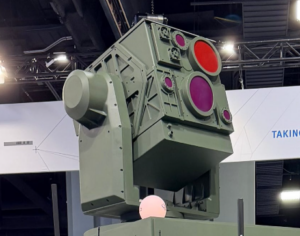
Lasers and coil guns. One drone-nullifying technology might be laser guns, more bureaucratically referred to as “directed energy systems.” Days before publication of this book, US Army soldiers used a laser weapon to shoot down three drones on the Mexican frontier. Widespread deployment of lasers for missile defense is said to be only two to three years away. Electro-magnetic rail guns and coil guns, which shoot projectiles at hyper-velocities, have been shown to work in the lab. Engineering bottlenecks in power generation and thermal management make active deployment of electro-magnetic weapons by militaries unlikely any time in the next 10 to 15 years, but those challenges likely will be solved within a 20- to 25-year time horizon.
Electronic warfare. Electronic warfare (EW) systems designed to control the electromagnetic spectrum are deployed today for the purpose of disrupting the enemy’s communications and sensors as well as protecting one’s own. The technologies associated with EW will become more sophisticated over time, both on offense and defense.
Advanced materials. The U.S. has engineered materials for extreme performance, making them lighter, harder, more heat resistant, and more resilient. These include metal alloys, composites, polymers, and nanomaterials. On the horizon: Carbon atoms layered atom by atom will make steel as soft as plaster by comparison. Research is uncovering other substances with remarkable properties such as malleability, elasticity and super-conductivity. Work is proceeding on “smart” materials embedded with sensors that make armor responsive and self-healing.
Artificial intelligence. The U.S. military is today integrating artificial intelligence into its operations for decision support, analysis, simulation & training, and to allow missiles, drones and other weapons to function autonomously, that is, without humans in the decision-making loop. Inevitably, in the future more decisions requiring split-second responses will be delegated to AI, although striking a balance between a weapon’s autonomy and human oversight will engender ongoing debate.
Robots. Military robots are used today for reconnaissance, logistics, explosives disposal and other narrowly defined combat operations. The near-future focus is on deploying humanoid robots capable of acting autonomously in combat. Near-future robots will come in sizes, shapes, and capabilities geared to specific capabilities and tasks. Given rapid advances in AI, it is reasonable to expect that robots will be imbued with general intelligence by mid-century.
Lunar conditions
The technologies, weapons and tactics developed for armed forces on the Earth will be adapted to the unique conditions on the Moon. Some key differences between Earth and Moon environments:
No air force. The Moon has no atmosphere. Lunar military forces will have no aircraft, flying drones, or anything resembling an air force. Any form of above-ground flight will consume scarce propulsion fuel that competes with many other priorities such as off-Moon flight. Lunar fliers will be used mainly in niche applications such reconnaissance, evacuating the wounded or delivering emergency supplies. Missiles and rockets will be exceptions, but due to resource constraints they will be used more sparingly than on Earth.
No navy. The Moon has no oceans, rivers or streams. Lunar forces will have no navies or sea-based logistics. Everything will travel overland.
Different ballistics. The lack of an atmosphere eliminates drag on projectiles. In the absence of air resistance, bullets using chemical propellants or powered by electro-magnetic force will maintain their velocity and striking force over long distances. Likewise, gravity, one-sixth that of earth, will allow projectiles to travel far farther before falling to the ground. Combined with AI-assisted targeting, accuracy will improve dramatically over current Earth weaponry.
Low gravity. With moon gravity one-sixth that of Earth gravity, lunar drive trains will be capable of propelling much greater mass than on Earth. That in turn will enable engineers to design battlecraft with thicker armor. Similarly, Moon troopers will be able to shoulder much heavier burdens than the 80 to 120 pounds of armor and equipment that U.S. soldiers currently do, although mass, inertia and momentum will not change, creating challenges for maneuverability and agility. Lunar militaries will make different tradeoffs between weight and mobility.
Extreme temperatures. Temperatures on the lunar surface range from -200°F at night and in shadowed areas to +250°F during the long lunar day, posing unprecedented stress on equipment. Maintenance and repair, assisted by AI diagnostics, will become an all-consuming preoccupation.
Regolith and dust. Over billions of years, meteoric bombardment has pulverized the lunar surface into regolith, consisting of mineral particles much smaller than grains of sand. This sharp, abrasive dust, electrostatically charged by solar radiation, can hang suspended above the surface when disturbed, cling to spacesuits, battlecraft and other surfaces and, if not cleaned regularly, cause serious abrasion and damage. Dust will be a major preoccupation.
Heat dissipation. The lack of air and water creates tremendous challenges for the design of weapons and battlecraft, which need to dissipate considerable heat during combat. The lunar vacuum does not absorb heat. Because high temperatures can melt mechanical systems, there is a hard limit on the rate of fire and how much power they can pulse. AI systems will be used to optimize the tradeoffs but the limitations will be significant.
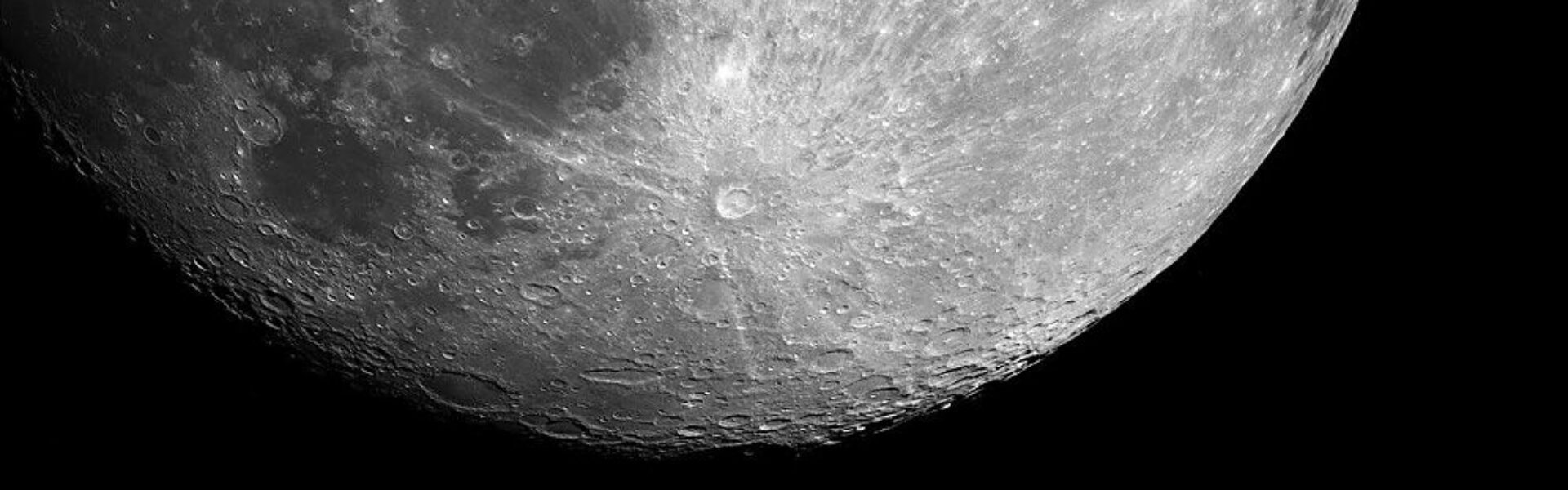
Terrain. Lunar terrain has few analogues on Earth – other than Antarctica perhaps. Devoid of water and life, the lunar surface has no rivers, streams, or forests that create obstacles to movement. The dominant features are craters, low-lying ridges created by ejecta, and highlands where crater rims have been demolished by eons of meteorite bombardment.
Lunar weaponry and battlecraft
In “Trogs” the U.S. Moon Patrol faces off against the Galileo Station National Guard. The underlying premise is that both militaries use weapons systems developed on Earth that have been adapted to the lunar environment.
Lasers. Lasers have important advantages and limitations compared to other weapons systems. They are highly accurate – even more accurate on the Moon than on Earth where the atmosphere interferes with light-beam coherence. And unlike projectiles, the effect of gravity on laser beams is imperceptible. Another advantage: beam intensity is scalable, that is, it can be dialed up for more destructive power (to penetrate armor) or down (to disable electronics) to conserve energy.
In the Trogs universe, lasers are used in rovers and stationary cannons.
Rovers are light reconnaissance vehicles designed for speed, not power. They use their lasers primarily to shoot drones and disable electronics (referred in “Trogs” as optics pods). Given sufficient dwell time on the same spot, laser beams can penetrate armor, although in fast-moving combat situations such opportunities are rare.
The Galiletians also use heavy laser cannons as part of their fixed fortifications. Endowed with dedicated nuclear-power generators and underground heat dumps, they can fire massive pulses repeatedly without disabling heat buildup. They are the most powerful weapons on the Moon, but they are stationary and confined to defense.
EMCs. Electro-magnetic cannons (EMCs), or coil guns, are the work horses of lunar militaries. They use electro-magnetic forces to propel tungsten-steel projectiles at hyper-velocities (measured in miles per second) and penetrate armor with pure kinetic force. They can dish out much more damage than laser guns. However, the rate of fire is limited by the coil gun’s heat build-up, and the firing apparatus requires heavy maintenance to mitigate the effects of repeated firing and/or exposure to regolith.
(Rail guns are a different type of EMC. However, due to power, heat-disposal, and maintenance issues, they are less suitable to the Moon than coil guns, so lunar militaries do not deploy them.)
Chemical-propellant weapons. Chemical-propellant weapons using nitrogen-based compounds play a role in Trogs-world warfare. Guns with bullets do not require an exterior power source to operate. Pull the trigger and they go boom. Rifles, machine guns, and anti-drone guns are far more accurate on the Moon than Earth, especially in long-range fire. Low gravity and the absence of air resistance and wind allow bullets to travel further and straighter. Because power and heat constraints are not an issue, guns have a higher rate of fire. Accordingly, they are the armament of choice for mech infantry and, at the other end of the lethality scale, for rockets and hypersonic missiles.
The primary drawback to chemical-propulsion weaponry on the Moon is resource scarcity. Nuclear energy is abundant, which favors lasers and EMCs. By contrast, nitrogen, a key component of nitrocellulose and nitroglycerine used in gun propellants, is a trace element on the Moon and has competing uses, primarily as the dominant element in air for human habitation. In theory, nitrogen can be imported from Earth where it is abundant. Whether that budgetary expense is sufficient to make chemical propellants uneconomical in 2076 is unknowable. The Trogs universe assumes that nitrogen scarcity restricts chemical propellants to their highest and best uses: primarily infantry weapons, rockets and missiles.
Armor. Progress in materials science has created stronger, more heat-resistant, more resilient armor. “Trogs” assumes that low-G will allow lunar battlecraft armor to sheath itself in more armor than their Earth-bound counterparts, and that armor will contain layers of materials with multiple properties and functions. Carbon-based materials fabricated at the atomic level, the hardest substance known to man, will be manufacturable in industrial quantities. Ablative armor, which sacrifices itself to dissipate the kinetic energy of projectiles, comprises another layer. Additionally, armor is “smart” – that is, it is embedded with sensors that update the battlecraft’s damage-control systems.
The “Trogs” universe assumes that, with the exception of the Galiletians’ four massive laser cannons, EMC weapons cannot destroy a battlecraft with a single blast. Rather, they chip and scrape away the armor with repeated blasts to degrade enemy vehicles – somewhat akin to the way 18th-century ships of the line slugged it out. The typical engagement protocol targets the enemy in the following order of priority:
- Enemy sensors and optics (to blind the enemy)
- Exposed weapons (so the enemy can’t shoot back)
- Wheels and tires (to impair mobility)
- Radiative fins (to destroy the enemy’s capacity to dissipate heat)
- The armored platform (which protects batteries, drive trains, computers, crew cockpit, life support, and storage).
When laser-equipped rovers work in tandem with EMCs, rovers prioritize the optics while the EMCs concentrate on the hardened targets.
Optics. Lunar battlecraft are equipped with a range of sensors: primarily cameras for visible light, infra-red sensors (for thermal imaging), lidar (to measure distances), and radar (to measure speed and distance). “Trogs” assumes that these sensors will be bundled in optics pods protected by armored cowls. In the Trogs universe, AI integrates battlecraft and ground-based sensors and translates them into detailed battlemaps to provide situational awareness.
Communications. Radio communications are trickier on the Moon than on Earth. On Earth long-distance radio waves propagate by bouncing off the ionosphere, which does not exist on the Moon. Radio communication on the Moon works only when there is a direct line-of-sight between sender and receiver, and even then is subject to electronic-warfare disruption. In “Trogs,” it is essential for the Moon Patrol to establish relays – either satellites or ground-based – to maintain the connection with command headquarters. The Galiletian’s defensive fortifications are wired with buried fiber-optic cable invulnerable to EW blockage.
Power sources. “Trogs” envisions energy being abundant on the Moon. Fossil fuels are non-existent, and solar is non-functional during the two-week lunar nights, so nuclear power, both fission and fusion, are the go-to power sources. As it happens, the Moon is mankind’s primary source of He-3, the fuel used to generate safe, clean, non-contaminating fusion energy. For purposes of conducting warfare, the trick is transmitting electric power from fusion reactors to the combatants. This is not a problem for defensive fortifications with their own dedicated nuclear reactors and electric-transmission lines buried safely underground. Mobile forces must bring their reactors with them. In Trogs parlance, these critical vehicles are known as “Mama Hogs.” They generate electricity and fast-charge racks of batteries; small, autonomous vehicles referred to as “piglets” convey the batteries to battlecraft when their batteries run low.
Auxiliary battlecraft. Besides rovers, EMCs, Mama Hogs, and piglets, mobile lunar forces are accompanied by numerous auxiliary battlecraft. The most important of these are battalion-, brigade- and expeditionary force-level vehicles where Command, Control & Communications (C3) functions are housed. “Trogs” also envisions military forces accompanied by mobile repair sheds to handle maintenance and repairs; as well as specialized trooper carriers to transport drones, mech troopers and battlebots.
Drones. Drones are a critical part of “Trogs” military armature. The critical difference with Earth drones is that there is no atmosphere, so they cannot fly. Ground-based drones rely upon a variety of means of locomotion, including wheels, belted treads, and legs. They are manufactured and deployed in large numbers (in the hundreds and thousands). Some drones are equipped with sensors only, some with chemical-propelled munitions, some with lasers, and some with cannons. Most common are the suicide or “kamikaze” drones which attach themselves to their targets and explode with devastating force. In “Trogs” the Galiletians have developed prototypes of drones using different types of locomotion. The “skate” drones (shaped like stingrays) rely upon electrostatic forces to skim above the regolith. The Arachnid-3 drones are launched by catapults newly installed on the rovers.
Mech troopers and battlebots. Some lunar terrain is too rough for battlecraft to traverse, even the nimble rovers. Occupying rocky highlands and scaling kilometer-high crater rims requires foot soldiers, sometimes with the assistance of exoskeletons. In the world of Trogs, there are two types of infantry: human “mech troopers” and humanoid robotic “battlebots.” Thanks to low-G, they are capable of carrying bigger guns, more ammo, and heavier armor than their Earth-bound counterparts. They are less agile, however because the greater weight of their gear translates into greater mass, inertia and momentum, which exoskeletons and AI can only partially offset.
The U.S. Moon Patrol relies heavily upon robotic infantry. The bots are stronger, faster and have better aim and quicker reaction times than the mech troopers. Even though they are capable of acting autonomously, they generally follow pre-programmed orders and directives and, as a consequence, when combat diverges from the battle plans, they are slower to adapt than humans are. The Galiletian National Guard eschews the use of battlebots.
Artificial intelligence and robots. AI will be so thoroughly integrated in computer and information systems by 2075 that it will be viewed as so ordinary as to be scarcely worth noting. Broadly speaking, AI will exist in two different forms: one in which it is inseparable from the computer/information infrastructure and has no distinct identity, and one in which it is the animating force of free-standing robots, or bots, with distinct identities, self-awareness and volition. “Embedded” AI assists humans with organizing and collating firehoses of information and data and assisting human decision-making. Little of this AI will have need of self-awareness; it will address highly specific tasks such as compiling battlemaps or fine-tuning targeting algorithms for greater accuracy. By contrast, bots will be used for tasks in which autonomous decision-making is required. Some bots will resemble humans; some will not. They will be differentiated not only physically but by the coding that defines their cognitive capabilities.
Craters. A core premise of “Trogs” is that most lunar settlements shelter inside craters whose high rocky rims protect against attackers – much as castles, city walls and hilltop fortifications did during the Middle Ages. The ability to put underground nuclear reactors, heat sinks, and fiber-optic cables underground confers crater defenders with enormous advantages over mobile forces trying to subdue them.
Join the discussion
You may see the future of lunar warfare – or the lunar economy, or political dynamics – very differently. I invite readers to join the discussion on my blog, www.luna-2076.com. Your participation could well help guide me when writing Part III of the Dust Mites saga.