Tiny Nuclear Reactors Could Provide Energy on the Moon

May 18, 2018
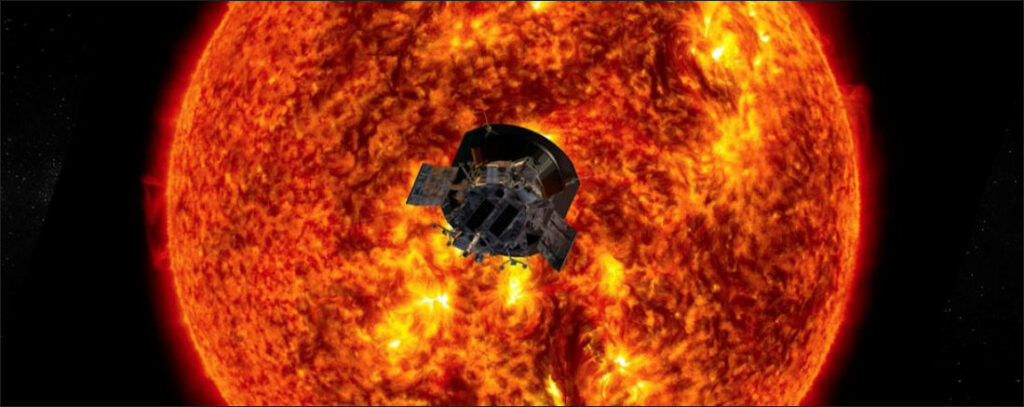
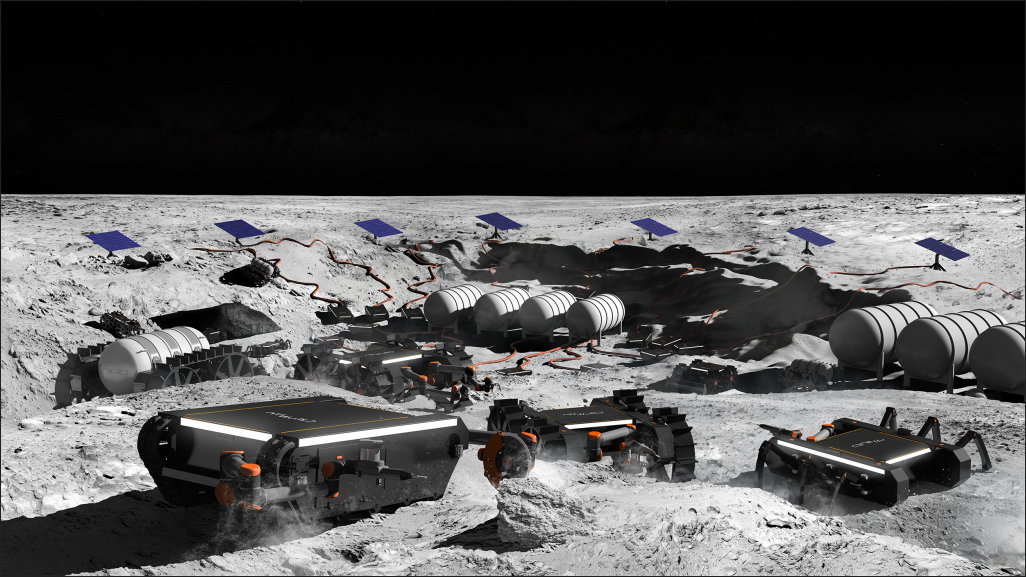
Artist’s rendering of a nuclear power system on the Moon. Photo credit: NASA

NSA has successfully tested a design for a small nuclear-fission reactor, the Kilopower, that could provide a reliable source of power on the Moon.

Current space missions, reports Scientific American, use fuel cells, nuclear batteries or solar power, but each source has drawbacks. A a night on the Moon lasts two weeks, and the strength of sunlight on Mars is only 40% that of earth. “When we go to the moon and eventually on to Mars, we are likely going to need large power sources not dependent on the sun, especially if we want to live off the land,” says Jim Reuter, NASA’s acting associate administrator for space technology.

Kilopower is a small, lightweight fission reactor that can provide up to 10 kilowatts of electricity, enough to power three to eight typical American houses — and enough to power a human outpost on the Moon or Mars. more “Tiny Nuclear Reactors Could Provide Energy on the Moon”

The Compelling Economics of Lunar-Built Bricks

July 19, 2017

Early settlers on the Moon will need to protect themselves against radiation, which will entails covering habitats with meters-thick layer of protective regolith. Professor Matthias Sperl, with the German Aerospace Center, imagines the necessity of transforming loose dust into sturdy bricks. Because the Moon lacks the components of mortar to bind the bricks together, they will have to be unterlockable, similar to Lego toys.

Given the economics of lifting building materials out of Earth’s gravity well, it would make far more sense fabricate the bricks on the Moon, said Sperl in an article in Horizon, the European Union research & innovation magazine, Using solar energy and 3D printing could bring down the cost tremendously.

Here’s how the economics shake out:

‘If you bring something up to the space station you may think about a cost between EUR 5 000 to EUR 10 000 to bring one kilogram of material. To such an order of magnitude you can easily add a factor of 10 if you go to the moon.

‘Imagine that you have a machine that you put on the lunar surface to build the bricks, something similar to the rovers we put on Mars. Such machines weigh about 200 kilograms, which would cost you roughly EUR 20 million. If you need to bring additional infrastructure such as shoveling devices, you can assume a cost of EUR 100-200 million.

‘Now imagine building bricks and other elements worth 10 tons of upload (material taken to space) on earth, as you will easily need a couple of thousand bricks for one building. To ship all of that to the moon, the estimated cost would be EUR 1 billion.

Of course, once you’ve paid to put machines on the Moon, they can build bricks to protect more than one habitat.

Bigelow Gets It: Geopolitics and the Moon

July 19, 2017

Robert Bigelow, a Los Angeles real estate baron turned space entrepreneur, understands the stakes involved with lunar colonization. It’s not just about exploration and scientific discovery. It’s not just about development of new power sources. It’s about geopolitical supremacy. If we don’t get a foothold on the Moon and the Chinese do, the United States is toast.

At a NASA conference today on the International Space Station, he predicted that his company’s first two space habitats would be ready for launch by 2020, reports Quartz. Bigelow expressed his hope that NASA would deploy them on the Moon.

“There’s no time to lose,” said Bigelow, CEO of Made in Space. China has lunar ambitions. If it gets there first, it will be able to impose its own rules on what is still a legal grey area. He made a similar argument in a Senate hearing earlier this year. As reported by Quartz, he said:

“China is very pre-disposed to ownership, whether its creating the islands in South China Sea, properties in massive quantities that they’ve purchased in South America or Africa, whether you open a [foreign subsidiary in China] and can only own 49% of it,” he said. “China could exercise an effort to start to lay claim to certain lunar territories. I don’t think it’s a joke, I don’t think it’s something to be cavalier about. Such an ownership consequence would have an amazing impact on the image of China vis-a-vis the United States and the rest of the world, if they should own large amounts of territory on that body, if we stood back and we were not prepared.”

more “Bigelow Gets It: Geopolitics and the Moon”

Thales Alenia Develops Space Tug Concept

June 2, 2017
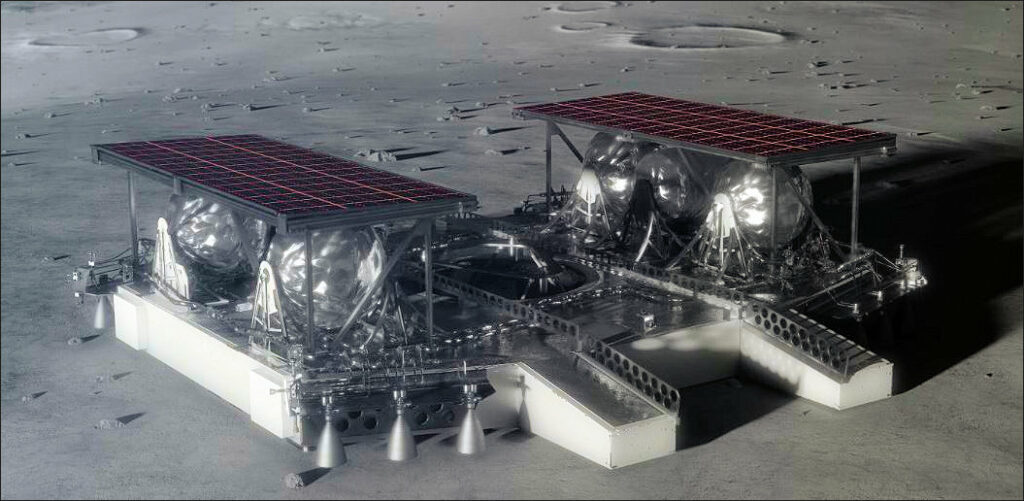
Image credit: NASA

A team from Thales Alenia, a Franco-Italian aerospace company, is developing the design for an electric-powered lunar space tug. The reusable vehicle would fly back and forth between Earth and the Moon, transporting cargo and passengers. It would be refueled at a low Earth orbit fuel depot and maintained by astronauts on the Moon and International Space Station. Reports NBC News.

The greatest advantage of the tug is that it would run off Hall Effect Thrusters, which use electric propulsion. In this sense, the tug would be powered much like NASA’s Dawn spacecraft and Japan’s Hayabuse 2.

The space-tug concept is described in an Acta Astronautica paper, “The Lunar Space Tug: a sustainable bridge between low Earth orbits and the Cislunar Habitat.” more “Thales Alenia Develops Space Tug Concept”

222 New Impact Craters Measured over Six Months

October 12, 2016
Photo credit: NASA/GSFC/Arizona State University

A count of new crater formations on the Moon has turned up 33% more than predicted, researchers at Arizona State University have found.

Meteors regularly impact the Earth but they usually burn up in the atmosphere. On the Moon, which has no atmosphere, they constantly form craters and impact basins. Bombardment by small meteors could post hazards to future lunar settlements.

Emerson Speyerer and his Arizona State colleagues compared 14,000 photos taken between Oct. 25, 2012 and April 21, 2013 by the high-resolution camera on the Lunar Reconnaissance Orbiter (LRO), reports New Scientist. They found 222 new impact craters more than 10 meters wide, a third more than predicted. They also found 47,000 new splotches, Speyerer’s term for splatter-like changes in reflectance on the surface caused by dust and rock thrown off by the initial meteoric impact.

The largest new crater was 43 meters in diameter. more “222 New Impact Craters Measured over Six Months”

$10 Billion to Put a Colony on the Moon

March 22, 2016

The United States could lead the return of humans to the surface of the Moon by 2022 for an estimated total cost of $10 billion, concludes NASA’s Alexandra Hall and NextGen Space’s Charles Miller in a paper written for New Space Journal, “A Summary of the Economic Assessment and Systems Analysis of an Evolvable Lunar Architecture that Leverages Commercial Space Capabilities and Public-Private Partnerships.

The big takeaway, NASA astrobiologist Chris McKay told Popular Science, “is that new technologies, some of which have nothing to do with space — like self-driving cars and waste-recycling toilets — are going to be incredibly useful in space, and are driving down the cost of a moon base to the point where it might be easy to do.”

According to the study’s introduction, the exercise explored a scenario in which the strategic objective was commercial mining of a propellant from lunar poles that would will be transported to lunar orbit to support a human expedition to Mars. Key assumptions include:

  • U.S. leadership an international partnership of countries to leverage private industry capabilities within the framework of an International Lunar Authority.
  • 100% private ownership of the lunar infrastructure and assets. The partnership would not own the land itself, but would own what was removed from the land.
  • An “evolvable lunar architecture” for the habitat.

more “$10 Billion to Put a Colony on the Moon”

Commercial Colony on Moon Could Cost $5-$10 Billion

March 10, 2016

Drawing upon insights from a group of thought leaders and venture capitalists, a  paper published by “New Space” argue that a permanently inhabited lunar outpost could be established by the early 2020s at a cost $10 billion or less.

The paper, “Site Selection for Lunar Industrialization, Economic Development, and Settlement,” provides a preliminary treatment of the factors that would guide the optimum location for a commercially driven lunar settlement, which, in its initial phase, would house at least 10 people on extended tours.

Key parameters include: (1) power availability, (2) low-cost communications over wide areas,” (3) availability of water (or hydrogen-based molecules) and other resources, and (4) surface mobility.

The paper resides behind a paywall, but Popular Science provides a summary.

Power. The sun will be the primary source of power. The problem is that most lunar locations have 15-day nights, which creates a significant energy-storage problem. By the poles have nights lasting only four days or so. Therefore, the first lunar station will likely be located at one of the poles.

Communications. Communications will be easiest from the side of the Moon facing the Earth.But a relay station on the Moon or in orbit  could remedy the problem.

Terrain. Although the lunar north and south poles receive similar amounts of light, the paper deemed the north pole a preferable location for a settlement because it has smoother terrain that’s easier to travel across. In particular, the paper singles out the rim of Peary crater as being the best spot to develop a low-cost solar station. The crater likely contains water and has a smooth floor, making it easier for robots to traverse as they extract resources.

Commercial potential. Export options include water as a rocket fuel, precious metals from asteroid impact sites, Helium-3 as a nuclear fusion fuel, and even tourism. A study made last year, adds Popular Science, found that a Moon base could pay for itself by generating $40 billion rocket propellant per year.

Russians Still Determined to Land on the Moon

January 6, 2016
Angara 5V rocket. Image source: Anatoly Zak

Western economic sanctions following the annexation of Crimea and war in Ukraine have forced the Russian Federation to curtail its space program. But putting cosmonauts on the Moon is one goal that Russian space strategists refuse to give up,

Last week, reports Popular Mechanics, President Vladimir Putin signed a decree that transforms the government agency of Roscosmos into a state corporation, similar to the nuclear conglomerate Rosatom. Meanwhile Russian engineers have been working on plans to revive the old Soviet dream of landing cosmonauts on the Moon.

Lunar expeditions would use four cheaper Angara boosters, which would pay for themselves by delivering commercial and military satellites in addition to flying cosmonauts. The expeditions would be cheaper than those planned by NASA with its behemoth SLS rocket, which is too big for most commercial purposes. According to Popular Mechanics, the Russian Moon-exploration program would proceed as follows:

“Unmanned flight testing of the new spacecraft in Earth orbit would start in 2021, followed by an automated docking at the International Space Station in 2023. In the same year, the first crew would fly the new ship to the ISS. more “Russians Still Determined to Land on the Moon”

Moon Express Teams with Rocket Lab in X Prize Competition

December 8, 2015

Moon Express, a Cape Canaveral, Fla.-based company promoting lunar colonization, has found a rocket to get its lander to the lunar surface, reports The Verge. The company views the Moon as an untapped source of minerals to mine and real estate to settle.

A participant in the Google Lunar X Prize, a competition that will reward the first company to land a privately funded rover on the Moon, Moon Express will launch its MX-1E micro-lander on top of the experimental Electron rocket. The Electron is manufactured by Los Angeles-based Rocket Lab.

The launch contract was accepted by the X Prize Foundation. The expected launch date was sometime in 2017.

“At X Prize, we believe that the spirit of competition brings about breakthroughs that once seemed unimaginable or impossible, and so it thrills us to now have two Google Lunar X Prize teams with verified launch contracts attempting missions to the moon in 2017,” Chanda Gonzales, senior director of the Google Lunar X Prize, said in a statement. “The new space race is truly on!”

more “Moon Express Teams with Rocket Lab in X Prize Competition”

Solar Wind Interacts with Moon’s Surface

December 1, 2015
Areas in red mark where solar wind is reflected the most. (Click for larger image.)

The Moon may not have an atmosphere, but it does have “weather” after a fashion. Researchers have found that the particles in solar wind appear to interact with the Moon in an unexpected way, reports the Daily Mail.

The solar particles interact with the Earth’s magnetic field to create the aurora borealis. But the Moon lacks a magnetic field, so scientists thought it passively absorbed the solar wind. But measurements made by Indian’s Chandrayaan-1 lunar orbiter have revealed that 10% of the solar wind is reflected back into space, creating turbulence as solar wind streams past the Moon. Vortexes billow onto the dark side of the Moon.

Charles Lue, a researcher at the Swedish Institute of Space Physics, has found that the reflection of solar wind varies with localized magnetic fields on the lunar surface.

Explains the Daily Mail:

In areas with strong magnetism, caused by iron in the crust, the solar wind flow is restricted, while adjacent areas receive increased flow. This results in unusual spirals of ions streaming off the dayside of the moon, where the solar wind strikes first, to the nightside.

The weathering of the moon’s surface by the solar wind may be less than previously predicted, which could mean there is less water hidden beneath the crust. Said Lue: “The reduced solar wind weathering allows us to separate micro-meteorite and solar wind-inducing weathering, including the effects of different solar wind species, differently well shielded.”