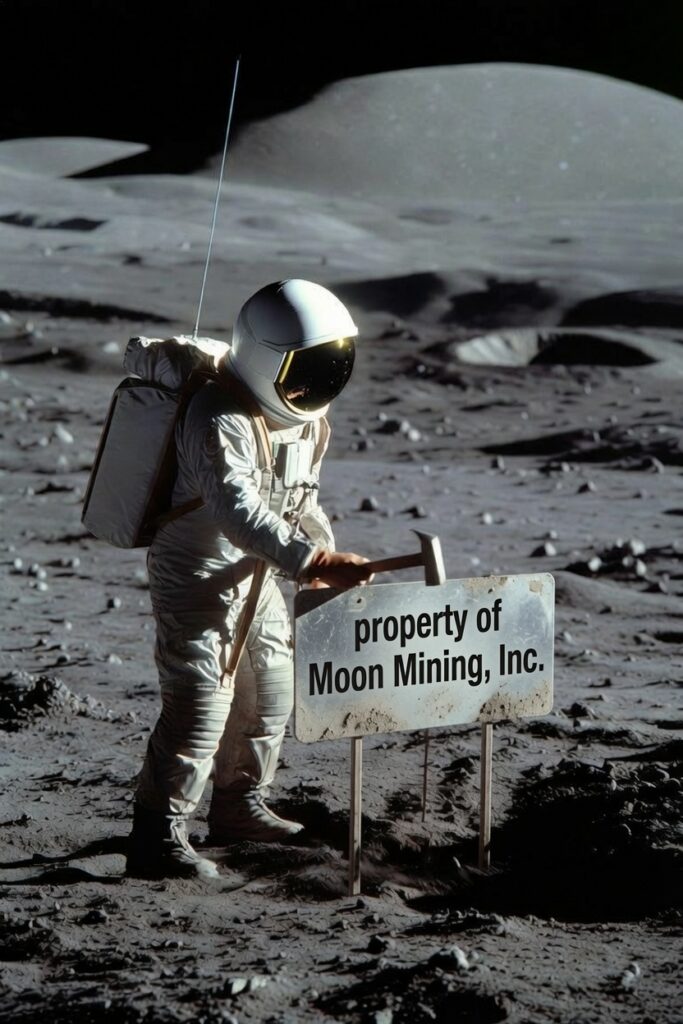
If we’re serious about settling the Moon and exploiting its resources for the benefit of mankind, it will be crucial to secure property rights.
Nations can’t create a self-sustaining lunar economy through government procurement, argue John Chisholm and Dan Garretson in today’s Wall Street Journal. They will need entrepreneurs and investors. And entrepreneurs and investors will need assurances that the improvements they make won’t be stolen or expropriated.
To be self-sustaining, a lunar economy needs paying customers beyond the governments footing today’s bills, along with entrepreneurs to serve those customers and investors to fund the entrepreneurs. All need assurance that what they buy, build or fund remains theirs to use or transfer. At the lunar south pole, mines may someday harvest ice for rocket propellant, avoiding Earth launch costs. To attract investment, miners will need legal acknowledgment of first and continuous occupation, control over land use, the ability to exclude others and assurance that land and improvements can be sold or transferred. In short, ownership rights to lunar real estate.
The existing patchwork of treaties and statutes, write Chisolm, a trustee of the Santa Fe Institute, and Garretson, president of the nonprofit Orbital Progress, is inadequate. The 1967 Outer Space Treaty and the 2015 U.S. Commercial Space Launch Competitiveness Act (CSLCA) provide some protection. But the 1979 Moon agreement — admittedly, never ratified by a major spacefaring nation — specifically disallows lunar land rights. The 2020 Artemis Accords’ “safety zones” guarantee the principle of “free access to all areas of celestial bodies” — the opposite of private property exclusion.
The writers argue for the right of “first possession and continuous use,” citing the practices of 19th-century Western mining camps that provided the basis for the General Mining Act of 1872. “First possession itself needs no novel theory: It underlies common law, civil law, Islamic law and African customary law.”
Strong private-property rights will give the U.S. a powerful advantage in the competition for lunar resources. Chinese law subordinates the rights of corporations to the needs of the state and asserts the state’s ultimate ownership over natural resources. Beijing can fund state enterprises lavishly, Chisolm and Garretson contend, but they can’t manufacture a “track record of restraint.”
A U.S. commitment to well-defined, well-protected property rights will encourage private investment without massive government subsidies.
The authors conclude: “Congress should recognize the private land registries lunar developers will inevitably establish and clarify jurisdiction and remedies for interference with equipment, extracted resources, improvements and continuous operations—without asserting sovereignty over lunar land.”