To the layman, there looks to be a lot of wide-open space between Earth and the Moon, so the idea of someone conducting a Straits of Hormuz-style blockade of transit between the two is not a possibility that comes readily to mind. But Leonard David writing in Space Insider warns that it’s an all-too-real possibility.
Blockading cis-lunar space is not a problem we’ll need to worry about in the short term. But with the space economy on a geometric growth track, the Moon is destined to become an integral extension of Earth’s economy. Satellites, He-3 mining, solar power, data centers, chip fabrication and pharmaceutical manufacturing — you know the drill.
“Just as the Strait of Hormuz is a narrow waterway, cislunar space, though seemingly large, actually contains a few unique and exclusive points of transit through which all lunar travel must pass,” David quotes Marc Feldman, executive director of the Center for the Study of Space Crime, Piracy & Governance, as saying.
The article does not elaborate on what those choke points might be, However, CoPilot suggests the following:
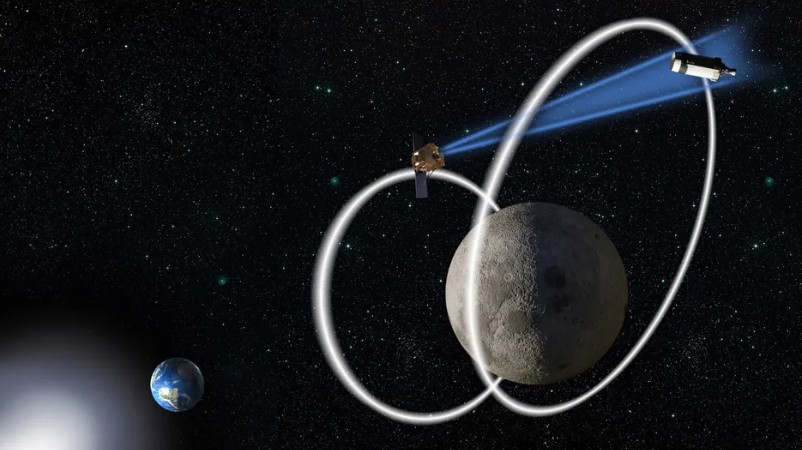
The key “choke points” in cislunar space are the Lagrange points and the narrow gravitational transfer corridors that spacecraft must use to move efficiently between Earth and the Moon. These are the few stable or semi‑stable regions where traffic naturally concentrates, making them analogous to maritime chokepoints like the Strait of Hormuz.
🌑 What the chokepoints actually are
1. The Earth–Moon Lagrange Points (L1–L5)
These are five gravitational “sweet spots” where the pull of Earth and the Moon balance. They allow spacecraft to loiter with minimal fuel and serve as natural hubs for navigation, surveillance, logistics, and staging.
- L1: Between Earth and the Moon — a gateway for most direct lunar transfers.
- L2: Beyond the Moon — ideal for communications relays and deep‑space staging.
- L4 & L5: 60° ahead and behind the Moon — stable parking zones for long‑term assets.
- L3: Opposite Earth, less useful but still part of the system.
Experts explicitly describe these as strategic chokepoints because anyone controlling them can monitor or influence nearly all lunar traffic.
2. “Stable transfer corridors” shaped by orbital mechanics
Even though space seems vast, efficient travel between Earth and the Moon is constrained by physics. Spacecraft must follow predictable, energy‑efficient pathways—sometimes called:
- Low‑energy transfer corridors
- Invariant manifolds
- Natural gravitational highways
These routes funnel traffic through narrow regions near Lagrange points and specific orbital arcs. Disrupting them could delay or block missions, much like closing a maritime strait.
3. Key lunar orbits and approach paths
Certain lunar orbits, especially near Near-Rectilinear Halo Orbits (NRHO) planned for the Gateway station, act as bottlenecks for landings and departures because they are the most fuel-efficient staging points for repeated surface missions. China and U.S. analysts both identify lunar transfer orbits and specific lunar orbital inclinations as “strategic thoroughfares.”
🌑Why these become chokepoints
– Monitoring is easy from stable gravitational vantage points.
– Interference is feasible (e.g., jamming, blocking, or shadowing spacecraft).
– Future lunar industry — mining, manufacturing, power stations — will depend on uninterrupted access through these corridors.
🌕 Summary
Marc Feldman’s analogy is literal: Cislunar space has only a handful of viable “passes,” and they are the Lagrange points and the gravitational transfer corridors that connect them. Control or disruption of these points could shape who gets to the Moon, when, and at what cost.