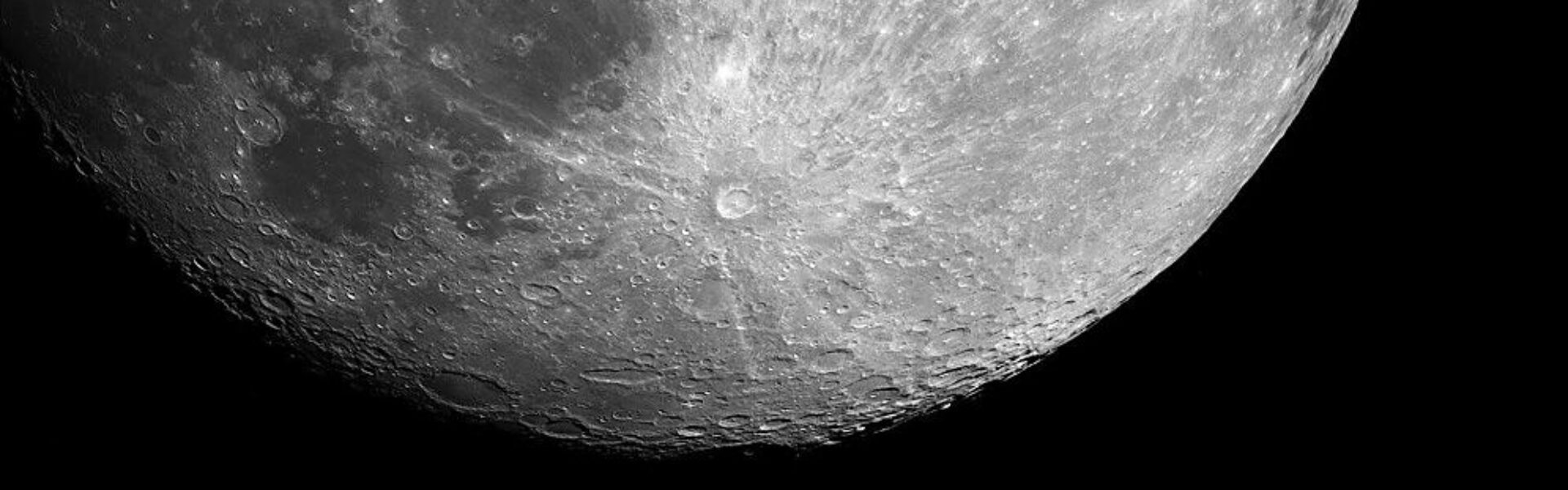
I was interviewed recently about my novel “Dust Mites” for Book Talk Central, a YouTube book-review channel. I had no idea what to expect. But the host, Barley James, dug deep into the major themes of the book. I found the interview enjoyable and thought-provoking, and I hope readers will too. You can listen to the interview here. Or you can read a lightly edited transcript of the interview below. — JAB
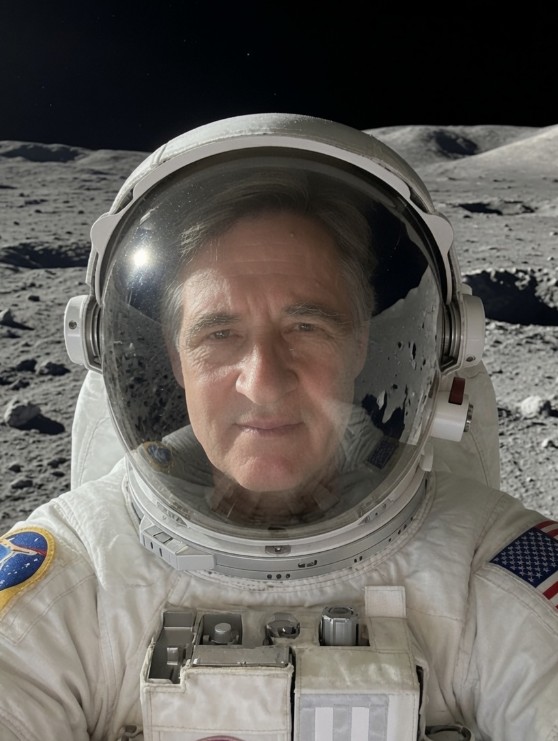
Barley James: Hello everyone, and welcome to Book Talk Central, where we bring you compelling conversations with today’s most thought-provoking authors, the stories that challenge the way we see the world. I’m your host, Barley. And today, we’re delighted to welcome James Bacon, journalist, commentator and author of “Dust Mites, A Second American Revolution,” set decades into the future on America’s lunar colony. “Dust Mites” blends political intrigue, high-stakes conflicts, and philosophical questions about freedom, governance, and the future of humanity beyond Earth. While the novel unfolds in a future setting, it speaks directly to the challenges and debates shaping our world today. James, it’s a real pleasure to have you with us. Thank you for joining Book Talk Central.
James A. Bacon: Thank you so much. It’s great to be here with you.
Barley: Amazing. Now, James, I think I should dive in by asking you a question. I’d like to know the inspiration behind the story. What first sparked the idea for “Dust Mites?” Were there specific moments, historical events, or political issues that inspired you to imagine this future conflict on the moon?
JAB: Yes, actually there was a very particular moment. It was maybe 10 years ago. I was at a cocktail party at a friend’s house and we got into a very lively conversation, and right there on the spot in the middle of this conversation I had this germ of an idea. Wouldn’t it be cool to explore the idea of American colonies on the Moon growing rebellious and restless against the tyrannical rule of the mother country back on Earth? It popped in my head just like that. It took me several years before I actually sat down and started to write it. Once I started with that premise, the next step was, well, how do I turn this into a page turner? Then I devised a plot, which I hope is pretty compelling, in which the U.S. marshals are ordered by the Attorney General of the United States to send an elite squad of commandos to the Moon to arrest the governor of the largest colony, called Galileo Station. Things go awry. The rest of the novel explores a lot of ideas and philosophy and things like that, but it really revolves around the marshals trying to get the governor out of the city — it’s an underground city — to where they can hold him up for trial, and how the inhabitants of Galileo Station, who I call Galiletians, try to get him back. That’s the spine of the novel.
Barley: That’s a fascinating origin story. Now, James, you described the novel as future fiction rather than science fiction. Could you explain that distinction and why it is important for readers to understand your vision in that way?
JAB: There’s an important distinction between science fiction and future fiction. In science fiction, even though Earth may be a character or a place, it bears no recognizable resemblance to any countries or nations or institutions or cultures on the Earth today. The authors tend to have other things they want to explore. I’m trying to project what it will be like 50 years from now. What will the Earth be like? And one of the core premises, which when I first started writing didn’t seem obvious to many people but maybe does now, is that the Moon will be colonized. It’s going to be just a year or two before we get the first permanent human presence on the Moon. The date keeps on getting pushed back and pushed back because NASA seems to have its problems. But we’re almost there.
And the Earth is going to be tied to the Moon economically, culturally, politically. The Moon is going to be critical. It’s going to be a huge source of energy. At some point in the not-too-distant future, there will be such a thing as fusion power, not fission power like we have today. Fusion power will be almost inexhaustible, and the fuel will come from a hydrogen isotope called He-3, which is abundant on the surface of the Moon. So, people on the Moon will be harvesting that resource. The Moon will be used as a base for a source of hydrogen fuel and oxygen fuel to be used for interplanetary travel. It’ll be used as a base of operations when so much of the economy is going to be located in what’s called cislunar space. That’s the space between the Earth and the Moon. There’ll be manufacturing out there. Elon Musk has already started talking about putting data centers out there. There’ll be satellites, there’ll be military facilities and installations, and the Moon is going to be an integral part of all that. So, I’m trying to envision what that will be like. That’s not a science fiction scenario. That’s a very real scenario that important people are thinking about.
Barley: James, the confrontation between the U.S. government and Galileo Station echoes several moments from history. Were there particular revolutions or political conflicts that influenced the story?
JAB: Yes, are obvious parallels that I put in there between this Second American Revolution and the origin of the first American Revolution. You have colonies in a distant location. Back in 1775, there were the North American colonies rebelling against their rulers across the Atlantic Ocean in England. Well, in “Dust Mites” it’s the lunar colonies rebelling against their rulers in Washington, D.C. I set the year in 2075, which will be the 300th anniversary of the American Revolution. That’s very deliberate. I created a society in Galileo Station with a very small, libertarian type of a government. It has a primitive government, nothing like the United States is today, more like the American colonies, which were self-governed and tended to rely upon their own resources and have their own local communities and institutions. That was very deliberate. My idea was that they are rebelling against a stultified and stagnant society. So, the picture I draw of the United States in the year 2075 is of a huge leviathan state; this huge government that is overbearing and slothful and is slowing down the economy. There is no dynamism at all. And everybody is excited to go to Moon because it’s a free society and they’re free to create wealth and generate new innovations, and they’re free from all the rules and regulations in the United States. So that’s the contrast I draw. My view of a libertarian society is maybe a little utopian, but a goal was to draw a picture of what a libertarian society would look like if we were able to invent one from scratch, which presumably people will be able to do when they go to the Moon. They’ll be able to invent new societies from scratch, just like the original settlers in North America. You had the Pilgrims going to Massachusetts. You had the commercial ventures landing in Jamestown in Virginia. And yeah, all those parallels exist and they’re all very conscious.
Barley: So much information. Love that. Giving us so much from the book. So, James, at the core, explore the tension between centralized authorities and individual liberty. Why do you think this debate remains one of humanity’s most enduring struggles?
JAB: It’s certainly one of the great struggles of our age. The book speaks to today. It’s set 50 years in the future, but human nature doesn’t change. Technology changes, institutions and cultures change, but human nature does not change. There will always be struggles for power. And there will always be people who want to assert their power over others. And there will always be people who want to throw off that power. In the United States today, you’ve got the challenge of Donald Trump, who some regard as an authoritarian figure, which in some ways he is. I think it’s exaggerated, but there’s no question he has authoritarian impulses. At the same time, the left is trying to radically transform society and make it something totally different from what it is today. And they are absolutely willing to utilize the power of government to enforce their vision of society. So, you have threats to freedom and liberty from both the left and the right. And you have a few people in the middle, and they tend to call themselves libertarians or to be sympathetic libertarians and say, no, we don’t believe in that. We just want to be left alone. We want to be able to live our lives and be members of our community and raise our families and have jobs and pay taxes and maybe be entrepreneurial and invent new things. But they increasingly seem to be a minority. Well, the premise of “Dust Mites” is those kinds of people flee to the Moon. They create their own society on the Moon and they’re free to live how they want. And they’re willing, as the early American patriots were willing, to fight and die in order to protect those freedoms.
Barley: That’s such a thoughtful perspective. James, one thing I appreciate is that you are not presenting simple heroes or villains. Instead, you are inviting readers to wrestle with different questions about freedom, authorities, responsibilities, which makes the story all the more compelling.
JAB: I’m glad you appreciate that. I really made an effort to do that. My sympathies in the story are clearly with the rebels, with the Galiletians and the free libertarian society. But I don’t paint the Americans as black-and-white villains. They don’t wear black hats. They have reasons for doing what they do. They’re trying to extend the rule of law as they see it from the Earth to the Moon. They have these great agendas that want to accomplish. They have these visions of helping mankind – I call it the Methuselah project. Think of the technologies that will exist 50 years from now, the things that will extend people’s lives and help people live better, healthier lives. That’s going to cost trillions and trillions of dollars. It’s an altruistic vision. But in order to carry out that vision, they have to pay for it. Where’s the money going to come from? Galileo Station and the lunar colonies are a big pot of money they want to get their hands on. So, they have reasons for what they’re doing and they’re not evil reasons, but they are reasons similar to the way many people think today – the millionaires and billionaires aren’t paying their fair share, that sort of thing. Those tensions are real. They exist. That doesn’t mean that one side is good one and one side is bad. It depends on what your values and priorities are. My values and my priorities and my sympathies lie with the Galileans.
Barley: James, although the novel is set over 50 years in the future, much of the technologies and society seem remarkably similar. Why did you choose realism over the more futuristic vision in speculative fiction?
JAB: That’s a really good question. When I sat down and wrote the first manuscript several years ago, it was before AI was a thing. I talk in the novel a little about artificial intelligence, but it wasn’t the craze then that it is today. So, I probably underestimated the extent to which society, social change and technological change will be driven by artificial intelligence. But think about it. Space travel between the Earth and the Moon will be routine, and that’s reflected in the book. I don’t go very deeply into the weaponry, but I talk about laser guns that you can dial up and down to adjust their power. I talk about electric shotguns. A new novel, the one I’m about to publish in September, goes into those military technologies much, much more deeply. It’s a very different vibe. But “Dust Mites” is basically a battle between Galiletian police, who aren’t heavily armed and don’t have all this exotic technology, and U.S. Marshal commandos who are lightly armed as well. I do talk about things like He-3 mining and refining, and where people get materials on the Moon. How can they build a society, which I see as going underground. How they meet their material needs by extracting minerals and metals and other elements from the regolith, which is the dust that’s accumulated over billions of years on the Moon. I get into that a bit, but just enough to do some world building and create something that seems plausible and futuristic. It’s really about the people, human nature, and the struggle over power and autonomy.
Barley: I really admire the approach, you know. Sometimes the most believable future is the one that’s built through gradual evolution instead of dramatic eclipse to realism makes the world you’ve created feel much more messy and convincing.
JAB: It’s interesting that you used the word “messy.” While I have a strong libertarian instinct and I’ve created a libertarian society, I don’t believe it’s possible for humans to ever have a utopia. Utopia is just a dream. Humans will never create the perfect society that makes everybody happy. It’s just in the nature of mankind. People will always have different perceptions. There will always be disagreements. There will always be factions. There will always be people who are noble and altruistic, and there will be people who are greedy and perverse and power hungry. So, I try to create a society where they strive for noble, altruistic vision of a free society, but run into complications. Like for example, if you set up a society on the Moon, one of the things you need to sustain life is air and water. Well, air and water are abundant on the Earth, but they’ll be extremely rare, very scarce, and extremely valuable on the Moon. They’re not something that you can just have for free. On Earth, air and water are virtually free commodities. On the Moon you’ve got to come up with ways of allocating scarce resources. And that’s going to cost money. That’s going to lead to hardship. And that’ll make some people unhappy. As I say, the world is messy. Reality is messy. And I try to acknowledge that in this book.
Barley: James, did your decades of experience as a journalist in politics and public policy shape the way you construct fictional words and political conflict?
JAB: Yes, it did. I have spent my life as a journalist in the state of Virginia focusing on state and local economic issues. I’ve stayed away from all that nonsense and craziness in Washington, D.C. We’ve got enough craziness here in Richmond, Virginia, our capital. I’m very attuned to the way politics works in a local environment. All I have to do is follow the news and you see how crazy it works in the national environment. One of the things going on in the novel is the protagonists’ struggle to impose their narratives. Both the left and right and all sorts of factions in between have their own narratives of the way the world works, and who’s oppressing whom, and who’s at fault for this and that, and why do we have inequality and why are people unhappy? Everybody’s got their own narrative. And, so, as a journalist, that’s what we do. We play in that sandbox. We used to report the narratives: this guy says this and that guy says that. Now more and more, journalists are spinning the narratives themselves. So, you have these competing versions of reality, trying to convince people that your version is real over someone else’s who’s not. I explore that theme and try to be realistic, not creating black and white, not having people wear black hats and say, stupid stereotypical things that you think the bad guys on the other side say, but make them real. What would people say? What would they think? How would they express their point of view and try to get it across? So, yeah, that’s a major theme of the book.
Barley: I think that makes perfect sense. Your background as a journalist clearly brings attention to details and understanding of political dynamics that strengthen the story. Now, James, the novel raises important questions about who has the right to govern newly settled territory. Do you believe humanity eventually faces this same debate as space exploration advances?
JAB: That’s a perceptive and interesting question. Humans throughout history have always explored and they’ve always expanded. Strong societies expanding at the expense of weaker societies. It’s just the way it’s been. It’s not right or wrong, it’s just what’s always been. Today, in our world today, we have the sense that everyone ought to play by rules and that it’s no longer legitimate just to go out and conquer your neighbor just because you’re stronger. And there’s also concern that when people go out and expand and tame new territory, they’re hurting the environment. There’s something to be said about that. We’re learning a lot about the human impact on the environment. So, you have this issue on the planet Earth of expanding, growing, dynamic societies oppressing weaker peoples and harming the environment. That places great limitations on what people can do today. Look at the way Russia treats Ukraine. The Russians are absolutely the villains in the point of view of world sentiment. On the Moon though, it’s different. There aren’t any indigenous societies. There are no weaker societies. There’s no environment. There’s no water. There’s no air. There are no microorganisms. There’s nothing. It’s a barren, sterile planet. So, one would think that being able to expand into new unoccupied territories, as Galileo Station is trying to do in the book – which is a root cause of conflict with the United States – would not meet objections or resistance. But human nature being what it is, there are objections. It’s all about the power, baby.
Barley: That’s really a thought-provoking point. The novel encourages readers to begin thinking about these issues long before they become reality. I know your readers will be excited to see what’s coming next. And if your work is anything like “Dust Mites,” I’m sure they will have plenty to look forward to.
JAB: Well, thank you so much. I love talking about “Dust Mites.” I really appreciate this opportunity to share the inside story with your listeners.
Barley: Amazing. So, to wrap it up, James, it has truly been a remarkable conversation. We’ve explored timeless questions surrounding freedom, governance, leadership, and humanity’s future beyond our planet. What makes your work especially compelling is that it entertains while also encouraging readers to think critically about the world we live in today and the one we may inherit tomorrow. Thank you for sharing your insights, your creative journey, and the inspiration behind this fascinating novel. It’s been an absolute pleasure having you with us on Book Talks Central. And I have no doubt our listeners will come away eager to experience “Dust Mites” for themselves. We wish you every success with the book and all your future writing endeavors. And now, James, where can we get your book?
JAB: Amazon.com.
Barley: Yeah, you heard that. To purchase “Dust Mites,” go to Amazon.com. Thank you for joining us. I was a genuine pleasure. Your ability to combine political insights, compelling stories, and thought-provoking questions about freedom, leadership, humanity’s future creates a conversation that extends beyond the pages of the novel. To everyone listening, thank you for spending part of your day with us. If you enjoyed today’s conversation, be sure to follow Book Talk Central for more engaging interviews with authors from around the world. Until next time, keep reading, keep asking questions, keep discovering stories that shape our world. I’m James Barley. I’ll see you on the next episode of Book Talk Central. James, it was a pleasure having you today.
JAB: Thank you.