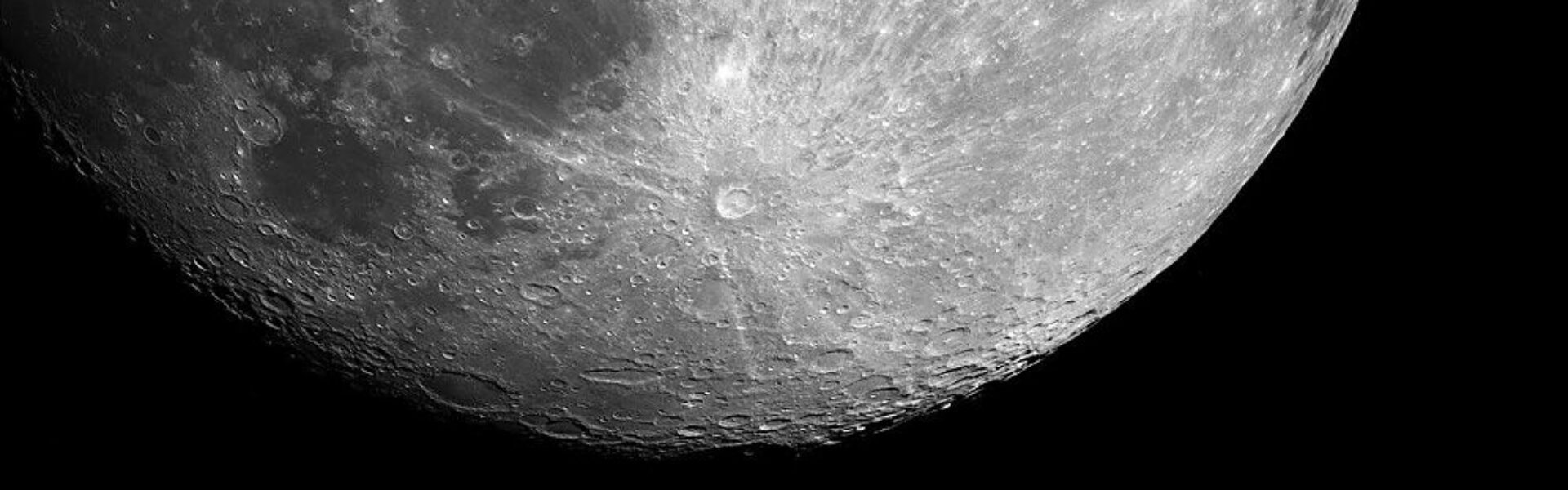
The Moon may lack the water, power and other resources to support large populations on the Moon, according to a report in the journal Frontiers in Space Technologies. Forbes magazine and ABC News have spun the article as skeptical of Elon Musk’s plans to build a “self-growing” city of millions of lunar settlers.
“There’s been so much talk and enthusiasm about a future in which the moon is a part of our civilization and abundantly populated, and science fiction shows with extensive cities on the moon and space traffic around it, and so we just wanted to, I guess, throw some cold water, literally, on some of that overoptimism,” co-author Martin Elvis told ABC News.
Co-author Jonathan McDowell said there will be settlements on the Moon but that “there are physics limits to how much of a lunar society you can end up having.”
Water harbored in craters in the Moon’s South Pole could amount to as much as a billion tons, which sounds like a lot, but Elvis and McDowell question if it’s sufficient to sustain a large lunar population over a long period of time. Without recycling, that volume of water would last a city of a million people about two years. With recycling recovery of 98%, a city might last 100 years. “That’s not very much, given the investment in building it,” Elvis said.
Another limit, Elvis told ABC News, was electric power, although he conceded that solar and nuclear power are both options. While a large city may not be realistic, he and McDowell said, a Moon “village” of about 1,000 — comparable to the winter-over population of Antarctica — could be sustainable.
Resource scarcity will be a formidable, though not insurmountable, challenge. I grappled with the issue when writing “Dust Mites” and “Trogs.” It was apparent even to my uncredentialed eye that a billion tons of water in polar craters would be insufficient to support a city of 1.5 million inhabitants (as I envisioned the protagonist colony Galileo Station to be), much less dozens of settlements or the use of the Moon as a “gasoline station” for travel throughout the solar system.
I don’t see energy as being a major constraint. Once fusion power becomes practicable, He-3, which is abundant on the Moon, will provide limitless energy for centuries. In the absence of fusion, solar energy supplemented by energy storage devices such as flywheels or molten-salt thermal storage can support large-scale settlement.
The big constraints will be oxygen, hydrogen, carbon, and nitrogen, the elemental constituents of water and breathable air. Once polar water supplies run out, some of these elements can be extracted from the regolith, which Moon pioneers will be processing for He-3 anyway. There will be steady replenishments from Earth as well, and asteroids and meteors will be mined if and when it becomes practical to haul them to Moon orbit for processing.
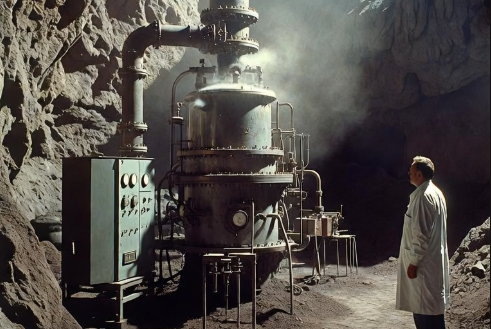
Of course, recycling will be essential. In the fictional world of “Dust Mites,” the inhabitants of Galileo Station create markets for chemical elements. Air and water are not free, and freeloaders are not tolerated. Every immigrant to the colony must bring with them a supply of air and water sufficient to support one individual or purchase it on the open market. Dwellings and places of business are designed to recycle in situ everything from air and water to poop and food waste to capture the economic value of those elements. The key is to let free markets find innovative solutions and allocate resources efficiently. Settlements that ration air and water through command-and-control techniques will suffer from the shortages that Elvis and McDowell describe.